The fourth part of this 12-post series exploring the energy of each zodiac sign is dedicated to Cancer . Beyond the popular astrology that associates signs with personality, we'll delve into their most essential meaning: their archetypal nature, their symbols, their characteristics, and their manifestation in the human experience on both a personal and collective level.
What is a Zodiac Sign?
Before talking about Cancer itself, it's important to clarify the following: when we talk about signs, most people assume we're referring to the personality of those whose Sun is in that sign. In reality, this is a vast oversimplification that leaves out many layers of valuable meaning for us.
First of all, a zodiac sign is not a person or a personality type . It's a pattern of expression, a way a principle behaves . In astrology, principles are represented by planets, asteroids, angles, and any other points on the celestial sphere. Depending on the sign they fall under, their manifestation takes on a specific quality. And that quality is, in essence, an archetype.
What is an Archetype?
An archetype is an essential pattern, an image or energy that is repeated throughout history and in different cultures . They are primordial models that structure the way we experience reality. In astrology, each sign is an archetype with its own characteristics, an energetic quality that shapes the way any astrological principle is expressed.
When a planet is in a sign, the archetype of that sign acts through it . The sign doesn't change the essence of the planet, but it does determine its style of manifestation. For example, Saturn will behave very differently when it's in Taurus than when it's in Aquarius.
In other words, signs are the way in which a principle takes shape.
Archetypes are Multiple, Eternal and Inexhaustible
Archetypes are profound and sophisticated realities, with countless nuances and manifestations. They are not static or limited to a single form of expression ; on the contrary, their richness is so vast that no human being can fully embody the entirety of an archetype in a single lifetime. They are eternal forces that exist beyond our individual experience and express themselves through us in diverse ways according to our consciousness, evolution, and choices.
This is where free will comes into play: (at least consciously) we don't choose which archetypes are present in our birth chart, but we do choose how we experience them. Throughout life, our relationship with an archetype changes . Having a planet in Libra at age 8 isn't the same as having it at age 55. The energy is the same, but the way we understand and express it transforms with experience. We learn to modulate it, integrate it with greater awareness, and use it more constructively.
From this, it follows that all archetypes are neutral. The same sign can express itself instinctively, chaotically, or unconsciously, or it can be channeled with wisdom and purpose.
We'll return to the archetypes later. Now let's look at the basics of Cancer.

A Nocturnal Sign, Water, Cardinal, Ruled by the Moon
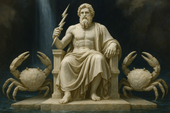
The name of the zodiac sign Cancer comes from the Latin cancer , meaning "crab." But long before that name, the crab was present in multiple mythologies as a symbol of transition, threshold, and ancestral memory . The quintessential liminal animal, it lives between water and land, between the invisible and the visible. Moreover, the crab sheds its exoskeleton when it becomes cramped. In many cultures, this shedding has been seen as a metaphor for the soul's passage : leaving a structure behind and crossing a threshold (whether toward the invisible or from the invisible).
In Japan, heikegani crabs bear human faces: they are believed to embody dead warriors whose spirits were trapped at the bottom of the sea. In African and Mesoamerican traditions, certain crabs represent the relationship with the dead, the threshold, and the retention of undigested memories. Cancer's energy refers to this deep sensitivity: it doesn't advance in a straight line, but rather moves in a spiral, inhabiting the connection with what has been and with what still needs to be nurtured.
Cancer is a night sign, also called yin or feminine in traditional classifications. This means its energy is receptive: it collects, integrates, and preserves. Unlike day signs like Leo, Libra, and Aquarius, night signs direct their energy inward.
It's also a water sign, the element linked to the emotional world, sensitivity, intuition, and the unconscious. Water has no form of its own, but takes on the form of the vessel that holds it. This is how water signs act: they perceive the subtle forms of their surroundings, absorb emotional climates, and respond internally rather than through the visible. Water stores and conserves, but it also erodes over time. Its essential quality is emotional containment. In astrology, this implies resonance, empathy, and a need for psychic security. The water element connects through emotions, not through ideas or actions.
The cardinal mode indicates the beginning of the season: Cancer ushers in summer in the Northern Hemisphere. Cardinal signs open a new cycle, marking a direction. But in Cancer's case, that initial impulse is not outward, but inward: it is an emotional initiation. Cardinal signs mobilize, and Cancer does so through the desire to create secure bonds, to form a protective base from which to develop. The cardinal, in this sign, takes the form of an impulse to nurture.
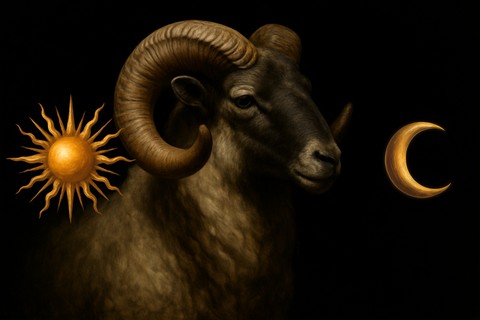
On the other hand, Cancer is ruled by the Moon . In astrology, rulership indicates a direct affinity between the planet's energy and that of the sign. The Moon finds its natural territory in Cancer, where it can express its cycle, its constant change, its need for shelter, and its relationship with emotional memory.
(We will go into more detail on these features later.)

The Cancer Glyph
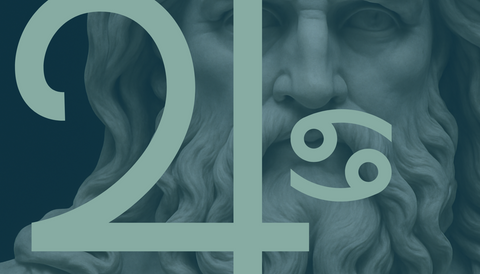
The glyph (or symbol) for Cancer is composed of two half-spirals facing each other. This figure refers to the spiral symbol, one of the oldest forms of representing origin. In many cosmogonies, the spiral embodies the way life unfolds: not in a straight line, but through a movement that twists, folds, and returns transformed.
In addition to its connection to the spiral, the glyph has been interpreted as a stylized representation of a crab's claws . It has also been associated with feminine forms —such as the uterus or breasts—alluding to the gesture of nourishing, containing, and allowing the soul to pass from the invisible into form through birth.
Finally, the glyph also evokes streams of water or emotional flows: a memory that revolves around itself without losing continuity.
Cancer: Beginning of Summer, Nature Bears Fruit
In the agricultural cycle of the Northern Hemisphere—the symbolic origin of the zodiac we use in astrology—Cancer marks the beginning of summer , the moment when nature "gives birth": fruits ripen, crops reach their fullness, and the fields become bountiful. It is a time of abundant harvest (and plenty of food ), but also of climatic vulnerability. As Dane Rudhyar points out in The Astrology of Personality , Cancer does not celebrate visible expansion (like Leo), but rather the quiet care of what has already germinated under spring. To this day, in many cultures, this is the time of year when they buy jars to make preserves with summer fruits and vegetables, when they are at their best. In other words, not only is food preserved, but emotions (the flavors of summer) are also "stored" for the dark winter.
On the other hand, during these weeks, the daytime heat reaches its peak , while the nights offer a cool refuge. This contrast reflects the essence of the sign: just as the crab (the symbol of Cancer) hides under rocks or sand to protect its soft body, humans seek shelter in the shadows, gathered on patios or terraces. The Moon, ruler of Cancer, governs these rhythms: its silvery light and the drop in nighttime temperature create a space for emotional connection, away from the scorching sun.
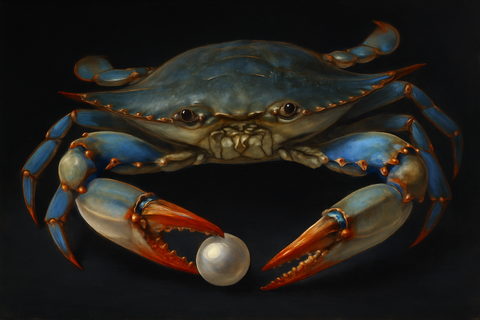
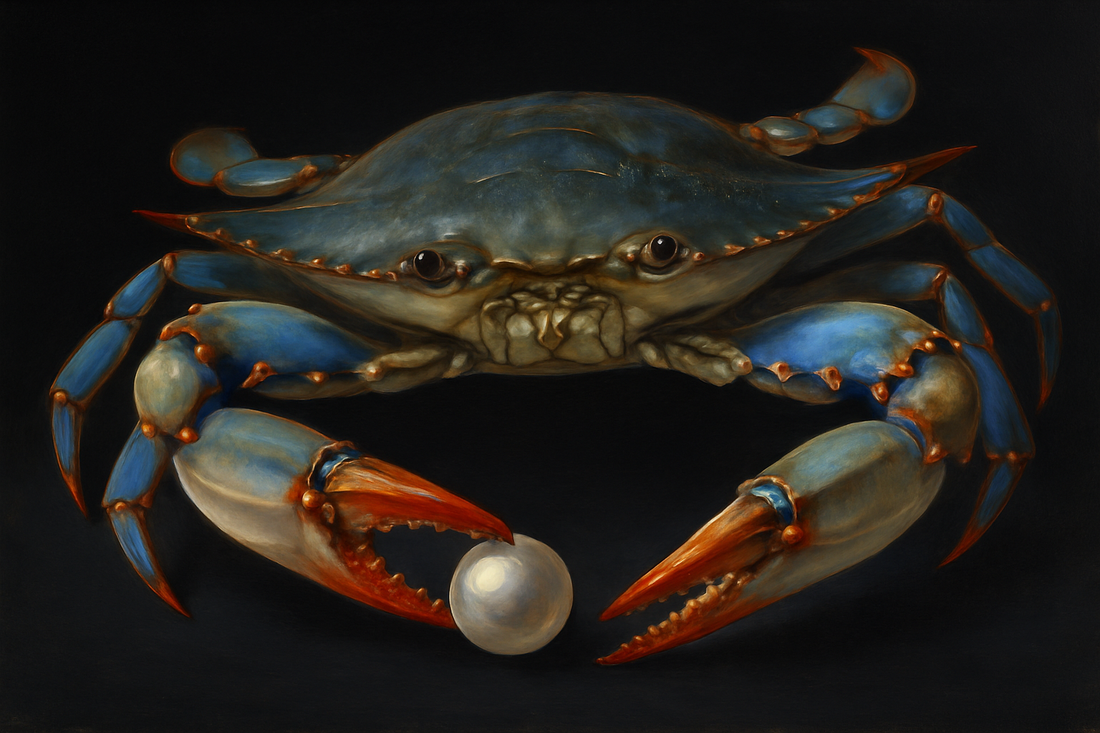
In nature, this period triggers key reproductive cycles. Atlantic blue crabs ( Callinectes sapidus ), for example, time their mating to the warm waters of this part of summer. Females migrate to estuaries to release eggs, protecting them under their shells until they hatch—a perfect metaphor for the Cancerian instinct to nest and protect nascent life. As biologist Judith S. Weis summarizes in Walking Sideways: The Remarkable World of Crabs :
"Their summer reproduction links warmth with the perpetuation of the species: a legacy that is renewed in the darkness of the tides."

Blue crab. Credits: Sandy Franz
Characteristics of the Cancerian Archetype
So, based on the characteristics of this part of the agricultural year, what traits define this energy in its purest form, before it becomes a personal experience? (Remember, we're not talking about people yet):
1. Tendency to contain
Cancerian energy does not expand outward, but rather creates internal space where emotions and memories can be stored.
2. Spiral logic
It doesn't move in a straight line: it circles, turns, and deepens. Its path is cyclical, like waves and tides.
3. Emotional organization
This energy organizes its world around emotional resonance. What matters is not just what happens, but how what happens feels. It is guided by emotional climates rather than data or results.
4. Rhythm linked to cycles
Cancerian energy regulates itself according to its environment. It senses the right moment to act, withdraw, or nurture. Just as Cancerians see their environment constantly changing due to the tides, this energy adapts to what is growing, declining, or yet to be born.
5. Instinct of conservation
He knows when to save, preserve, and conserve for later. He functions well when he can accumulate emotional or material resources to ensure support in more arid times.
6. Active memory
It doesn't just remember: it lives through memory. Memory is not a passive archive, but an emotional guide that constantly revives through the cyclical perception of time. Likewise, Cancerian energy takes the initiative to create memories but also to build upon them.
7. Refuge logic
Wherever it is present, Cancerian energy creates refuges with whatever it finds. It doesn't need visibility to act. It doesn't usually impose an external order, but rather creates shelter where the world becomes inhospitable.
8. Preference for familiar environments
Cancerian energy tends to retreat toward the familiar; not out of rejection of the new, but out of a logic of continuity and respect for affection and memory. It's interested in what contains an emotional imprint, what offers some form of permanence.
9. Gestational capacity
It's an energy primed to carry out long processes without immediate external evidence. It doesn't seek visible results or demand early decisions: it preserves, matures, and transforms things in silence.
10. Pairs of opposites as a structure
It contains opposing and complementary forces: strength and vulnerability, containment and defense, receptivity and tenacity, leadership and isolation.
11. Affinity for the repetitive and cyclical
It doesn't require linearity or constant novelty. It works through rhythmic repetition, like the phases of the moon (which are changing but rhythmic, as they do so regularly) or the feeding cycle of a newborn. Repetition isn't redundant: it's how something takes root.
How These Characteristics Are Expressed in People with Planets in Cancer
When a person has planets in Cancer, these archetypal qualities take shape in their life experience. However, the way they are integrated and expressed depends on many factors: the level of consciousness, inner work, and the rest of the birth chart . This is where free will comes into play, as Cancerian energy is not experienced uniformly. Each of its characteristics can manifest in constructive or challenging ways, depending on how it has been internalized and worked with.
1. Tendency to contain
They tend to offer emotional shelter to those around them. It's their natural instinct to care for, protect, or guard what they feel is valuable. In relationships, they can become the repository of other people's secrets, stories, or emotions. The risk? Confusing caregiving with becoming someone else's parent, and ending up carrying more than they can or should.
2. Spiral logic
Linearity seems a bit dizzying and superficial to them. That's why they go around in circles, revisit what they've already experienced, and need to process their emotions before making a decision. When there's no space for these internal moments, they withdraw.
3. Emotions are what give them life
They don't experience situations just for what they "are," but for what they make them feel: the first day in their new home after moving, the euphoria of their country winning a major sports tournament.
4. Fluctuating rhythm
They need breaks, spaces to reflect, and time for themselves. They function best when they can regulate their energy according to their environment. If they can't do this, they can become overwhelmed or reactive without knowing why.
5. Instinct of conservation
They tend to hoard things, connections, memories, objects steeped in history. They have a knack for anticipating what might be missing later and preparing a kind of emotional or material cushion. When this is taken to the extreme, they can live in a constant state of alert.
6. Active memory
Their past is present, and they honor it regularly. They tend to have a fertile and powerful memory: they remember gestures, climates, phrases, smells. In its less positive expression, this trait can lead them to cling to the past and fail to close the loop.
7. Refuge logic
They tend to create intimate environments, even in the midst of chaos. They care about how a place, a relationship, or a job feels. If they don't feel protected, they can withdraw, and they struggle to open up again if they feel exposed.
8. Preference for familiar surroundings; shyness
At first, they tend to stick to familiar surroundings: people, places, and emotional routines. Not because they fear new things, but because they struggle to open up in contexts where they haven't yet built trust. Once they do, they tend to be extremely approachable and warm people.
9. Gestational capacity
They have patience for processes that don't show immediate results. They tend to get emotionally involved in what they do and need to mature things from within before showing them.
10. Pairs of opposites as a structure
They simultaneously contain strength and vulnerability, containment and defense, receptivity and tenacity, leadership and isolation. The important thing is that they can recognize these two polarities without denying either.
11. Affinity for the repetitive and cyclical
They create emotional routines, domestic rituals, and small customs that anchor them (for example, being the person who makes the barbecue on Sunday; having their signature phrase that they say when they return home).
12. Emotional Leadership: Creating Families
When healthy, they radiate powerful emotions that influence their environment. They inspire others to feel part of the community, participate, and feel understood and secure. Their leadership creates families—literal or symbolic—homes, teams, networks of belonging. They don't command by imposition; they provide the emotional framework that unites, organizes, and protects.
13. Emotional intelligence
They tend to be tremendously perceptive of what other people feel, even if it's not expressed out loud. They can read inner climates, pick up emotional nuances, and accompany without words. Their understanding of the world comes less from rational analysis than from an emotional reading of their surroundings. When this ability isn't developed, they can absorb too much of what's foreign without distinguishing what belongs to them and what doesn't.
Practical Examples: Courtney Love, Nelson Mandela and Brian May


Courtney Love's Birth Chart, 09/07/1964, 14:08, San Francisco, California, USA. Rodden Category: AA (birth certificate). Bottom image credit: FilmMagic
Courtney Love was born on July 9, 1964, in San Francisco, California. A singer, actress, and songwriter, she is a central figure in 1990s alternative rock and one of the most intense and contradictory personalities on the American music scene. Her birth chart shows her Moon, Sun, and North Node in Cancer. This intense Cancerian energy speaks to a creative imprint built on raw emotion, a need to belong, and a drive to protect —sometimes tenderly, sometimes furiously.
The energy of Cancer manifests in her as emotional intensity, active memory, and visceral leadership. Courtney Love doesn't express herself from logic or reason: her public life, her lyrics, her relationships, her aesthetic—everything is permeated by a radical emotionality that seeks to channel what hurts, what is lost, what remains trapped in collective and personal memory. In her case, —and unlike what we'll see with the following two birth chart examples, which have the Moon in other signs—, it's the Moon in Cancer that gives her stellium a much more immediate and visceral character . Her raspy voice is a perfect symbol of this configuration: technique takes a backseat to the power of emotions.
On the other hand, her need to protect and belong has been one of the driving forces of her life. In her band Hole , she not only occupied the central role as vocalist and songwriter, but also as a core figure: the one who brings the group together, but also the one who sustains it—sometimes through complex or conflicting relationships. This emotional leadership characteristic of Cancer appears in her as the ability to generate a space where other people feel part of an emotional "tribe": wounded, angry, fragile, intelligent women, capable of transforming that pain into artistic expression.
Her biography is marked by an active memory , like an underground current that pushes her to repeat certain gestures, certain relationships, certain emotional climates. The death of Kurt Cobain—her husband and father of her daughter—was not only a personal tragedy, but a turning point in her public narrative. Since then, Courtney Love has lived between the need to protect the memory of what was lost and the difficulty of letting go . Her Moon in Cancer does not forget, but she does not forgive easily either.
Another obvious Cancer trait is her ability to contain contradictions. Love can be fierce and vulnerable in the same breath, maternal and destructive in the same sentence. She doesn't hide or moderate herself to be understandable: her emotional complexity is unedited. This exposure of intimacy, this unfiltered emotional rawness, is part of her artistic language. In that sense, her way of expressing herself responds more to the result of her emotional experiences than to the control of a public strategy .
Even in the most chaotic moments of her life, that Cancerian impulse to create a family remains—whether caring for her daughter, building the mythology of Nirvana, or articulating from the stage a community of fans who feel recognized in their pain. Courtney Love doesn't seek to please: she seeks to resonate emotionally , even if that means making people uncomfortable, unsettling, or exposing indigestible areas of the human soul.
Throughout her career, she has embodied the Cancer archetype from its rawest, fiercest, and most symbolically maternal side . In her, emotion is nothing less than the foundation of everything. Everything passes through the body, through sensation, through memory. Her natal chart doesn't speak of an orderly life, but rather of an emotional and artistic legacy that, like the tides, will likely return again and again.


Nelson Mandela's Birth Chart, 18/07/1918, 14:54, Mvezo, South Africa. Rodden DD Category: Unverified. Image credits below: Mirrorpix/Alamy
Another person with strong Cancer energy in their birth chart is Nelson Mandela. A lawyer, leader of the anti-apartheid movement, and the first Black president of his country, he was one of the most decisive figures of the 20th century. His fight for racial equality, his 27-year imprisonment for opposing the segregationist regime, and his ability to lead a peaceful transition to democracy made him a global ethical and political figure. In his birth chart, the Sun, Jupiter, and Pluto in Cancer reveal a creative and vital impulse, a vision of the transcendent, and the principle of transformation deeply linked to belonging, origin, and reconstruction.
Unlike Courtney Love, where the presence of the Moon gave a much more personal, immediate, and frontal expression to her planets in Cancer, in Mandela the fact that Jupiter and Pluto are not personal planets allowed the Cancerian element to express itself in a much broader and more social way: the capacity to create a homeland, on a symbolic level . He spoke from history, from shared pain, from the dignity of a collective identity denied by the apartheid system. He didn't need theatricality or inflammatory rhetoric: his authority came from a lived memory . He was the embodiment of a wounded history that had not yet found words.
Jupiter in Cancer amplifies this communal dimension. Mandela fought not only for individual rights, but for the restoration of the emotional and cultural fabric of his people . His vision of justice was not abstract: it included land, language, ties, and the right to belong. This expansion was not achieved with fury, but with empathy and generosity. Once released from prison, and far from seeking revenge, he proposed a path to national reconciliation centered on acknowledging the damage and creating a shared collective memory .
Pluto in Cancer holds the key to the most profound process of his life. In 1962, he was arrested for conspiracy against the state and spent nearly three decades in prison, most of them in extremely harsh conditions on Robben Island. However, faithful to this position in his birth chart, he did not break: he regenerated after having hit rock bottom in the most painful emotions . This regeneration did not remain solely on the personal level: it became the inner force capable of sustaining an epochal change. He emerged from prison in 1990 with a transformed determination and a mature vision: to lead the transition to a democratic South Africa without bloodshed.
In it, the structure of Cancer's opposite pairs is also clearly evident: strength and sensitivity, restraint and firmness, leadership and meditation . Mandela was neither a martyr nor a leader: he was a man capable of integrating contradictions without being fragmented. Instead of denying the past, he proposed integrating it through the Truth and Reconciliation Commission: a way of caring for his people without hiding the wounds .
He expressed his Cancerian energy not in a defensive way, but in a foundational way. He didn't dedicate himself to protecting privileges, but to creating a common home where no one would be excluded . That home—post-apartheid South Africa—wasn't perfect, but it was made possible by his Cancerian leadership and tenacity.


Brian May's birth chart, July 19, 1947, Hampton, England. Rodden X Category: No birth time. Bottom image credit: Getty Images
And our last notable figure with a significant amount of Cancer energy is Brian May. A guitarist, composer, producer, and astrophysicist, he's world-renowned as one of the pillars of Queen, a band that redefined the history of rock. In his birth chart, we see the Sun, Mercury, and Venus in Cancer , all personal planets. Thus, what we see is a creative expression, an aesthetic, and a way of communicating built through emotional bonds and the preservation of that which deserves to be remembered.
In his case, the presence of Mercury (a more logical and cold planet than the Moon) makes the Cancerian energy manifest in a completely different way to what we saw in Courtney Love: a contained, but powerful sensitivity , which finds an outlet in a much more structured and formal way of experiencing music, thought and aesthetic construction . Brian May is not an exuberant figure: his charisma lies in what he transmits without needing to impose himself. His warm, close, almost protective presence was an emotional counterweight within a band where others embodied excess or fire.
The Sun in Cancer gives him a creativity linked to memory, emotion, and collective resonance . It's no surprise that many of his most celebrated compositions—such as "Who Wants to Live Forever ," "Save Me ," or "The Show Must Go On" (co-composed)—are anchored in themes of great emotional charge, traversed by loss, tenderness, or the need for permanence. In these works, the spiral structure of Cancer is clearly perceived: there is never a direct message, but rather a way of surrounding painful emotions, enveloping them, revisiting them from different angles without completely breaking them.
On the other hand, Mercury in Cancer brings a great ability to translate internal climates into musical language. His way of thinking and communicating is not quick or abrupt, but rather thoughtful, careful, and intuitive. This configuration is also expressed in his passion for astronomy and history : Brian May not only observes the sky, but records, catalogs, and preserves . He is the author of scientific studies and books that rescue old materials from Victorian visual culture, which reaffirms another Cancerian trait: the desire to preserve what could be lost if not carefully guarded.
With Venus in Cancer , for May, harmony (not just in a musical sense, but also in absolute terms) is built on emotional bonds. Her compositions aren't formal exercises, but rather ways of caring for something through art. And her commitment to Queen fans—even after Freddie Mercury's death—reveals another central characteristic of this configuration: the need to create bonds-refuges where memory can live on.
And finally, his technique as a guitarist also directly embodies the Cancer archetype. From a very young age, he and his father built his own guitar, the Red Special , in pursuit of a warmer, rounder, and more emotionally resonant tone than the generally rawer sound of the rock of his time. His playing is neither aggressive nor exhibitionist, but enveloping and intimate, with solos that unfold like emotional narratives, insistently returning to certain motifs , modulating the intensity without breaking it. Likewise, his use of delay—especially evident in pieces like Brighton Rock —allows him to dialogue with himself in layers, as if the present resonated with his own memory .
The Energy of Cancer at the Collective Level
When Cancer's energy manifests at a collective level, it manifests itself in processes of retreat, a search for security, and reconnection with memory in the face of experiences of loss, fragmentation, or threat. These are not moments of expansion or radical invention, but rather stages where it becomes essential to protect what already exists , safeguard what has not yet healed, and preserve what has symbolic or emotional value.
In the political and social sphere, Cancer appears in periods where internal cohesion becomes a priority . It is not the energy of great revolutions, but of returns to origins: revaluation of history, territory, local culture, shared identity. It can be seen in moments when societies try to rebuild a broken fabric , return to a common narrative, or create symbolic figures that serve as emotional refuge—from protective leaders to institutions that function as homes. It is also an energy that emerges after a catastrophe or collapse , when what is needed is not to move forward, but to contain what has been damaged.
Economically, Cancerian energy is linked to forms of production and consumption oriented toward basic security, protection, and subsistence. It is expressed in local food chains , domestic economies, community networks of mutual aid, and care policies. Cancer does not seek to scale or accumulate, but rather to guarantee what is necessary , store for the future, and build reserves in the face of uncertainty. In times of crisis, at its best, it activates forms of redistribution based on empathy and shared need , rather than on efficiency or competition.
In the cultural sphere, Cancer expresses itself in the return to intimate stories, traditions, and personal and collective memories . This can be seen in the rise of archives, genealogies, and intergenerational transmission. It also manifests in the proliferation of narratives that rescue the everyday, the domestic, and the ancestral. It is the energy that activates the emotional dimension of language, art as a refuge, and culture as a space of belonging . In contrast to the logic of production or innovation, Cancer cultivates what grounds a society.
On a global level, Cancerian energy can be reflected in cycles where The need for collective protection prevails over external openness. This leads to defensive nationalisms, border policies, an emphasis on sovereignty or the family as the central core . But it can also give rise to international solidarity movements , the defense of territory as a common good, or the rebuilding of emotional bonds between peoples. Everything depends on how this energy is integrated: it can become containment or confinement.
Like all cardinal signs, Cancer takes the initiative , but it does so by focusing on the intangible. Its collective function is to germinate new structures from the emotional roots . It is an energy that does not focus primarily on the future, but rather works with what has been inherited—to protect and transform the shared legacy into real security.

Practical Example: Inauguration of the Saint Louis Olympic Games (1904)
July 1904 saw a huge concentration of planets in Cancer— the Sun, Moon, Mercury, Venus, Mars, and Neptune all passed through the sign during that period. On the first day of the month, the third Olympic Games of the modern era opened in St. Louis, USA, in parallel with the World's Fair for the centennial of the Louisiana Purchase . The event, conceived as a great national celebration, clearly reveals the tensions inherent in Cancerian energy at a collective level: the construction of identity from historical memory , the need to protect one's own, and the exclusion of what is foreign.
Originally planned to be held in Chicago, the Games were politically relocated to St. Louis to integrate them into a fair celebrating a founding milestone of the American nation-state : the territorial expansion that gave rise to the "national home." In that sense, the event was charged with Cancerian symbolic content: the exaltation of a shared belonging, anchored in the land, the territory, and the past as elements that order the present . The major problem is that it was less a universal sporting event than a reaffirmation of internal identity.
This logic was also expressed in the uneven distribution of participants. Of the more than 650 athletes, fewer than 100 were foreigners (most of them Canadians), and many European countries were sidelined by the outbreak of the Russo-Japanese War. Even Pierre de Coubertin, the founder of the modern Games, chose not to attend , unhappy with the localized nature of the event . Rather than consolidating a global community, the 1904 Games inward-looking structure , prioritizing the domestic over the international. Here we see a very clear example of the least positive expression of Cancerian energy.
The most alarming component of this logic was the inclusion of a section called “Anthropology Days,” where Native Americans, Africans, Asians, and island peoples were forced to compete in events such as mud wrestling, javelin throwing, and rope climbing. This use of racialized bodies as spectacle reinforces another cancerous aspect: the tendency to establish a “protected” community as opposed to the "savages", as they were called at that time.
The energy of Cancer at the collective level speaks not only of protection, but of who deserves to be protected and from what memory that protection is organized . In 1904, that question became visible in the institutional architecture of an event that, while intended to be universal, ended up reflecting the political emotionality of an era that sought to define itself inwardly, while the world was reorganizing itself from the edges.
Essential Dignities for Cancer
Essential dignities in astrology are a system that determines the strength and quality of a planet's expression based on the sign it's in. Each planet has places where its energy manifests most easily and others where it faces more challenges. There are five main dignities: domicile , when a planet is in its ruling sign and operates completely naturally; exaltation , where its energy is enhanced and expressed in a heightened way; detriment , when it is in the sign opposite its domicile and its expression is weakened or outside its comfort zone; fall , when it is in the sign opposite its exaltation, which can hinder its manifestation; and terms and decans , which are minor dignities that modify the planet's influence in specific degrees of the sign (we will see these last ones in future blog posts). This system allows us to interpret how a planet functions in a natal chart based on its zodiacal position.

Moon at Home
When we say the Moon is domiciled in Cancer, it means it's in the sign it naturally rules . This allows it to fully and directly perform its function. The Moon is the planet of emotions, the unconscious, memory, internal rhythms, and the need for security . In Cancer, all of these functions operate strongly.
This position often manifests itself through deep emotional perception , an ability to register the invisible and to react subtly to the climate of the environment. The Moon in Cancer doesn't think about what it feels: it feels it first, and from there it organizes everything else. It is interested in protecting what is valuable, supporting what is fragile, and safeguarding what still needs time to develop. Its intelligence is instinctive, based on an intuitive reading of the emotional field.

Jupiter in Exaltation
When we say that Jupiter is exalted in Cancer, we are referring to a condition that allows it to express its function in a particularly fertile, generous, and protective way . Jupiter is the planet of growth, expansion, wisdom, and a sense of belonging to a larger order. In Cancer, this expansive impulse becomes nurturing, emotionally involved, and oriented toward caring for life.
This position is tremendously fertile (both literally and symbolically) and fosters growth that is built on containment. Authority is exercised as protection and empathy , and abundance is measured in terms of what can be preserved and shared. Jupiter in Cancer doesn't seek to conquer territory, but rather to create emotional community and multiply what is available without destroying what sustains it.
Thus, Jupiter in Cancer deploys its power in an affective and ancestral way: it protects, teaches, preserves, and transmits . Its influence is perceived in the ability to generate climates of trust, sustain long-term processes, and expand without displacing .

Saturn in Detriment
When we say that Saturn is in detriment in Cancer, we mean that it is in the opposite sign to the one it naturally rules. This doesn't mean that Saturn's energy is malfunctioning, but rather that it struggles to operate according to its usual logic : that of control, structure, limits, and consolidation. Saturn seeks to order from a distance, establish hierarchies, and contain chaos through rules (all attributes quite alien to Cancer).
In this position, Saturn loses some of its rigidity, but also its functional clarity . It finds it difficult to set limits when everything is perceived through affection; to delimit without hurting, to take responsibility without absorbing. Sometimes it tries to regulate emotion through judgment, or it defends itself against it with extreme withdrawal. A tension can arise between the desire to protect and the fear of being overwhelmed; between the need to care for and the demand to control.
For all these reasons, Saturn in Cancer doesn't find its best expression (at least until the planet has been integrated) . Instead of building stable structures, it tends to erect defensive walls . Instead of consolidating, it can harden. But it can also develop alternative forms of strength: in its most developed version, this position allows us to honor emotional pain with maturity , create protective boundaries, and assume emotional responsibilities without rigidity.

Mars in Fall
When we say that Mars is in fall in Cancer, we mean that it is in the sign opposite its exaltation . This doesn't mean that the planet is doomed to be weak, far from it, but it does have work to do to express its best qualities. In Cancer, its way of acting becomes less direct, less clear, and more emotionally conditioned . Mars represents drive, the affirmation of desire, initiative, the ability to cut and separate. In Cancer, a cardinal water sign ruled by the Moon, that fire finds a humid, changing, and nurturing terrain.
Here, the action isn't frontal: it becomes defensive, protective, reactive . The first impulse of Mars in Cancer, rather than advancing, is to retreat. Instead of attacking, it's to protect. Aggression can be expressed indirectly—sometimes passive, other times contained—and is often motivated by old wounds or the need to preserve a bond. The main difficulty is that the energy of Mars, which needs direction and affirmation, gets trapped in emotional climates , unable to act clearly or effectively.
In terms of essential qualities, Mars in Cancer doesn't find a favorable terrain . Its drive is disoriented by emotional ups and downs, by memory, by the need to take care of even those things that interfere with its progress. But in its most elaborate expression, it can develop a powerful protective force : the courage to defend those who cannot defend themselves, the tenacity of those who fight for their own, the bravery of those who protect the vulnerable without losing sensitivity .

Cancer Mythology: Karkinos and the Hydra
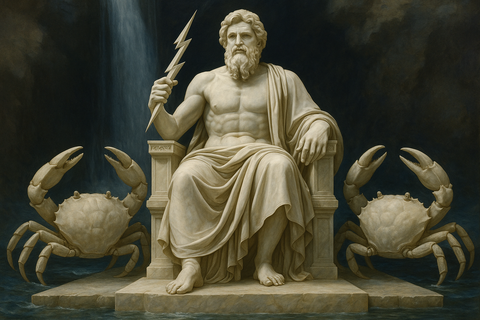
Cancer is linked to a minor but highly symbolic passage in the labors of Heracles (Hercules), the quintessential hero of Greek tradition. During his second labor— the fight against the Lernaean Hydra , an aquatic creature with multiple heads that regenerated when cut off—a seemingly insignificant being appears on the scene: a crab, Karkinos, who attempts to aid the Hydra by biting Heracles' foot to distract him and give his enemy the advantage.
The gesture is unsuccessful. Heracles crushes the crab, focused on the main battle. But the goddess Hera —Heracles's sworn enemy, as he was the illegitimate son of her husband Zeus—moved by the loyalty of this small creature who sacrificed himself without asking anything in return , decides to elevate him to heaven as a constellation. Thus, the constellation of Cancer is born: from the silent gesture of defense against what threatens the home, even if that home is associated with difficult emotions (represented by the monstrous nature of the Hydra).
Clearly, the myth of Karkinos is not a tale of triumph. The crab doesn't represent glory or fame, but rather unconditional loyalty, visceral protection, the courage born of affection rather than ambition . It is the small, tenacious guardian who, even knowing it cannot win, intervenes. This attitude defines a deep part of Cancerian energy: the impulse to protect what is perceived as one's own , even if it means losing.
Cancer, as a sign, holds that memory of domestic sacrifice, of the act of protection that doesn't need acknowledgment to have value. Its strength lies not in direct combat, but in emotional resilience , in the support it offers without calculating risks, in the ability to act from a place of belonging. The mythology of Karkinos speaks of mobilizing bonds, of decisions that don't rely on rational calculation, but rather on loyalty to a deeply felt, even tragic, cause.
And although the crab dies in the story, the constellation remains: what was small in life becomes an eternal symbol in the sky. The brief, marginal action is transformed into collective memory. This is also part of the Cancerian mystery: what we protect with love, even in loss, can become immortal .

The Pearl and the Colors White and Silver
The stone linked to the sign of Cancer is the pearl , one of the few gems not mined from the Earth's interior, but formed within a living being . Unlike crystalline minerals, the pearl is not carved or melted: it gestates . It is the result of a biological process inside certain mollusks, which coat any particle or irritation that enters their body with mother-of-pearl. This ability to transform a wound into beauty has made the pearl a universal symbol of protection, tenderness, and emotional wisdom.
Chemically, pearls are composed of aragonite , a form of calcium carbonate, and conchiolin , a protein that acts as an organic binder. This mixture produces a soft, milky sheen—known as orient —that doesn't reflect light like a mirror, but rather diffuses it . This quality links them to the Moon, ruler of Cancer, whose radiance isn't its own but a reflection of the Sun. Just as the Moon softens the intensity of the day, pearls transform external aggression into a form of protection.
In many ancient cultures, pearls were considered petrified tears , fruits of the sea and emotion. In Vedic tradition, they are directly associated with the Moon and with water as a maternal element. In China, they were used as amulets to protect the unborn child; in Persia, as a symbol of the purity of the soul that passes through the terrestrial world without being corrupted. Their use in feminine and funerary rituals was not due to their decorative value, but to their symbolic quality of emotional support and transition between planes .
On the other hand, the color white , associated with Cancer, is not the absence of color but the sum of all colors. In the visible spectrum, white reflects all the light it receives, without absorbing or modifying it. This quality makes it a protective, enveloping, non-invasive color . It symbolizes the womb, the home, maternal protection. Visually, white expands spaces and fills them with silence. In many cultures, it is the color of initiation, birth, and death, because it marks the thresholds between states : what begins and what ends.
Silver , on the other hand, is the color of the Moon. Unlike gold, which radiates, silver whispers . It has a cooler, more subtle glow, which is associated with nocturnal reflections, introspective thinking, and emotions that don't seek attention but shape the emotional atmosphere of whatever they touch. In color therapy, it is linked to receptivity, calm, and the regulation of the autonomic nervous system —functions directly linked to Cancer's dominance.
On a cultural level, white and silver have historically been used to denote ritual, intimacy, and protection . White vestments at births and funerals, silver tableware reserved for honored guests, sacred objects placed on white cloths in temples and altars. In all cases, these colors define a space of emotional shelter , where something can begin, end, or simply be nurtured .
Keywords Associated with Cancer:
Africa in general - agriculture - ocean currents - crustaceans - spas - boats and vessels - breasts - animal farms - Cadiz (Spain) - Canada - cancer (disease) - Chicago, Illinois - iridescent and opalescent colors - collections - domestic life - emotions - environment - fish and fishermen - white or night-blooming flowers - everything related to food and eating - glass - gastritis - frogs - home - hotels - introverted people - Istanbul (Turkey) - swamps and wetlands - motherhood - Milan (Italy) - milk, dairy industry - obstetrics - New York - oceans - Paraguay - pearls - water pipes - places near water - sense of protection - pumpkins - real estate - resting places - restaurants - sailors - reserves and wineries - silver and silverware - water - stomach - Venice (Italy) - uterus - climate and meteorology - saliva - kitchens and kitchen items - gardens - nutrition - nurses.