This is the seventh part of a 12-part series exploring the energy of each zodiac sign. Today's post is dedicated to Libra . Beyond the popular astrology that associates signs with personality, we'll delve into their most essential meaning: their archetypal nature, their symbols, their characteristics, and their manifestation in the human experience on both a personal and collective level.
What is a Zodiac Sign?
Before talking about Libra itself, it's important to clarify the following: when we talk about signs, most people assume we're referring to the personality of those whose Sun is in that sign. In reality, this is a vast oversimplification that leaves out many layers of valuable meaning for us.
First of all, a zodiac sign is not a person or a personality type . It's a pattern of expression, a way a principle behaves . In astrology, principles are represented by planets, asteroids, angles, and any other points on the celestial sphere. Depending on the sign they fall under, their manifestation takes on a specific quality. And that quality is, in essence, an archetype.
What is an Archetype?
An archetype is an essential pattern, an image or energy that is repeated throughout history and in different cultures . They are primordial models that structure the way we experience reality. In astrology, each sign is an archetype with its own characteristics, an energetic quality that shapes the way any astrological principle is expressed.
When a planet is in a sign, the archetype of that sign acts through it . The sign doesn't change the essence of the planet, but it does determine its style of manifestation. For example, Saturn will behave very differently when it's in Taurus than when it's in Aquarius.
In other words, signs are the way in which a principle takes shape.
Archetypes are Multiple, Eternal and Inexhaustible
Archetypes are profound and sophisticated realities, with countless nuances and manifestations. They are not static or limited to a single form of expression ; on the contrary, their richness is so vast that no human being can fully embody the entirety of an archetype in a single lifetime. They are eternal forces that exist beyond our individual experience and express themselves through us in diverse ways according to our consciousness, evolution, and choices.
This is where free will comes into play: (at least consciously) we don't choose which archetypes are present in our birth chart, but we do choose how we experience them. Throughout life, our relationship with an archetype changes . Having a planet in Libra at age 8 isn't the same as having it at age 55. The energy is the same, but the way we understand and express it transforms with experience. We learn to modulate it, integrate it with greater awareness, and use it more constructively.
From this, it follows that all archetypes are neutral. The same sign can express itself instinctively, chaotically, or unconsciously, or it can be channeled with wisdom and purpose.
We'll return to the archetypes later. Now let's look at the basics of Libra.

A Diurnal Sign, Air, Cardinal, Ruled by Venus
The name of the Libra sign comes from the Latin libra , meaning "scale." In ancient Rome, libra was the unit of weight, but it also referred to the measuring instrument used to balance commercial transactions. The symbol of the scale has since been linked to justice, equity, and proportion . The word "book" also comes from this: originally, the wax tablets used for writing were bound and called liber . Books record, keep accounts, and leave a record. They are a symbol of truth, memory, and justice (from which also comes the meaning of "keeping accounts").
Regarding its polarity, Libra is a diurnal sign , also called yang or masculine in some traditional classifications. This means that its energy tends to project outward , unlike nocturnal or yin signs like Scorpio, Taurus, or Capricorn, which direct their energy inward.
It is also a sign of Air , the element that symbolizes the realm of ideas, abstract intelligence, logic, and communication . It is an invisible but indispensable element, like the bonds that connect us to others through words, signs, and signals. Air has no form of its own: it adapts to space and inhabits it without occupying it. Its essential quality is circulation. In astrology, this implies exchange, dialogue, and mental displacement . In air, there is no emotional density or material stability: rather, we find speed, variability, and continuous translation between codes. The air element needs to connect, because it only exists in interrelation.
On the other hand, Libra's cardinal modality refers to initiative and leadership skills . Cardinal signs mark the beginning of the seasons and are considered fundamental in the zodiac. The word "cardinal" comes from the Latin cardinālis , derived from cardo , which means "hinge," indicating something essential upon which everything revolves or is sustained; but also a turning point.
On another side of this energy, Libra is a sign ruled by Venus . In astrology, saying that a planet rules a sign means there's a direct affinity between the two. Venus is the planet that rules harmony, connections, what we attract (as opposed to what we strive for), and what we associate with each other. As ruler of Libra, Venus manifests as the harmony-relationship between two parts : between us and others, between different elements that must coexist peacefully. The important thing here isn't that one predominates, but that each part has its place. Celebrating differences and incorporating them in the right proportion is what generates beauty in this sign. And beauty is also ruled by Venus.
Finally, the concept of beauty in Libra is much more abstract than that observed in Venus's other domicile, Taurus, where it is about sensory experience: the landscape, the sound of music, the softness of a fabric. In Libra, on the other hand, beauty comes from proportion , from the correspondence between parts, and from each one being given its own. It is an aesthetic of balance, a search for justice in relationships that goes beyond the visible or the tangible.
It is no coincidence that this conception coincides with some of the roots of classical philosophy. The Greeks had already associated beauty and justice with proportion and measure:
• Pythagoras : According to Aristotle in the Nicomachean Ethics (V, 3, 1131a), the Pythagoreans understood justice as an exact proportion, a relationship of equality that assigns to each party what corresponds to it.
• Plato : in the Philebus (64e) states that “the beauty of the body is not in size or strength, but in the proportion of the parts to each other.”
• Aristotle : in Metaphysics (1078a) points out that “the principal kinds of beauty are order, proportion and limitation.”
This philosophical tradition reflects what Venus embodies in Libra: beauty as abstract balance, as justice between parts, as the proportion that makes harmony possible.
(We will go into more detail on these features later.)

The Libra Glyph
The glyph (or symbol) of Libra represents, first of all, a scale : a straight line with a curve above it that quite graphically refers to the scale as an object.
But this same glyph also symbolizes the setting Sun : the lower line is the horizon, and the upper curve, the descending solar disk. It's no coincidence that the Sun is in fall in Libra (we'll see this in the last part of this entry when we discuss essential dignities). Twilight represents the end of visibility, the passage to the nocturnal and the invisible.
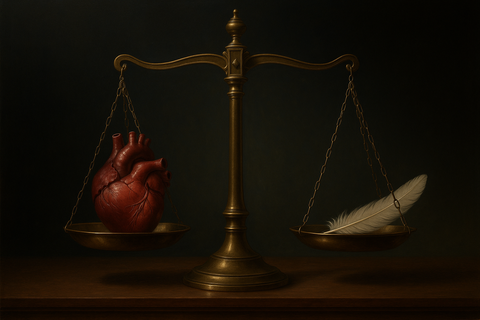
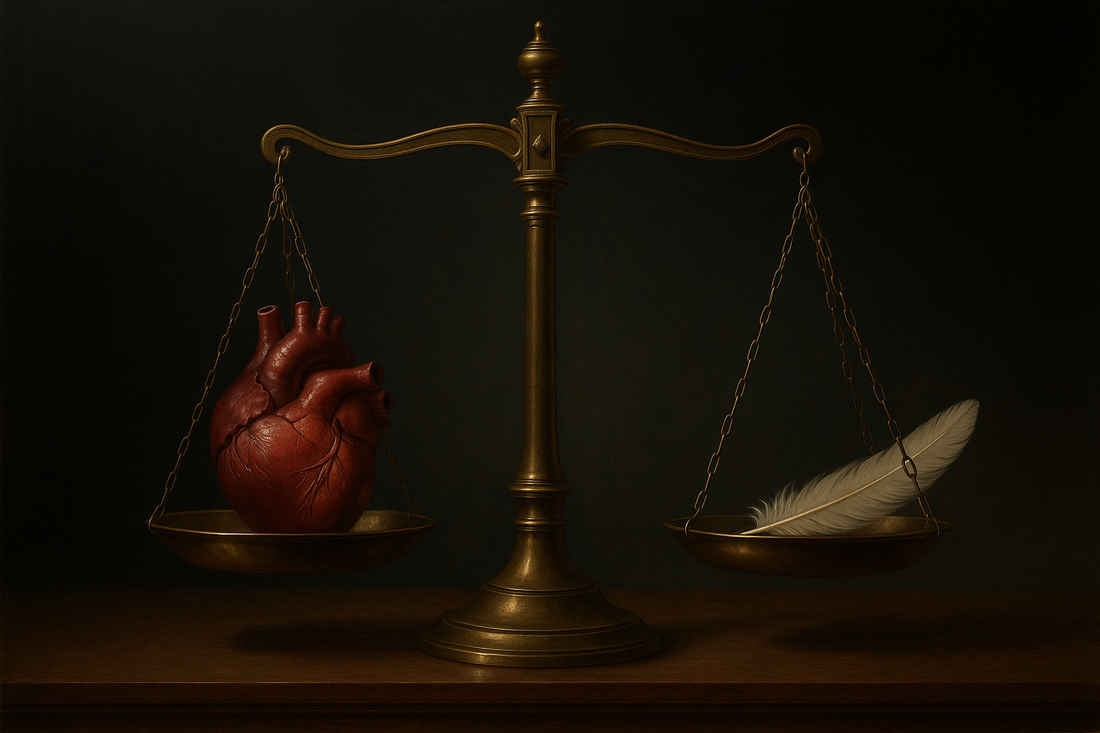
These two symbols—the scales and the setting sun—are practically two sides of the same coin. In ancient Egypt, they were united in a single image: psychostasis , the weighing of souls. There, the deceased's heart was placed on one plate and the feather of Ma'at, symbol of truth, on the other. If the heart was as light as the feather, the soul could continue its journey to the afterlife; if not, it was devoured by Ammit, a goddess with the head of a crocodile, the paws of a lioness and a hippopotamus (the three deadliest animals in the Nile Delta). The scales decided the soul's fate , and the souls crossed over to the afterlife at twilight.
Libra: The Beginning of Autumn and the Months of Survival
In the agricultural cycle of the Northern Hemisphere—the symbolic origin of the zodiac we use in astrology—Libra begins with the autumn equinox . This is the moment when day and night are of equal duration , and from then on the balance of the year tips toward darkness . The sun loses its strength , the days become shorter, and the air becomes colder and windier. If in Virgo the leaves only turned red and yellow, in Libra, in addition to changing color, they begin to fall directly; the trees need to conserve energy. The visibility of nature declines: what was on display in summer now retreats.
Among the fruits of this season, the quince held a central place in ancient culture. In Greece, it was considered the fruit of Aphrodite (the same goddess as Venus) and was offered in marriage rituals as an emblem of a fruitful and lasting union. Its penetrating aroma and firmness—inedible raw—required cooking or processing, and only then could it be transformed into a precious and fragrant sweet.
Alongside it, chestnuts and walnuts were collected, which were dried or ground into flour for the winter, and dried corn was stored and turned into bread or cakes. Sowing of winter wheat and barley also began, taking advantage of the autumnal moisture. The agricultural logic was no longer one of visible abundance, but rather one of foresight: what was harvested should last until the following spring .
On the other hand, the equinox was celebrated in different ways in ancient cultures:
• In Greece , the month of Boedromion included the Great Mysteries of Eleusis . Initiates walked in procession from Athens to Eleusis, fasted, purified themselves at sea, and drank kykeon , a mixture of water, barley, and mint. The central rite, linked to the myth of Persephone, took place at the Telesterion: what was buried germinated in spring, and what died was reborn.
• In Rome , the Meditrinalia was celebrated on October 11. New wine was tasted for the first time and mixed with old wine, making libations to the gods for health and continued life. It was a rite of passage: giving thanks for what had been harvested and consecrating what was to be preserved.
• In Celtic societies , the equinox coincided with the second major harvest . Communal feasts, sacrifices, and the storage of nuts and grains were held. Monuments such as Loughcrew Cairns in Ireland or Callanish in Scotland show alignments with the sunrise on the equinox, proof that this moment was sacred.
There's a central component of this time of year that, as 21st-century humans, we sometimes forget. In a world without global trade or supply chains, the period ruled by Libra ushered in scarcity (and with scarcity, mortality was much higher): it was necessary to strictly balance what had been stored, so that it would cover the needs of the entire winter. The scales here weren't a metaphor; they were the tool that decided how much each person got . Today, however, in a world where, thanks to trade, it's possible to eat watermelon in the middle of winter, we've lost that direct experience of limits. But the zodiac preserves that memory: Libra was the time of measure, of foresight and adjustment, of dispassionate calculation (and regardless of hunger) so that life could be sustained through New Year's Eve.
Precisely because of this need, exchanges between families and communities also gained importance at this time. Those who had oil could exchange it for wheat; those who had wine exchanged it for nuts or flour. No household produced everything in equal measure, and survival depended on establishing fair agreements . These exchanges strengthened alliances and balanced differences: what was one's own was complemented by what was another's.
On the other hand, the human body also reflects this survival mode with a drop in vitality . Less sun exposure reduces the production of vitamin D and serotonin, which influences mood. Melatonin increases, causing more sleep and fatigue. Circulation retreats to the internal organs to conserve heat, generating the sensation of diminished external strength . The beginning of autumn is a reminder that energy is not infinite: it is necessary to balance the internal and external, manage energy, and adjust rhythms.
The climate also reflects this tension. The beginning of autumn is characterized by its instability : the days are no longer steady, but alternate between bursts of warmth and sudden drops in temperature. Sometimes a gentle sun appears reminiscent of summer, and the next day rain and gusts of cold wind arrive. This constant fluctuation marks the passage of the season: nature balances the excess on one side with the lack on the other, as if everything were being regulated on a scale.

Loughcrew Cairns, Ireland.
Characteristics of the Libra Archetype
So, based on the characteristics of this part of the agricultural year, what traits define this energy in its purest form, before it becomes a personal experience? (Remember, we're not talking about people yet):
1. Balance of opposites
Libran energy tends to seek the right balance between two extremes, regulating what's superfluous and compensating for what's lacking. Its function isn't to deny difference, but to maintain it in proportion.
2. Oscillation
Balance is never fixed: to achieve it, Libra's energy swings between the poles like a pendulum. Harmony does not arise from immobility, but from constant movement that adjusts and corrects.
3. Order and moderation
This energy is oriented toward order. Moderation eliminates excess, distributes what is appropriate, and gives each part a place within a common structure.
4. Complementarity
Libran perception is marked by peer awareness: everything is recognized in relation to a complement. Nothing exists in isolation, but in coexistence with its other part.
5. Reciprocity
Libra's energy is activated through exchange. It doesn't unilaterally impose itself, but rather seeks to generate correspondence: what is one's own is balanced by what is not, and what is given is returned in a different form.
6. Measure and restriction
Libran justice does not depend on personal desire, but on a standard that is considered superior and impartial. Even if one's own rights must be limited, the just measure prevails over individual inclination.
7. Abstraction
Libra's energy inhabits conceptual planes: justice, proportion, symmetry, harmony. It doesn't need tangibles to operate; it moves within categories that organize experience from the abstract.
8. Impersonality
Their perspective tends to dissolve the subjective to achieve a neutral vision. Libran energy detaches itself from personal involvement to consider the whole from the outside.
9. Suppression of personal desire
The self is not the focus here. Libran energy subordinates individual preference to what is considered fair, balanced, or proportionate, even if it means renouncing one's own inclination.
10. Search for stillness
Libran action isn't expressed in uncontrolled impulses, but rather in regulation that leads to calm. Its tendency is to reduce conflict and generate peace: an energy that discourages excess and leans toward stability.
11. Beauty in proportion
Beauty, in Libra, comes not from the concrete, but from exact proportion. Diversity finds harmony in balance: the right measure reveals beauty.
How These Characteristics Are Expressed in People with Planets in Libra
When a person has planets in Libra, these archetypal qualities take shape in their life experience. However, the way they are integrated and expressed depends on many factors: the level of consciousness, inner work, and the rest of the birth chart . This is where free will comes into play, as Libran energy is not experienced uniformly. Each of its characteristics can manifest in constructive or challenging ways, depending on how it has been internalized and worked with.
1. Balance of opposites
People with strong Libra energy tend to gravitate toward extremes to find the middle ground. Rather than immediately defining themselves, they explore different poles to understand the whole of a situation. They may strongly adopt a position—for example, a lifestyle or philosophy—and then, with equal conviction, test its opposite and discover which one makes the most sense.
In group settings, they tend to gravitate toward underrepresented voices: if one position dominates, they naturally tend to position themselves closer to the other to restore balance. This ability to balance allows them to have a broad and impartial view, although at their most challenging, they can become "devil's advocates."
2. Oscillation
Oscillation is the natural way for strong Libra people to achieve harmony: it is a Constant movement between perspectives. These natives tend to consider scenarios from at least two angles before acting.
In their minds, there's a constant dialogue between alternatives: "If I do this... but also if I do that... what would happen if..." They rarely make quick, linear decisions: they need to mentally navigate the extremes before settling on the center.
When this oscillation is integrated, it becomes a powerful tool for evaluating options fairly, without rushing. But when it becomes disordered, it can turn into paralysis: the person becomes trapped in an endless back-and-forth that prevents them from moving forward decisively.
3. Order and moderation
People with strong Libra energy tend to seek order, harmony, and proportion in their surroundings. They are uncomfortable with excess and tend to prefer clean, clear, balanced spaces—both physically and energetically. Their interactions with others are usually measured: they avoid unnecessarily raising their voices, are careful with their manners, and moderate their gestures to avoid creating imbalance.
When this quality is expressed in a mature way, it can lead to people with a great capacity to create pleasant environments and stable relationships, where tensions are calmly regulated.
4. Complementarity
Libran perception is crossed by the idea of Coexistence in pairs. People with strongly Libran birth charts find it easy to think in terms of "we" rather than "I." They tend to quickly grasp what others need, adjusting their behavior to create harmony. This can lead to profoundly generous attitudes: they tend to be supportive, offer help, and prioritize the common good. But it can also lead them to subordinate their own needs if they haven't developed clear boundaries. They often find it easier to balance others than to listen to themselves.
In its most mature form, this energy manifests itself as true cooperation: the self does not disappear, but finds its strength by combining with another part.
5. Reciprocity
They tend to have a natural ability to see the best in the person in front of them and to articulate the strengths of different parts into a common framework. They are very aware of the impact that actions—their own and those of others—have on the environment. This principle of reciprocity is deeply linked to a karmic worldview: what goes around, in some way, comes around.
At its best, this quality translates into upright behavior, guided by the inner conviction that every action generates an effect that tends toward balance. If they act with integrity, they know they are contributing not only to their own well-being, but also to that of the whole. But they are also usually quite aware that a selfish or unjust action leaves traces that eventually manifest themselves in the future.
In its most immature form, this awareness can become excessive, leading to a fear of making decisions for fear of the consequences. Or they may expect from others the exact same reciprocity they offer, and become frustrated if that doesn't happen.
6. Measure and restriction
In Libra, the principle of just measure is truly a lifeline. People with prominent planets in this sign are often guided by an internal notion of what's right that permeates both their personal choices and their relationships. Manners, forms, words, and actions align with a standard that depends not on their mood, but on a higher idea of justice and proportion.
When this quality is integrated, it generates ethical coherence: they are trustworthy, upright people who don't need to agree with something to recognize what is right. But if this tendency becomes rigid, it can lead to a moralizing stance or a difficulty in acting spontaneously: they feel they must do it "right" even when the situation requires flexibility or a bit more healthy selfishness.
7. Abstraction
They tend to have a strongly conceptual mind. They feel comfortable operating on mental planes, handling ideas like justice, harmony, proportion, or balance. For them, the intangible—the plane of ideas—can carry more weight than the concrete. This ability allows them to organize complex situations, see structures where others only see fragments, and translate tensions into clearer patterns.
In its highest form, this quality gives rise to individuals capable of understanding the structural aspects behind the immediate, of anticipating consequences, and of giving conceptual form to what others only barely intuit.
At its least integrated, this disconnection from the tangible can lead to a failure to register basic bodily signals (not knowing when they're hungry, tired, or experiencing certain somatized emotions) or to confusing reflection with action. They have great ideas, but they can remain suspended in the mental plane if they fail to materialize them.
8. Impersonality
One of the distinctive qualities of people with strong Libra energy is their ability to step back from personal involvement and analyze a situation neutrally. They can fairly assess what's happening, even if it involves someone they love, and can tactfully but frankly say if something isn't right.
When this ability is used in a balanced way, it allows for difficult conversations without drama, conflict resolution with maturity, and a lucid and objective perspective. But at its most problematic, it can adopt an overly detached role (or, let's return to the "devil's advocate" example from earlier) even when it's not necessary. This can make others uncomfortable—especially when someone seeks emotional support and receives rational analysis.
9. Suppression of personal desire
In Libra, The self is not at the center. People with this predominant energy tend to subordinate their personal desires to what they consider just or necessary to maintain balance. This can give rise to a very noble form of altruism: they are not interested in imposing themselves or being the center of attention, but rather in preserving overall harmony.
However, when this quality isn't integrated, they can become disconnected from what they want. In these cases, when asked what they want, they often respond, "I don't care" or "whatever you prefer," because they fail to register—or forbid themselves from registering—their own desire. In the long run, this can translate into low vitality and loss of enthusiasm, since personal desire is also a source of energy.
When they manage to balance this tendency, they become people who know how to give up without disappearing: they prioritize what is common without dissolving into it.
10. Search for stillness
Libran energy seeks peace, stability, and conflict reduction. People with strong Libra elements tend to avoid unnecessary confrontations and act diplomatically. However, paradoxically, this same tendency can generate indirect conflicts: by avoiding uncomfortable conversations or postponing decisions, the problem silently grows.
They can also irritate others when they adopt an overly neutral stance—when the context requires taking sides. At its best, this search for stillness is not avoidance, but an active form of mediation that creates order and calm without denying the tension that exists.
11. Beauty in proportion
These people tend to possess a fine aesthetic sensibility. They don't seek beauty in ostentatiousness, but rather in exact proportion. This is reflected in their way of dressing, organizing spaces, speaking, and relating to others. They tend to have innate good taste and instinctively know when something is "in balance."
Practical Examples: Yma Sumac and Serena Williams


Birth Chart of Yma Sumac, 13/09/1922, 13:00, Cajamarca, Peru. Rodden Category: AA (birth certificate).
Yma Sumac was born on September 13, 1922, in Cajamarca, Peru. She was one of the most extraordinary voices of the 20th century , an unmistakable performer who dazzled international audiences with a vocal range that spanned more than four octaves and a stage presence of impeccable precision. Her emergence onto the music scene in the 1950s coincided with the rise of exotica music in the United States. Since the release of her album Voice of the Xtabay in 1950, she became a cultural phenomenon that crossed borders and stages around the world. In her natal chart, we find a powerful stellium in Libra: North Node, Midheaven, Saturn, Mercury, and Jupiter.
In it, the Libran energy manifested itself clearly. The oscillation —one of Libra's central qualities—was directly reflected in her voice: she could move from the low notes of a contralto to crystalline high notes with fluidity , without losing clarity or musicality. This balance between extremes became her trademark: it wasn't just a demonstration of technique, it was proportion. Moreover, every melodic curve, every silence, and every accent were measured with a precision that was more striking for its measure than its volume.
His work combined diverse repertoires—songs inspired by Andean motifs, stylized lyrical pieces, and orchestral rhythms from the mid-century exotic scene—which he integrated coherently within a single aesthetic framework. It had little to do with scattered eclecticism; it was understood as a carefully constructed system of balances. Libra's influence is also evident here: the ability to maintain unity through difference , to articulate contrasts without losing their form.
Another evident Libran characteristic was her pursuit of beauty in proportion. Yma Sumac took care of every element of her stage presentation: elaborate yet understated costumes, clean lines, and an almost ceremonial bearing . Her image was an organic part of her artistic proposition. Everything about her was measured, balanced, contained within a coherent aesthetic framework. Contemporary critics emphasized precisely this impression: her voice wasn't overwhelming, but a controlled phenomenon, a force that unfolded with grace and calculation.
A form of suppression of the self in favor of the work is also evident in her figure. She never positioned herself on stage as a narrator of her personal life or as a confessional protagonist. What she displayed was not her biography, but rather an ideal of beauty and harmony that transcended it. In that sense, her public presence was marked by an elegant, almost impersonal distance, which reinforced her mythical aura and transformed her into a symbol rather than an individual figure.
Thus, Yma Sumac embodied Libra's energy through measure, proportion, and formal elegance. Her presence was majestic without being strident, powerful without being invasive. Her legacy is not only that of an incomparable voice, but also that of an artist who knew how to transform balance into spectacle.


Serena Williams Birth Chart, 09/26/1981, 20:28, Saginaw (Michigan), United States. Rodden Category: AA (birth certificate). Bottom image credit: Juergen Hasenkopf/Shutterstock
Another notable example of this energy is Serena Williams, born on September 26, 1981, in Saginaw, Michigan. She is one of the most influential figures in the history of tennis , an athlete who redefined not only the way to play, but also the way to occupy space in a historically rigid sport. Throughout her career, she won 23 Grand Slam singles titles—the highest number of the Open era—four Olympic medals, and an undisputed place in the history of the sport. In her natal chart, we find a gigantic stellium in Libra: Sun, Saturn, Jupiter, Pluto, and Mercury.
The Libran's ability to balance opposites is evident in his style: he combined tremendous physical power with a fine understanding of the game, aggression with tactical patience, intuition with calculation. He knew when to accelerate and when to slow down, when to let the momentum run and when to contain it. It wasn't just his strength that disarmed his opponents; it was his ability to find the exact point where the match was decided.
Her on-court presence also reflected the Libra principle of restraint and structure . Serena was known for maintaining her composure even in highly charged matches. Her technical style—compact strokes, measured movements, perfectly calibrated serve—specifically reveals the influence of her Saturn and Jupiter in Libra: control, proportion, and long-term vision . She didn't improvise: she organized the match as a system that could be adjusted and adapted without losing its focus.
On the other hand, her famous relationship with her sister Venus embodies another key aspect of this archetype: complementarity. Throughout her career, Venus was not only her closest rival, but also her mirror (in fact, the two were often referred to and treated as a whole; the Williams sisters ). From the beginning of their careers, the two sisters built a dynamic that broke traditional competitive molds: it was not a destructive rivalry, but a balance of complementary forces . In several interviews, Serena has said that Venus was her "greatest inspiration" and not simply an opponent. This way of perceiving competition as a mirror and not an enemy embodies one of Libra's most refined principles: the coexistence of two poles that mutually reinforce each other .
In another area of her life, and in true Libra fashion, Serena has been an active voice on issues of racial and gender justice both inside and outside of sports. For example, her response to a well-known episode of racism at Indian Wells 2001 was not confrontational in the classic sense: there was no violence or discursive rupture, but rather a silent but sustained boycott lasting 14 years . When she returned in 2015, she did so with a speech focused on reconciliation and setting an example. This gesture undoubtedly encapsulates the Libran logic of reciprocity and balance: pointing out injustice, but also leaving open the possibility of restoring harmony. In addition, she founded her own investment company. —Serena Ventures—focused on startups led by women and underrepresented minorities, with a pitch focused on “ redistributing opportunities ” and “ balancing power structures .”
Another aspect in which we see the Libra influence is that throughout her career, Serena has kept her personal life highly private. Although she is one of the most media-friendly athletes in history, her image was not built on her intimacy but on her work and her causes . Her way of speaking at press conferences is frequently diplomatic and measured , avoiding personalizing conflicts or displaying uncontrolled emotions. Even in moments of controversy, such as at the 2018 US Open, after a famous argument with the umpire, she focused her public discourse on the structural inequality towards women in sports, not on her individual experience. This shift from the personal to a larger idea is profoundly Libran.
In a more concrete sense, Serena also marked an era in terms of her aesthetic . Her outfits at Wimbledon, the US Open, and other tournaments weren't just fashion choices: it was clear that this was an important aspect for her, one that she put a lot of dedication and care into. Ballet-inspired dresses, athletic outfits designed to allow freedom of movement without losing elegance... She never lost her impeccable style even in the toughest matches.
In short, throughout her career, Serena Williams maintained a narrative centered entirely on abstract things : on legacy, on structural change, on paving the way for other generations. Her image wasn't that of a self-absorbed athlete , but rather that of someone who consistently took the initiative to build bridges and level the playing field, giving visibility to many underrepresented groups at the time (and to this day). Her personal drive gracefully subordinated itself to a larger idea of fairness, representation, and balance . And that makes her great both in and out of sports.
Libra Energy at the Collective Level
When Libra energy is strongly present in the collective, it expresses itself as Ability to negotiate, regulate, and reach agreements . It's a climate in which positions shift from one side to the other until they reach a middle ground, where decisions aren't made hastily, but rather calmly, with dialogue and attention to form. Consensus, protocols, established forms, and norms that organize coexistence are prioritized. Individual egos lose centrality in the face of shared structures . The priority is harmony and impartiality .
On the political and social level, Libra is associated with the strengthening of institutions, treaties, laws, and multilateral agreements . It is also associated with peace treaties and truces . It is an energy associated with the creation of regulatory frameworks, mediation bodies, and arbitration mechanisms. Diplomatic negotiation, deliberative processes, and the construction of common norms that distribute responsibilities among multiple parties are privileged. Libra marks periods in which societies are organized through legal structures and political agreements that seek to preserve balance.
On an economic level, Libra is associated with trade agreements and exchange treaties . Its logic is structured reciprocity: different parties negotiate, make agreements, and establish clear terms that benefit each of them. Networks of regulated interdependence are prioritized, where economic flow is sustained through alliances, contracts, and sustained negotiations.
On the cultural level, Libra appears in cycles marked by beauty, harmony, and order . Sophisticated, refined, and balanced artistic expressions develop, with an emphasis on proportion and elegance. There is also often special attention to codes of conduct and shared social norms : good manners, etiquette manuals, protocols, and rules that define accepted behaviors. Aesthetics are not accessory: they are a structural part of how collective life is organized.
As a cardinal sign, Libra marks the beginning of dynamics of regulation and balance . It seeks to establish shared conditions that integrate multiple poles in a balanced tension, where differences can coexist without destroying each other.


Practical Example: Reissue of Amy Vanderbilt's Complete Book of Etiquette (1978)
On September 6, 1978, with Pluto, Mars, Venus, and the Moon in Libra , a reissue of Amy Vanderbilt's Complete Book of Etiquette , one of the most influential manuals of manners and etiquette of the 20th century , was published. This book, originally published in 1952, was not simply a compendium of rules of courtesy: it established a shared language of social behavior that transcended classes, generations, and cultural contexts. Its republication, almost three decades later, responded to a historical moment in which American society was undergoing profound transformations and needed to renegotiate its codes of coexistence.
In a country emerging from a decade marked by feminist movements, civil strife, and political tensions, the reissue of this manual did not represent a return to the past, but rather the creation of a common framework for interaction . The rules of etiquette functioned here as an invisible structure of harmony: guidelines that facilitated coexistence and the silent negotiation of differences. It was not about imposing oneself, but about establishing agreements .
The reissue of this book was not an isolated editorial gesture, but a cultural act that embodied the Libran spirit: the need to coordinate forms , to establish proportions and manners that allow differences to coexist within a single framework. It was, in other words, a moment when structured beauty and social harmony took center stage, displacing individual urgency in favor of collective coexistence.
Essential Dignities for Libra
Essential dignities in astrology are a system that determines the strength and quality of a planet's expression based on the sign it's in. Each planet has places where its energy manifests most easily and others where it faces more challenges. There are five main dignities: domicile , when a planet is in its ruling sign and operates completely naturally; exaltation , where its energy is enhanced and expressed in a heightened way; detriment , when it is in the sign opposite its domicile and its expression is weakened or outside its comfort zone; fall , when it is in the sign opposite its exaltation, which can hinder its manifestation; and terms and decans , which are minor dignities that modify the planet's influence in specific degrees of the sign (we will see these last ones in future blog posts). This system allows us to interpret how a planet functions in a natal chart based on its zodiacal position.

Venus in Domicile
When Venus is domiciled in Libra, it means it's in one of the two signs it rules (along with Taurus), allowing it to express its energy with strength and confidence. Venus is the planet of harmony, connections, what we value, and what we attract ; in Libra, these qualities are oriented toward the search for proportion and balance between two different parts. Beauty here doesn't depend on material things, but on a just balance and harmony.
Unlike when Venus is in Taurus, its other sign of residence, in Libra Venus doesn't seek sensory stability or concrete pleasures. Its impulse is abstract: it needs symmetry, reciprocity, and justice . What appeals to Venus in Libra is coherence in a relationship, the sense that each part has its own place and that no one dominates the other. Aesthetics are perceived in proportion, in the balanced organization of social life, and in the ability to integrate differences.
This position gives a great ability to detect contrasts and harmonize them , to mediate and create bonds that feel fair. Venus in Libra thrives on reaching agreements and maintaining relationships where balance prevails. However, this same impulse can lead to excessive concessions: maintaining the appearance of balance even when there is underlying tension or difficulty.
In terms of essential dignities, Venus in Libra has complete control over its astrological function, making it a strong position. It favors diplomacy and respect in relationships , an elegant and sophisticated aesthetic sense, and the ability to create relationships, spaces, and rhythms where harmony simply occurs without much effort.

Mars in Detriment
Mars is in detriment in Libra. This doesn't mean it's functioning poorly, but rather that it's in a territory it's not comfortable with. Mars represents direct action, self-affirmation, the urgency to move forward and cut through what stands in its way. Libra, on the other hand, seeks balance, negotiation, and balance between two different parties. Therefore, in this sign, Mars has to act in a way that doesn't come naturally to it.
Instead of addressing things quickly, Mars in Libra is forced to consider others, gauge their reactions, and pause before acting . The Martian urge to make decisions impulsively is diluted by the need to evaluate consequences and find a compromise. This can lead to indecision, postponing decisions for fear of conflict , or discharging energy in indirect confrontations rather than clear action.
Even so, planets in detriment, when worked with, can bear valuable fruits. In the case of Mars in Libra, action is elevated by always incorporating the perspective of others: it is the union of drive and conciliation, assertiveness and the pursuit of peace. It can produce people who fight for justice, who defend equitable agreements, or who put their energy at the service of collective causes . When integrated, this position shows that strength has nothing to do with aggression, but rather with acting with an awareness of connection and balance.

Saturn in Exaltation
Saturn is exalted in Libra. This is considered its strongest position, where its energy finds maximum coherence and power . Saturn represents order, structures, boundaries, and karma. In Libra, these principles are expressed in their most related realm: balance, just measure, and the need for rules that preserve harmony.
The symbolism is profound. Libra marks the beginning of the Sun's descent into the dark half of the year, associated in many cultures with the passage to the underworld . In Egypt, psychostasis —the weighing of souls on the scales of Maat—decided one's fate after death: the deceased's heart had to be balanced with the feather of truth. This image connects directly with Saturn in Libra: the idea of judgment, responsibility, and consequences . It's not just about external limits, but about the implicit law that governs existence.
In this sign, Saturn teaches that harmony doesn't just "happen," but rather we make it happen through respect for rules that guarantee fairness . For justice to exist, a framework of order is necessary. And karma, in its broadest sense, finds its ultimate expression here: what goes around comes around , for better or worse. Saturn in Libra reflects that justice doesn't depend on individual will, but on a universal principle of compensation.
Those with this position often display a strong sense of responsibility, clear ethics, and an impressive sense of impartiality . They can assume roles of authority with sobriety and balance, not out of a desire for control, but rather an understanding of the order necessary for relationships and society to function. Their greatest strength lies in understanding that nothing is left unanswered: every action generates a consequence, and everything tends toward the right measure.

Falling Sun
The Sun is in fall in Libra, and this is considered the weakest position for this star. Fall doesn't mean that the energy is doomed to failure, but rather that it expresses itself in a realm unsuitable for it and requires conscious work to unleash its potential. Many classical astrologers describe it as a weakened dignity, but in practice, planets in fall, when integrated, can become excellent positions: there are many examples of people with planets in fall who have achieved extraordinary things thanks to the discipline with which they learned to work through this initial difficulty.
Why is the Sun in fall in Libra? Because its natural impulse is to focus on itself. The Sun symbolizes the affirmation of one's own vitality, the need to radiate from a core and project one's own creative impulse outward . Libra, on the other hand, is other-oriented, seeking to harmonize two parts and cede center stage in favor of the relationship. This makes it an uncomfortable terrain for the Sun, which tends to be self-referential and encounters resistance in an energy that demands balance, reconciliation, and shared focus.
This imbalance can translate into low vitality or a certain difficulty in getting excited about personal projects. The Sun in Libra may hesitate about where or with whom to express their creative impulse , as if they always need an external mirror to recognize themselves. The search for peace and quiet, characteristic of Libra, can also weaken the solar dynamism, which is associated with movement, warmth, and affirmation. The result is that, instead of expressing itself firmly, vital energy can disperse or fall into passivity.
However, when working with this position, the Sun in Libra can reach a heightened dimension. Here, vitality is expressed by taking others into account : it's about creating a balance where one's own brilliance neither overshadows nor is overshadowed. This can be the hallmark of those who direct their vital force toward causes of justice, toward creating balanced relationships, or toward the pursuit of beauty in proportion and measure. The initial challenge then becomes a virtue: the ability to radiate without excluding, to affirm oneself without nullifying, to ignite one's own light in dialogue with that of others.

Libra Mythology: Themis
Libra is associated with Themis , the Greek goddess of divine order. Themis did not represent human laws or the decrees of a ruler, but rather that which was already inscribed in the cosmos before humanity existed. Her name, derived from the Greek themis ("that which is established"), alludes to a justice that is not invented but discovered.
Daughter of Uranus and Gaia, Themis belonged to the generation of the Titans . Her power is therefore older than that of the Olympians: it stems from a natural order that runs through both gods and humans . She was an advisor to Zeus, who could not make momentous decisions without hearing her voice. On the throne of Olympus, she sat by his side as a principle reminding the gods that even they were subject to a greater balance.
She was credited with oracular gifts : before Apollo ruled Delphi, Themis dictated her answers there. Her word was recognized as true, because she saw not only what was shown, but what was hidden behind actions. From her were born deities who embody the very structure of life: the Hours , who regulated the passage of time and the seasons; Dike , personification of justice; and the Moirai , the Fates who assigned destiny to each human being. Themis was not, then, an isolated figure, but the matrix of universal order in all its dimensions.
In the sky, the constellation of Libra is the only one represented by an inanimate object : the scales. There is no beast or hero, but an instrument. This is no coincidence: in Libra , the central focus is not the judging figure, but the very act of weighing and balancing. The myth of Themis reminds us that true purpose comes from embodying an order that is older than any will.

The Opal and the Pastel Pink
The stone associated with the sign of Libra is the opal . Opal is a mineral composed primarily of hydrated silica, whose internal structure contains tiny spheres that diffract light. This diffraction generates its characteristic iridescence : a play of shifting colors that varies depending on the angle of observation. Unlike fixed-color stones like ruby or emerald, opal never displays a single hue: it is always plural , always a variation.
Since ancient times, it has been considered a symbol of balance and reflection . Pliny the Elder, in his Natural History (1st century), described the opal as a stone that contained within itself the fires of ruby, the purple of amethyst, and the green of emerald, all in a single gem. It was therefore understood as a talisman of harmony, capable of uniting diversity into a unity. In the Middle Ages, it was used as a stone of justice and equity: it was believed to help the wearer see the truth amidst appearances, to find the correct proportion.
On the other hand, the color associated with Libra is pastel pink . In physical terms, pink corresponds to wavelengths that combine red light (approx. 620–750 nm) softened by mixing with white. The result is a shade that doesn't exist in the pure spectrum, but rather emerges from a synthesis: it is literally a relational color, a product of mixing.
Culturally, pastel pink has been used as a symbol of delicacy, tenderness, and reconciliation . It is neither the fiery red of immediate passion nor the absolute white of abstract purity, but rather an intermediate: a calming shade that integrates without extremes. In heraldry and modern visual arts, it is associated with diplomacy, courtesy, and understated elegance. Pastel pink dominated the aesthetics of 18th-century French Rococo : salons, tapestries, and noble attire adopted it as an emblem of refinement, courtesy, and poise.
Keywords Associated with Libra:
fresh air - alliances - Fine Arts - armistices - bedrooms - balance - beauty and the response to beauty - beauty salons - Argentina - artists of all kinds - boutiques - Austria - buttocks - China - having company - Copenhagen (Denmark) - copper - coral - interior and exterior decorators - diplomacy - luxury furniture - lilies in general - flowers and florists - doves - fashion - engagements - social gatherings - actors and actresses - marriage - Japan - grace - cosmetics - arbitrations - harmony in general and in music - intermediaries - divorces - justice - love - white marble - lumbago - music and musicians - jewelry, jewelry and jewelers - contracts - negotiations - ovaries - pacifists - business partners - couples - kidney disorders - scales for weighing - skin - symmetry - tailors - vines - opals - diabetes - wigs - west - truces - weddings - trials, courts and laws.