We know that 2025 is a decisive year astrologically, marked by planetary transits that completely alter society as we have been perceiving and experiencing it. Uranus's entry into Gemini is the last of the year's major sign changes , and also one of the most significant. This is because Uranus is a long-cycle planet: it takes approximately 84 years to travel through the entire zodiac . That is, it remains in each sign for about seven years. And the slower the planet, the more profound its effects.
Since 2018, Uranus has been transiting Taurus, exerting its influence on what stability, matter, and predictability have meant to us. That cycle ends now, and with the entry into Gemini , a new collective era opens. But not only that: every time Uranus changes signs, not only does a seven-year chapter close, but a resonance with the previous complete cycle is also activated. The last time Uranus was in Gemini was between 1941 and 1949 , in a world that was also undergoing reconfiguration.
Next, let's look at what Uranus's effect on Gemini is and what we can expect now.
A Transpersonal Planet
Uranus is a transpersonal planet. To understand what it means for a planet to be transpersonal, it's important to first situate it within the three major levels of planetary influence.
First, personal planets (such as the Moon, Mercury, Venus, and Mars) govern basic functions of immediate experience: thought, desire, and action. Their transits are rapid and short-lived, and their effects are often visible in everyday behavior. Then, social planets (Jupiter and Saturn) introduce a mediation with the collective: they shape our beliefs, values, roles, and the way we relate to institutions and social time. They do not act directly on our will, but they do structure the way we position ourselves in the world.
Uranus, Neptune, and Pluto, on the other hand, are transpersonal planets . Their influence does not originate in the self, nor is it directed toward the self. They act as great collective forces that transcend the individual , but in doing so, propel processes of radical transformation. Dane Rudhyar—one of the great innovators of astrology in the 20th century—defined them as agents of the world soul , instruments of an evolution measured not in years but in profound shifts of consciousness.
Transpersonal planets are slow, impersonal, and often disruptive. Ninety percent of the time, the lasting effects they produce aren't immediate , but rather slowly peel away structural layers of the human experience : our certainties, our sense of reality, what we considered stable and known. When a transpersonal planet activates a point in the sky, it not only changes something in society and our lives , it also changes our understanding of what is happening to us .
The Exact Dates
Uranus will be in Gemini from July 7 to November 8, 2025, and from April 26, 2026, to May 22, 2033.

Birth Planets in Gemini, Virgo, Sagittarius, and Pisces: The Importance of Preparing in Advance
This transit will have an impact on everyone, both personally and collectively. But if you have natal planets or angles in Gemini, Virgo, Sagittarius, or Pisces , you're likely to feel its effect directly and destabilizingly. This is because Uranus from Gemini will form tense aspects with these signs—squares and oppositions—which can generate unexpected movements, abrupt shifts, or changes that break with the established order.
With Uranus transits, the ideal is to prepare ourselves two years in advance, not to anticipate what will happen—because Uranus isn't predictable—but to open ourselves up to the new. The key is to pay attention to the signs of acceleration, to the ideas that slowly begin to break with the logic of what is habitual for us, to the paths that begin to open up without us yet knowing where they lead . The more space we have to move, the more easily the liberating potential of this transit can be expressed.
If we begin preparing early, the passage of Uranus doesn't have to be experienced as a crisis. Quite the opposite: it can mark a period of liberation, innovation, or reconnection with a part of our lives that had become trapped in outdated and fearful routines. The difference between experiencing it as a fracture or a surge depends, in large part, on how willing we are to change.

Uranus: The Anomaly and the Divine Mind
In its most essential meaning, Uranus is the planet associated with the emergence of something from outside the system that shatters the way we've been seeing things . Its influence doesn't develop in stages, nor does it accumulate slowly: it manifests abruptly, not unlike an earthquake.
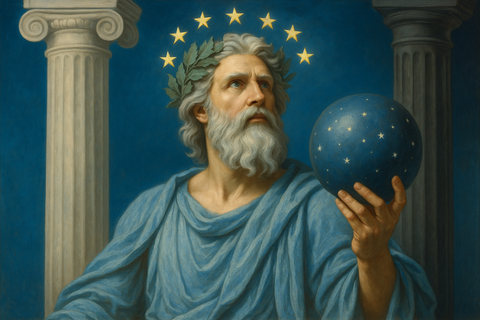
In Greek cosmogony, Ouranos (Οὐρανός) is the Primordial Starry Sky . Emerging from Chaos, he is the first god to impose a form on the indeterminate. He unites with Gaia, the Earth, and together they engender the first beings: the Cyclopes, the Hecatonchires, the Titans; truly monstrous figures. Ouranos, horrified by their appearance (his idea of what his children would be like was very different), decides to prevent them from coming to light . One by one, he pushes them back into Gaia's womb.
This is simply a metaphor for the conscience repressing what doesn't fit its ideal . Everything we find uncomfortable, disproportionate, and/or unpredictable is pushed into our unconscious. We suppress everything that escapes order, threatens the perfection of our ideals, and so on. In other words, it's the part of us that censors everything that doesn't fit our image of how we should be (especially anything we feel isn't socially acceptable).
But Gaia, unable to bear this abuse any longer, conspires with one of her sons, Cronus (the Greek equivalent of Saturn), to free all her children who had been buried. Cronus—time—castrates Ouranos and displaces him. Thus the dominance of the pure ideal is interrupted , and the reign of limit, sequence, conflict, and history begins. Cronus's severance is a courageous and necessary act: time appears when disconnection from reality becomes pathological . However, the reign of Cronus-Saturn is not sustainable indefinitely either: it is then that the system must break down so that something new can emerge .
Since then, Uranus has carried that legacy: it represents the moment when the repressed returns with enough force to deconstruct what denied it . Everything that returns with Uranus arrives unpredictably and rapidly to interrupt, destabilize, and then restore a more complex order that, at the time of the events, we have no idea where it's going.
This is because Uranus is linked to a form of intelligence that doesn't operate within the usual human confines. In astrology, it's associated with the higher or divine mind : because it operates on a different plane. It doesn't deduce, analyze, or compare. It receives complete patterns , structures that appear almost en bloc, as if arriving from a place the logical mind can't access. That's why Uranus is associated with invention, genius, and a vision that abruptly breaks away from the familiar. What arrives under its influence doesn't adapt to what exists; it directly replaces it.
By transit, then, Uranus bursts forth through unexpected events, unlikely encounters, and unforeseen decisions. Sometimes it does so through crises, sometimes with a clarity that can't be explained. But the effect is always the same: something (anomalous) that we had left out of the picture returns and forces us to reorganize everything else .
In any case, we must remember that Uranus doesn't seek to break away because it symbolizes an adolescent whim. It breaks away when the system can no longer sustain itself without betraying some vital part of itself. And so, although at times its transits may feel like chaos or loss (at other times, it may be receiving exactly what we've longed for), ultimately they open the way to a life more aligned with what had been denied. Thus, as in myth, Uranus's function is to restore contact with what has been excluded .
Uranus Transits: The Fracture That Reorganizes
Uranus transits have several characteristic features, and the attitudes these features require from us. On a personal and collective level , the key points of Uranian energy are:
Boredom and Need for Something New
When a Uranus transit approaches, we begin to notice that everything feels too predictable. We feel like our routine is becoming tedious and monotonous, the pace of our days seems slow—or rather, we feel like our life is falling behind. We feel an almost urgent need for something to change, for our life to stop being so peaceful. This feeling is one of the hallmarks of Uranian energy: the inner impulse to break away from what holds us back. If we listen to this impulse intentionally, it can lead us to positive transformations without burning bridges or making decisions we later regret.
Willingness to Let Ourselves Be Led Down a Different Path
During Uranus transits, if we have a disposition toward openness to the unknown, we're halfway there. It doesn't have to start with something radical. Sometimes it's enough to enroll in a course outside our usual field, change our route to work, or try a different way of doing something everyday. These are small gestures, but they have a cumulative effect: they put us in a state of mind that's more open to the unexpected. And that openness, over time, can lead us to a freer—and possibly much better—version of our lives.
Restitution of the Excluded
What seemed buried—ideas, emotions, untrodden paths, rejected aspects of our identity—reappears. Uranus presents it to us as an anomaly that demands to be acknowledged. If we are not willing to integrate what we had denied, we will experience it as a crisis. But if we acknowledge it, it becomes a reorganizing axis of incalculable value.
Anomalies that Bring Important Messages
When something doesn't fit with what's "usual" in our lives, when an event deviates from the pattern, or an internal response can't be logically explained, it's possible that Uranus is at work, showing us something important. It's best to observe the impact of this anomaly, but never repress or dismiss it. Uranus is often understood only in retrospect: first it disrupts us, then it reveals its meaning.
Radical Changes
Uranus transits don't take us "beyond," but to another place entirely. They replace the old system, so it's better to accept early rather than late that what falls apart cannot be recovered. If we insist on going back, we remain trapped in a completely fruitless conflict. If we let the new shape its own rules in our lives, a form of order more faithful to our current purpose and moment emerges.
Disidentification with Outdated Roles
Often, what collapses with Uranus isn't a specific situation, but the identity we had built around it. It shatters labels, roles, or certainties with which we had been functioning, and which ultimately weren't who we were. In retrospect, we often end up seeing that the previous version of ourselves was almost a caricature, something we weren't aware of at the time.
Direct Vision without Mediations
Uranus doesn't operate through analysis. Its intelligence is literally immediate. It's that eureka moment when we receive knowledge "out of the blue," from who the hell knows, without having thought it through. During its transits, these moments are frequent. Let's listen to them.
Instability with Enormous Creative Potential
It's a fact: Uranus transits make our lives unstable. It's not personal (remember, transpersonal planets are impersonal ). Without this instability, we wouldn't be able to reorganize our priorities. In this tension between what's crumbling and what's just beginning to take shape, an extremely fertile space emerges for creating a life that perhaps we wouldn't dare imagine even in our wildest dreams.
External Approval = Value Close to Zero
Uranus transits confront us with the need to think for ourselves, act from our own truth, and resist the mold. We can't experience a Uranus transit if we continue to wait for external approval or clear instructions from others.
Reflections on Freedom
Each Uranus transit confronts us with a question we don't always know how to answer immediately: what does it mean to be free today? Not what we once felt as freedom—perhaps ten or twenty years ago—but what we now, with everything we've been through, truly need to avoid suffocating. It's not about rebelling for the sake of rebelling, or returning to adolescence. But it is about reviewing the moment we began to lock ourselves away without realizing it, in what routines, commitments, or loyalties no longer represent us. Of course, these reflections aren't always comfortable. Sometimes they require a courageous change to maintain our internal coherence, even if at the moment we don't know where that change will lead.
Keywords Associated with Uranus:
Aberrations - anomalies - abruptness - acceleration - accidents - advance movements - aeronautical industry - air - agitators - airplanes and airports - alienation - indifference - altruism - astonishment - anarchy - assassination attempts - armored cars - artillery - astrology and astrologers - audacity - autocracy - voting and votes - batteries - birds in general - the bizarre - boycotts - mass media - bullets - buses - catastrophes and calamities - caricatures - unexpected changes - civic organizations - clubs and their members - electric colors - colleagues - contradictions - controversies - cooperative societies - crises - sudden deaths - cyclones - detachment - dictators - discoveries - neurological diseases - disobedience - earthquakes - eccentric people - engineers - electricity - electromagnetism - electronics and electronic devices - emancipation - emigration - errors - ether - exoduses - the extraordinary - feminism - firearms - fireworks - fugitives - freedom - freelancers - geniuses, genius - healing without drugs - highways - LGBTQ+ - humanitarian sense - hurricanes - hydroelectric plants - independence - innovation - insurrection - intuitive intellect - interference - inventions and inventors - legislators - light - mechanics and mechanical skill - modernization - electronic music - nervous system - nervousness - organizations - overthrows - Parliament - political parties - atomic radiation - reforms - Russia - segregation - sparks - technocracies - tornadoes - tyrannies - clocks - strong winds - cables - X-rays.

Uranus in Taurus (2018-2025): The Displacement of the Stable
Let's now place everything we've talked about about Uranus in the recent timeline.
Although every Uranus transit activates a process of change, its passage through Taurus was extremely challenging . For many astrologers, Uranus is considered to be in fall in Taurus: as we saw above, Uranus represents disruption, the unexpected, and openness to the unforeseen. Taurus, on the other hand, is a sign that strongly resists all of these attributes (it represents stability, value, earthiness, and unchanging nature). The friction between both energies meant constant tension during the seven years of the transit, which was often experienced as a stagnant energy that didn't have many ways to express itself constructively.
At the collective level, value systems shifted , but not without resistance. Uranus shook the foundations of everything Taurus rules: money, land, material security, the relationship with the body, the bond with what one owns. New forms of property emerged—cryptocurrencies, NFTs, metaverses, digital goods—but so did economic crises, inflation, real estate recessions, financial collapses. Value was dematerialized , and at the same time, the fear of losing the concrete intensified .
During this period, the conflict between technological innovation and sustainability became evident. While digital tools promising a freer life—such as artificial intelligence, decentralized payment systems, and metabolic monitoring of the body—advanced, droughts, forest fires, soil degradation, and the depletion of natural resources also worsened. The physical body, the earth, food, and the environment became urgent issues , as if everything "solid" was beginning to creak from overexploitation.
The notion of belonging has also changed. Geopolitical tensions—war, displacement, the global housing crisis—showed that we can no longer take territory or access to basic needs for granted . What seemed stable has become volatile. And what we used to consider valuable has had to be redefined again and again (we're still at it).
On a personal level, it was a difficult transition to assimilate . We had to confront the need to change precisely in the places where we needed security the most. Our relationship with money, with our bodies, with what we consider "ours" was put to the test. But, like everything in Taurus, the change was slow and full of resistance . It was experienced as a slow tremor, which made us uncomfortable without immediately offering any new certainties (in fact, it's clear we don't have any yet).
Many of us have had to redefine what value means, both in its abstract and concrete sense : What is worth preserving? What is hoarding and accumulation that we hadn't seen before? Uranus moved us right where we wanted to stay put, to show us that what is truly solid doesn't need rigidity to endure.

Uranus in Gemini: Connections Accelerate
Uranus begins a new chapter in the most ethereal sign of the zodiac . After seven years in Taurus—a transit that confronted us with internal and external resistance, where every movement was slow, blocked, or forced—it now moves to Gemini: a completely different territory, where it encounters no opposition. Gemini offers no resistance . It is the sign of transitions, of thresholds, of paths that link one thing to another. Everything in Gemini is connection, mobility, exchange. And what is exchanged is all intangible: data, ideas, words, mental pathways.
( Read more about the behavior of the planets in Gemini at this link) .)
In this area, Uranus finds enormous freedom of action. We're talking about a planet that accelerates time, deconstructs the known, and generates impulses of innovation—now operating within the most flexible, changeable, and light sign of the zodiac. Gemini is mutable and airy. It holds nothing back: everything it touches connects it to something else. Therefore, this transit will feel like a burst of stimuli . Unlike Uranus's passage through Taurus, which was dense and contained, here we'll see a much more active Uranian manifestation, with visible effects on many fronts at once . Uranus's energy will infiltrate all of Gemini's territories: communication, education, technology, media, language, transportation, and exchange networks.
Although Uranus isn't domiciled in Gemini, there are clear affinities between their natures. Uranus breaks with the fixed. Gemini doesn't need to be broken: it's already multiple, it already splits itself. Therefore, this transit won't encounter barriers; it will happen at full speed . Of all the slow transits that characterize 2025—Pluto in Aquarius, Saturn in Aries, Neptune in Aries—this is, without a doubt, the most dizzying. Uranus in Gemini brings a mental pace that will at times feel overwhelming. Ideas duplicate, news overlaps, patterns fragment. There will be times when we literally can't keep track.
The positive side is that Gemini, as a mutable sign, can also help us adopt a more open, lighter, and less clingy mindset . As the transit progresses, we may begin to flex the way we think, learn, and connect.
The Last Two Transits of Uranus in Gemini
Although we may not realize it on a daily basis, time has a cyclical quality. That is, while specific events may not repeat themselves identically, the underlying archetypes and energies do . This means that the emotions, challenges, and choices we face during one astrological cycle can be surprisingly similar to those of previous cycles. What really varies is how we respond to these energies and how our actions and decisions manifest in tangible actions. Thus, by understanding the past few times Uranus transited Gemini, we can anticipate what will happen next.

Last Transit (1941-1949): Accelerated Innovation in the Midst of War
Information technology
• 1943 – Colossus (United Kingdom): The first programmable electronic computer, created to decipher the Enigma codes. It hastened the end of the war. It was the beginning of automated data processing.
• 1945 – ENIAC (United States): The first general-purpose computer. Designed to calculate ballistic trajectories, it marked the beginning of the digital age. It weighed 27 tons and processed in seconds what previously took hours.
• 1947 – Invention of the transistor (Bell Labs): It replaced vacuum tubes and allowed for a reduction in the size and cost of electronic devices. It was the starting point for all subsequent technology.
• 1948 – Mathematical Theory of Communication (Claude Shannon): introduced the concept of the “bit” as the smallest unit of information. It defined the foundations of all current digital technologies.
• 1943 – Radio telescopes in the Netherlands: allowed mapping of cosmic radio waves, literally opening a door to communication with space.
• 1945 – ZIP Code in the United States: reorganized postal zoning and allowed for faster mail delivery.
• 1949 – Invention of the barcode: patented as an “automatic sorting method.” Although it wouldn't be widely used until 1974, it was the seed of commercial automation.
Reformulation of communication
• Mass propaganda: During World War II, language was used as a weapon. The BBC and Radio Berlin broadcast messages in multiple languages. Eighty percent of the European population listened to some form of propaganda.
• First digital voice encryption system ( SIGSALY ): allowed encrypted conversations between Roosevelt and Churchill. It was the precursor to secure digital communications.
• Founding of UNESCO (1945): proposed that wars are born in the mind and that peace must be built through language, education and culture.
• 1946 – First Frankfurt Book Fair: brought together 100 publishers from 21 countries. Marking the beginning of a global literary exchange.
• 1949 – Birth of the paperback: Penguin Books popularized accessible editions. Reading ceased to be the preserve of a select few and became a mass tool for cultural transmission.
Innovation in education
• GI Bill (USA, 1944): Guaranteed free college education for millions of veterans. It changed the structure of access to knowledge and expanded social mobility.
• Creation of new universities and research centers: scientific and technological training expanded. The generations trained during this period later led the digital revolution.
Reconfiguration of borders and neighborhoods
• Division of Germany and creation of new borders in Eastern Europe (1945–1947): Neighborhood relations between countries were redefined. New dividing lines were drawn that changed the map of Europe.
• Indian independence (1947): division with Pakistan, conflicts over the territory of Kashmir, and mass displacements. Gemini also rules the immediate surroundings and tensions between neighboring countries.
• Beginning of the Cold War (1946–1949): the ideological dividing line between blocs was also expressed in terms of surveillance, espionage and information control.
Doors, passages and canals
Gemini rules thresholds and passages—that idea of a “door to the other side.” During Uranus's last transit in Gemini, symbolic infrastructures were built to fulfill that function.
• 1940–1941 – Shelters and tunnels in London: Underground channels were dug to serve as protection and alternative routes during bombing raids. These spaces became symbols of transition: from danger to safety, from chaos to accessible, hidden places.
• 1942–1943 – Whittier Tunnel (Alaska): A 13,000-foot tunnel was opened through the mountain, connecting Passage Bay (Prince William Sound) to the rail network. It not only facilitated military supplies but also opened a permanent route between isolated areas.
• 1942 – Lincoln Tunnel (USA): connected New Jersey and Manhattan under the Hudson River. 14 million vehicles crossed it in its first year. It redefined urban mobility in one of the most densely populated areas in the world.
• 1945 – Victory Bridge (Canada): Connected Quebec and Ontario over the Ottawa River. It became a symbol of reconnection after the war.
• 1948 – Heathrow Airport (London): transformed from a military base to a civilian airport. In 1946, it was operating its first commercial flight from London to Buenos Aires.
• 1949 – First nonstop US–Europe flight: The Lockheed Constellation reduced the journey time to 14 hours, compared to three days crossing the Atlantic by ship. It was a radical change in the perception of time and space.
Trade and exchanges
Gemini also governs exchanges, including trade. During the period 1945–1949, the global rhythms of trade underwent rapid transformation.
• 1945–1949 – U.S. Exports: Between July 1945 and June 1949, U.S. exports of goods and services amounted to $67.4 billion. This reflected the U.S. commercial leadership in global reconstruction and the opening of new markets.
• Global trade growth : The expansion of international trade after the war was the most rapid in the 20th century. Between 1948 and 1968, trade volume increased by 290% thanks to reduced transaction costs and technological improvements in transportation, telephony, and navigation.
• 1944 – Bretton Woods Conference: the IMF and the World Bank were created to regulate international financial flows.
• 1947 – General Agreement on Tariffs (GATT): 23 countries signed the agreement to reduce trade barriers. This was the basis for what is now the WTO.
• 1948 – Marshall Plan: The United States injected $13.3 billion to rebuild Europe and reestablish destroyed economic networks.
• 1945–1948 – “Economic miracle” in Belgium: The country regained its industrial capacity and resumed large-scale exchanges of coal, steel, and textiles, reflecting a renewed flow of goods between nations.
• 1947 – First home pizza delivery service (Naples): a minor innovation that symbolizes immediate local commerce.

Penultimate Transit (1858-1865): Accelerated Communication and Mobility in an Expanding World
Physical and symbolic thresholds
• 1859 – Mont Cenis Tunnel (France–Italy): This was the first transalpine railway crossing, with over 13 km excavated with dynamite. It shortened journeys from days to hours and marked a milestone in connecting regions separated by mountains.
• 1863 – Opening of the London Underground (Paddington–Farringdon): the world's first underground line, used by more than 40,000 passengers daily upon its opening.
• 1859 – Construction of the Brooklyn Bridge (USA) begins: it symbolically joined Manhattan and Brooklyn, although it was completed later, it began during this transit.
• 1860 – Installation of electric lighthouses on maritime routes (England and the USA): they reduced shipwrecks by 40% according to Lloyd's Register, illuminating the routes and increasing the safety of passage between previously uncertain points.
Redefining trade
• 1859 – Opening of Bon Marché (Paris): the first modern department store, with five floors and 52 departments. It revolutionized consumerism: fixed prices, free circulation, and mass access.
• 1862 – International Commercial Code (London): 32 countries signed agreements to standardize cross-border commercial contracts and regulations.
• 1865 – The New York Stock Exchange was connected by telegraph to London: quotes were updated within minutes. The weeks-long delay in financial trading was eliminated.
• 1861–1865 – 200% increase in cotton exports from the U.S. , despite the Civil War.
During this transit, exchanges became more agile, coordinated, and global. Uranus in Gemini not only amplifies circulation, but also transforms its internal rules.
Revolution in popular culture
• 1860 – Mobile libraries on trains (England): wagons with more than 2,000 books circulated through rural areas, bringing knowledge where schools could not reach.
• 1864 – Publication of the first modern comic (“Max und Moritz”, Germany): popular graphic narrative that reached even those who could not read at all.
• 1865 – Telegraph chess between London and Bombay: long-distance games published in the press, turned into a collective spectacle.
• Exponential increase in readers in Paris: between 1858 and 1865, the number of daily newspaper readers increased from 100,000 to 600,000.
Uranus in Gemini opened channels to other forms of reading, play, and knowledge. What was once local was now circulating. What was once scholarly was now commonplace.
Reconfiguration of borders and paths
• 1858 – Mapping of British India: A geodetic survey of over 2.4 million km² was completed, redefining colonial boundaries with technical precision.
• 1861 – Time unification of the U.S. railroad system: For the first time, four time zones were organized to coordinate trains. Time was no longer local.
• 1861 – Baedeker Guides (Germany): they were created as manuals for individual travelers who traveled around Europe on their own.
• 1863 – First daily urban mail system (USA): the postal service is reorganized and begins operating in several cities.
• Railroad expansion during the American Civil War: it grew by 40%, changing connections between regions and shortening distances between towns and cities.
• 70% of European migrants used the train to reach ports of embarkation , facilitating the passage to new lives.
Gemini rules the immediate surroundings, but also the lines that separate or connect them. Uranus in this sign makes these divisions mobile and transforms routes into dynamic networks.
Perception of time and information
• 1858 – First transatlantic message between Queen Victoria and President Buchanan (USA): a submarine cable between Ireland and Newfoundland reduced communication time from three weeks to a few minutes.
• 1858 – Public clocks synchronized by telegraph: In European railway stations, telegraph signals were used to maintain coordinated time.
• 1862 – First “flash” news in newspapers (The New York Herald): urgent headlines were included thanks to the immediacy of the telegraph.
• 1865 – Telegraphic Meteorology (Paris Observatory): the first daily forecast service is created using data collected in real time.
Uranus in Gemini not only accelerates movement, it also accelerates the mind. What matters is no longer how far away things are, but how long it takes for them to reach our consciousness.

Extra Section: United States, Uranus in Gemini and Wars
It is no coincidence that every time Uranus has transited Gemini, the United States has been at war. The Revolutionary War (1775–1783) coincided with Uranus’s transit through Gemini between 1774 and 1782; the American Civil War raged under the transit from 1858 to 1866; and World War II , between 1941 and 1945, also occurred within Uranus’s transit in Gemini, which extended until 1949. The reiteration of this pattern suggests that, for the United States, each passage of Uranus through Gemini activates a critical fracture in its internal structure or in its projection toward the world.
In the Sibley chart—the most widely used natal chart for analyzing American astrology —natal Uranus is in Gemini, conjunct the Descendant (the beginning of the 7th House, a house traditionally associated with sworn enemies) . This position reinforces the idea that the country projects its internal tensions outward, and that each time Uranus returns to that sign, that area of the chart is reactivated. Gemini as a sign represents the two halves of something: the dual, the fragmented, yet still part of the same thing. And in American history, this Gemini energy manifests itself both in its two-party system and in its constant tension between states, regions, and conflicting narratives.
The characteristic polarization of Gemini is not only ideological, but also geographical and symbolic: east coast and west coast, north and south, conservative and progressive, urban and rural. Uranus, as the planet of ruptures and sudden breakthroughs, accelerates these tensions every time it crosses the sign. The result has historically been a warlike conflict that, although with different faces, always puts at stake the redefinition of alliances, identity, and the future.
We'll cover this topic in more depth in another post (and America's upcoming Uranus revolution as well), but we mention it here because it highlights a structural constant: Uranus in Gemini seems to signal a violent threshold for the United States, a transition that demands division and then reformulation.

Gemini Innovations: What to Expect with Uranus in Gemini from 2025 to 2033
At the Collective Level:
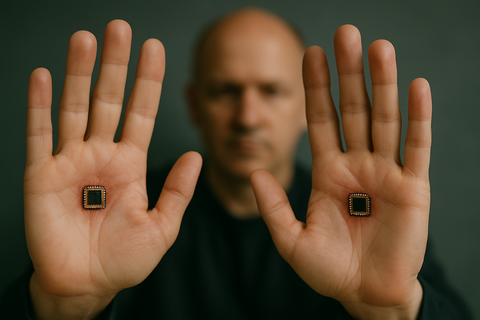
• Brain-computer interfaces (BCI) and shared mind expansion
The noninvasive BCI market could reach between $5.6 billion and $6.5 billion by 2030, growing at a rate of 18% to 19% annually. This opens up the real possibility of real-time mental translators and the transmission of ideas or sensations as data that can be exchanged directly between brains. This is no longer science fiction: companies like Neuralink are moving toward human clinical trials as early as 2024.
• Contextual and multimodal generative AI
Technology can be modulated according to our emotional state, environment, or nonverbal language, cultivating a new form of digital communication that is deeper, more adaptive, and subtly controlled by our minds, not just our hands.
• Neuromorphic computing and adaptive intelligence
The consolidation of neuromorphic chips inspired by brain architecture will enable environments and tools that react and learn autonomously, adapting in real time to usage patterns, emotions, or life context.
• Community innovation networks
The coming years will witness the rise of decentralized communities of practice—a hybrid of the digital and the local—where technology, art, and care come together to generate collaborative projects: AI-managed urban gardens, emotional care networks, digitalized parenting clubs, and more.
• Care economy and local reconnection
Collective care, local production, and solidarity could become pillars of an emerging social model, facilitated by open and horizontal technological platforms that allow for the online exchange of resources, knowledge, and care, strengthening proximity without becoming closed.
• Decentralized trading and instant transactions
Smart contracts and blockchain will enable an ecosystem in which a large percentage of B2B transactions could be automated by the end of this transition. This will combine with automated predictive logistics mechanisms (such as "digital twins"), which will reduce losses and streamline flows, transforming material exchange into an act almost as dynamic as communication.
• Territorial changes and redefinition of state borders
Previous transits of Uranus in Gemini have coincided with geopolitical transformations that redrew national borders. New states could be consolidated, whether through political rupture, regional self-determination, or institutional collapse. We may see rising tensions in regions such as the Caucasus, the Balkans, and the Sahel, where latent territorial disputes could be reignited. International recognition of partially sovereign entities, such as Palestine, Kosovo, or Taiwan, could also accelerate, challenging the map inherited from the 20th century.
• Disputes over maritime, orbital and polar borders
As physical boundaries become more porous, we will see new borders emerging in previously marginal or shared spaces. The expansion of submarine cable networks, Arctic shipping routes, and deep-sea mining activities will intensify claims to exclusive economic zones. Regions such as the South China Sea, the Arctic, and the South Atlantic could come into conflict over strategic resources or trade routes. In parallel, the rise of satellites, private space stations, and quantum communication technologies will open the debate on sovereignty in low-Earth orbit. International organizations may be forced to create new regulations to define rights to use space, including geostationary orbits, frequencies, and space debris. In other words, emerging forms of borders will emerge.
On a Personal Level:
• Unexpected changes in relationships with siblings or people in the immediate environment
Uranus can completely reconfigure ties with fraternal or neighboring figures. Relationships that seemed stable can become distant, break down, or unexpectedly revive.
• Relocations that alter routine and connection with the environment
Many people will experience relocations that will force them to live in new neighborhoods, languages, and social contexts. It's not just about changing places, but about moving toward contexts that stimulate new neural networks, new ways of reading the world, of understanding everyday life.
• Destabilization of mental habits and ways of learning
Uranus in Gemini can shake up rigid cognitive structures, especially if they were inherited or adapted without question. Some will abandon study methods or mental practices that previously worked, but now generate distraction or frustration. Attention, perception, and the way we process information will be constantly adjusting.
• Attraction to new languages, unusual combinations and alternative logics
The transition can spark a sudden interest in disciplines that operate with different mental structures, such as programming, quantum logic, visual languages, or non-alphabetic languages. This pursuit doesn't always respond to a rational plan: it's a need to reorganize thinking from a different starting point.
• Rethinking the link with information and devices
Some people will feel increasingly uncomfortable with hyperconnectivity; others will immerse themselves in new forms of digital communication, such as neural speech or augmented environments. But in both cases, what changes is our relationship with the medium through which we think, converse, and connect.
• Reconfiguration of narrative identity
Uranus in Gemini affects the way we tell our stories about life. The stories that once served to explain ourselves—about who we are, where we come from, how we got here—may suddenly seem obsolete. The transit could invite us to break away from linear narratives and create new forms of storytelling that are more fragmented, mobile, or downright unstructured.
• Distancing from people in our immediate environment with whom we no longer share a mental frequency
Even if there's no conflict, a difficult-to-explain gap can arise with those who were once part of your everyday, physical circle (e.g., your neighborhood, your gym). The closeness ends up being more mental than physical.

Virginian Innovations
Although Uranus is transiting Gemini, its passage will also directly impact Virgo, as this sign is located at 90° to Gemini in the zodiac. This angle forms a square: an aspect of tension that pushes for change and readjustment. Therefore, although the focus is on Gemini, we can also expect tensions that will trigger innovations in the areas ruled by Virgo:
• Advances in mind-body connection technologies
Devices designed to map the body's emotional response in real time will emerge, integrating neurological, digestive, and hormonal data. This information will be applied in clinical settings as well as in workplaces and educational environments, redefining care protocols. Health will cease to be conceived as a set of symptoms and will become a dynamic mapping of the body in interaction with its environment.
• Normalization of sex as an indicator of comprehensive health
We could see the emergence of clinical and biometric indicators that integrate sexuality as part of overall well-being. In parallel, the use of sexual health-oriented technologies, such as monitoring devices, personalized educational platforms, and new sex toys, is likely to increase. All of this under an approach that prioritizes emotional regulation, consent, and prevention.
• Redesign of work spaces based on biological rhythms
The standard workday will be challenged more strongly, and organizational models adapted to chronotypes, menstrual cycle phases, and levels of cognitive attention may emerge. This will especially affect technical, administrative, and support jobs, areas directly governed by Virgo. Productivity metrics could include indicators of rest, mental clarity, and self-regulation.
• Consolidation of service micro-enterprises based on personal technique
Individual technical mastery will gain strength as a key to job placement. Professions that require precision, detailed attention, and specific skills—from fine-tuned embroidery to healthcare algorithm programming—will gain institutional recognition and support. Platforms that certify non-academic, but highly specialized, technical skills are likely to be developed.
• Structural reform of public health systems
Faced with a saturation crisis, many countries could redirect their healthcare model toward decentralized prevention. This would involve strengthening neighborhood care networks, specialized mobile clinics, and virtual assistants who monitor hygiene and nutrition routines from home.
• Expansion of economies based on functional and silent services
Services linked to order, cleanliness, technical efficiency, and invisible support will begin to occupy a more visible place in urban economies. This visibility will not come from spectacle, but from the recognition that functionality is indispensable.
• Revaluation of sex work as a field of care and technique
Virgo governs the intersection of sexuality, body, and service. The professionalization of sex work is likely to increase, with a focus on the physical and emotional health of both the provider and recipient. Discussions will arise about hygiene standards, social protection, and therapeutic support, especially in regions where these conversations have historically been hidden.
• Technologies applied to the purification of the body and the environment
Innovations could emerge aimed at purifying domestic air, water, food, or even human digestive cycles, integrating nanoscale or bio-based solutions.
• Freer relationship with the body as a space for daily experimentation
There could be a growing interest in unstructured body practices, intuitive movement methodologies, eating based on internal listening, and forms of care that prioritize self-perception over external norms. This freedom doesn't imply disorder, but rather functional attunement to the real body.

Sagittarian Innovations
Sagittarius is in opposition (180° of arc) with Gemini, so during this transit , Sagittarian beliefs and visions come into tension in order to innovate . It will be necessary to find a balance between both poles to avoid falling into extremes.
• Growth of nomadism with a philosophical or spiritual meaning
Nomadism will no longer be solely digital or professional. Intentional migration will expand toward communities that share ethical values, worldviews, or sustainable ways of life. So-called "purpose-built cities," such as the Telosa project in the U.S., anticipate this settlement model. There are currently more than 10,000 registered eco-villages, and many are expected to adopt more Sagittarian organizational forms: open, mobile, and based on ideals.
• Inclusion of philosophical and spiritual content in formal education
Sagittarius rules meaningful knowledge. Universities could incorporate programs linked to non-dogmatic spiritualities, ancestral wisdom, or indigenous cosmologies. By the end of this transit, it's quite likely that elite universities will be able to offer departments or chairs dedicated to applied spirituality.
• Consolidation of tourism as a transformative experience
A redefinition of tourism is expected, shifting toward experiences that provoke personal change. Spiritual retreats, purposeful journeys, and pilgrimage routes augmented by immersive technologies will gain traction. This type of travel will seek to generate inner expansion, not just the accumulation of destinations.
• Religious deinstitutionalization and emergence of new models of spiritual community
Traditional religions could face a crisis of belonging. Communities that function as spaces for practice without hierarchies or dogmas will increase, even in digital environments. The emergence of "NFT churches" and self-managed temples through DAOs (decentralized autonomous organizations) is already projected.
• Legal systems influenced by expansive ethical principles
Sagittarius promotes visions of law that transcend the national. Legal frameworks that recognize rights to nature and symbolic entities will multiply. In the coming years, at least 20 countries plan to classify ecocide as a criminal offense. This could lay the foundation for a cross-border legal ethic with a strong symbolic and environmental imprint.
• Colonization of space as a new field of philosophical and legal dispute
With the advances of SpaceX and other private actors, the debate on ownership and governance beyond the planet will intensify. Discussions will range from interplanetary citizenship to the ethical use of extraplanetary resources. In the face of corporate appropriation, collectives will emerge demanding shared and democratic management of space, introducing for the first time a conflict of meaning beyond Earth.
• Emergence of mythopoetic media and symbolic narratives
Faced with the exhaustion of the traditional news format, media outlets that interpret current events through archetypes and symbolic narratives could gain traction. News explained with mythological or astrological insights, analysis of current events based on collective imaginations, and algorithms that filter information according to emerging symbols could become a legitimate form of knowledge organization.

Piscean Innovations
Like Virgo, Pisces is located at 90° to Gemini in the zodiac. This angle forms a square: an aspect of tension that pushes for change and readjustment. Therefore, although the focus is on Gemini, we can also expect tensions that will trigger innovations in the areas ruled by Pisces:
• Expanded mental health and suicide prevention with compassionate AI
Platforms will be developed that combine artificial intelligence with biometric sensors to detect depressive patterns or risk signals on social media, digital conversations, and wearable devices. Mental distress will be recognized as a collective dimension that requires listening beyond the symptom. These technologies could be integrated into public mental health systems, especially for adolescents.
• Non-religious spirituality assisted by algorithms
Digital platforms will emerge that design personalized rituals based on each person's emotional state, life story, and inner search. These "algorithmic temples" will not require affiliation or belonging, but rather sensitivity and connection. At the same time, neurotheology will gain ground: studies that map mystical states in the brain using fMRI and artificial intelligence. Not to reduce spiritual experience to data, but to understand its pathways.
• Legal psychedelic therapies and digital psychedelics
Uranus in Gemini will promote controlled legalization of psychedelic substances as part of therapies for grief, deep depression, or complex trauma. Along with this, technological alternatives will emerge: virtual realities and neurostimulations that induce altered states without drugs. These devices could be regulated as pharmaceuticals and be part of treatment in specialized clinics.
• Revolution in addiction care
From opioid-blocking vaccines to decentralized blockchain-based recovery communities, the fight against addiction will move away from being centered on blame. Expect a more integrative approach, where relapse is understood as part of the process and community support takes on new forms.
• Music as medicine and collective synchronization of emotional states
Music could cease to be entertainment and become emotional technology. Concerts where audiences' brainwaves are synchronized through BCI devices could become massive experiences of emotional fusion. Compounds that amplify musical perception could also be developed, designed for use in clinical or ritual spaces.
• Volunteering from the metaverse and compassionate economies
Immersive platforms will allow assistance to be provided in remote or conflict-affected areas from realistic virtual environments.
• Art and compassion as public policy
Sensitivity could begin to be understood as a political resource. Music and art could be incorporated into palliative care, with virtual realities designed to accompany life-ending processes.

Questions to Reflect on During Uranus in Gemini:
• What ideas do I consider immovable truths, and how open am I to questioning them without losing myself?
• How does my way of speaking transform when I feel truly free?
• What kind of information empowers me, and what kind of information disperses me?
• Where do I notice mental rigidity, and how could I become more open to exchange?
• What kinds of conversations could change the trajectory of my life if I dared to have them?
• What topics do I avoid learning about because I'm afraid of what they might reveal to me?
• What is the cost of maintaining superficial consistency if it prevents me from exploring new ideas?
• What kind of news or narratives do I choose to repeat and why?
• What source of information am I willing to stop following if it distorts my ability to think clearly?
• Am I willing to accept that my voice can become part of a broader web of transformation?
Key Dates Within This Transit

Trine with Pluto in Aquarius: 2025-2028
This trine will bring about a tremendous acceleration in the processes of social, political, and technological transformation . Uranus in Gemini proposes a radical redesign of information systems, exchange networks, and the ways in which different areas of knowledge connect, while Pluto in Aquarius activates collective processes of power reconfiguration. Being a fluid aspect, both planets amplify their influence without restraint: what begins to mutate encounters no resistance.
On a collective level , this trine can translate into unprecedented advances in artificial intelligence, decentralized communication, quantum physics, collaborative platforms, and digital governance. It can also lead to new forms of algorithmic surveillance, mass data manipulation, or leaks, revelations, or hacks . The transformation of power and information continues unabated, like a sequence of dominoes falling one after the other: each step opens up new possibilities, but also eliminates what doesn't adapt.
This transition may coincide with a global breakdown of centralized control over information , with struggles between technology corporations, organized communities, and state agencies for control of knowledge channels. In its most extreme version, it may lead to a total reorganization of the education system, the media, and social spaces, where content is fragmented, distributed through alternative channels, and hierarchies of knowledge are redefined.
The intensity of this aspect lies largely in the fact that Uranus (ruler of Aquarius) is the dispositor of Pluto (which is in Aquarius) during this transit. There is no stopping the two : the momentum of mutation advances without turning back. History never turns back.

Trine with Jupiter in Libra: October 2028 and July 2029
This trine opens two brief but constructive windows of collaboration between two air signs: Uranus in Gemini, which introduces radical changes in the ways we communicate, learn, and connect, and Jupiter in Libra, which expands the ideals of justice, balance, and mutual agreement. The result is a synergy between technological innovation and social diplomacy: disruptive ideas that find acceptance in more harmonious collective frameworks.
At the collective level , this aspect may coincide with treaties, legal reforms, or international pacts aimed at regulating new technologies, protecting digital rights, or creating common ethical codes in the face of advances in artificial intelligence and automation . It can also enable alliances between platforms, communities, or states to promote more transparent, horizontal, and equitable communication.
Although brief, these aspects can leave a significant mark on the way we reach consensus, deliberate, and make decisions. If the trine with Pluto intensified transformation, this one with Jupiter facilitates a lucid pause to articulate new rules of the game in a rapidly changing landscape.

Conjunction with Saturn in Gemini: July 2032
This is an extremely rare conjunction, occurring only every 45 years , and initiates a new synodic cycle between two very different forces: Saturn, which seeks structure, boundaries, and clarity in thought, and Uranus, which promotes disruption, innovation, and radical redesign of language, ideas, and networks. The result is a tension between the emerging new and the old, which still attempts to organize, define, and control the processes of change.
At a collective level , this conjunction can translate into an attempt to institutionalize new cognitive technologies, regulate artificial intelligence systems, and redefine the educational, legal, and communication frameworks within which we function as a society. It is a period in which the mind, at a social level, is forced to restructure itself, as if a new mold were being forced to process a quantity of stimuli, data, and forms of interaction that are completely new and that we do not yet know how to manage or regulate.
This transition could manifest itself in legal reforms related to neuro-rights , in the redefinition of the role of digital media, in the creation of international protocols for the ethical use of cognitive platforms, or in the complete transformation of learning systems. In its most somber version, it could reveal the collapse of the filters that organized information —and, with them, of the collective capacity for discernment—if a clear integration between innovation and tradition is not achieved.

Uranus Leaves Gemini: May 22, 2033
On May 22, 2033, Uranus definitively enters Cancer , not to return to Gemini until 77 years from then.