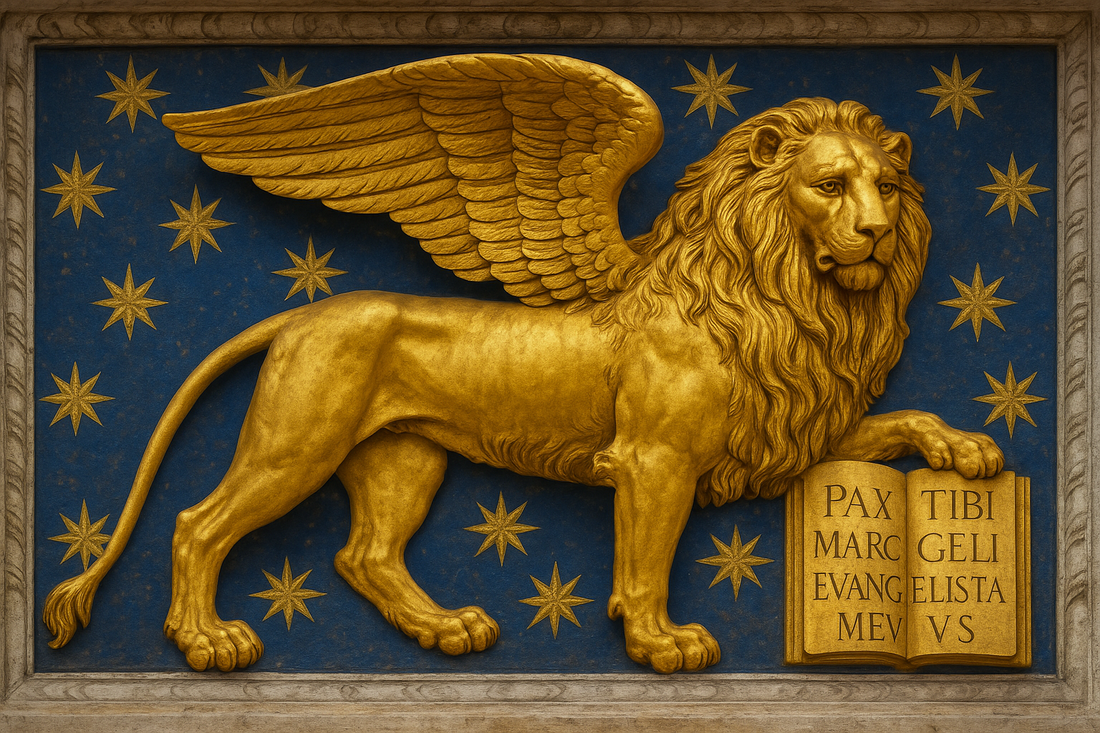
And we've reached the fifth part of this 12-post series exploring the energy of each zodiac sign. Today's post is dedicated to Leo . Beyond the popular astrology that associates signs with personality, we're going to delve into their most essential meaning: their archetypal nature, their symbols, their characteristics, and their manifestation in the human experience on a personal and collective level.
What is a Zodiac Sign?
Before talking about Leo itself, it's important to clarify the following: when we talk about signs, most people assume we're referring to the personality of those whose Sun is in that sign. In reality, this is a vast oversimplification that leaves out many layers of valuable meaning for us.
First of all, a zodiac sign is not a person or a personality type . It's a pattern of expression, a way a principle behaves . In astrology, principles are represented by planets, asteroids, angles, and any other points on the celestial sphere. Depending on the sign they fall under, their manifestation takes on a specific quality. And that quality is, in essence, an archetype.
What is an Archetype?
An archetype is an essential pattern, an image or energy that is repeated throughout history and in different cultures . They are primordial models that structure the way we experience reality. In astrology, each sign is an archetype with its own characteristics, an energetic quality that shapes the way any astrological principle is expressed.
When a planet is in a sign, the archetype of that sign acts through it . The sign doesn't change the essence of the planet, but it does determine its style of manifestation. For example, Saturn will behave very differently when it's in Taurus than when it's in Aquarius.
In other words, signs are the way in which a principle takes shape.
Archetypes are Multiple, Eternal and Inexhaustible
Archetypes are profound and sophisticated realities, with countless nuances and manifestations. They are not static or limited to a single form of expression ; on the contrary, their richness is so vast that no human being can fully embody the entirety of an archetype in a single lifetime. They are eternal forces that exist beyond our individual experience and express themselves through us in diverse ways according to our consciousness, evolution, and choices.
This is where free will comes into play: (at least consciously) we don't choose which archetypes are present in our birth chart, but we do choose how we experience them. Throughout life, our relationship with an archetype changes . Having a planet in Libra at age 8 isn't the same as having it at age 55. The energy is the same, but the way we understand and express it transforms with experience. We learn to modulate it, integrate it with greater awareness, and use it more constructively.
From this, it follows that all archetypes are neutral. The same sign can express itself instinctively, chaotically, or unconsciously, or it can be channeled with wisdom and purpose.
We'll get back to the archetypes later. Now let's look at the basics of Leo.

A Diurnal Sign, Fire, Fixed, Ruled by the Sun
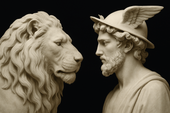
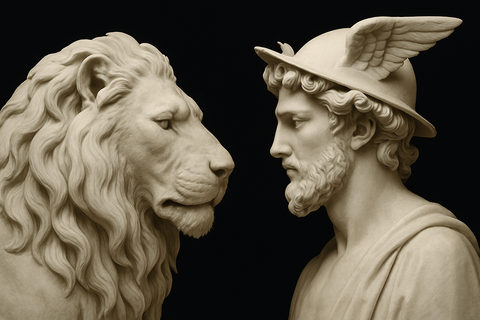
The name of the zodiac sign Leo comes from the Latin leo , meaning "lion." However, the figure of the lion had already been associated with royalty, solar divinity, and creative power in various ancient cultures before the existence of Latin. In Egypt, the lion was a symbol of protective strength , linked to goddesses like Sekhmet, associated with the Sun and the ability to heal or destroy with its fire. In Mesopotamia, it was depicted alongside kings as an emblem of sovereignty over chaos. The lion also appears in Greek myths, such as the Nemean Lion defeated by Hercules, whose invulnerable hide becomes the hero's armor.
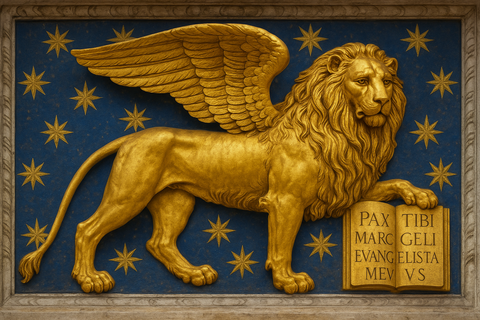
Likewise, since the Middle Ages, the lion has held a central place in European heraldry . Coats of arms, family emblems, and symbols of monarchies have adopted it as a representation of nobility, valor, and legitimate power. Standing, rampant, crowned, or winged, the heraldic lion makes no secret of its function: to show who has the courage to protect their land and its symbols. In this sense, the energy of Leo refers to the impulse to radiate who one is—authentically, without hiding—and to find an expression worthy of that inner vitality.
Regarding its polarity, Leo is a diurnal sign , also called yang or masculine in some traditional classifications. This means that its energy tends to project outward , unlike nocturnal or yin signs like Scorpio, Taurus, or Capricorn, which direct their energy inward.
With respect to its element and modality, Leo is classified as a fixed fire sign. Fire has been revered in various cultures for its transformative and purifying power. It symbolizes both destruction and renewal, acting as an agent that eliminates the old to make way for the new. In many traditions, fire is seen as a mediator between the human and the divine.
It's no coincidence that the word enthusiasm (a characteristic of fire signs) comes from the Greek enthousiasmós , which means "to be possessed by a god" ( en = within, theos = god). Enthusiasm isn't simply being animated: it's feeling something greater than oneself moving from within , a kind of divine spark that compels one to act.
The same goes for the word inspiration (another hallmark of the fire element), which comes from the Latin " inspirare ," "to breathe inward," as if an external force—spiritual, intangible—were entering the body and giving it dynamism. In other words, in astrology, fire represents precisely that: the spirit that drives, animates, ignites .
On the other hand, the fixed mode comes from the Latin fixus , which means "fixed," "established." Fixed signs represent the force that gives continuity to the processes initiated by cardinal signs . Fixed signs consolidate; and to do so, they need to resist change and focus on one thing at a time.
And finally, Leo is ruled by the Sun. In astrology, rulership indicates a direct affinity between the planet's energy and that of the sign. The Sun finds in Leo a kinship territory, where it can display its nature as a center, a source of light, and a creative impulse. In this context, solar consciousness is linked to the desire to radiate vitality, to the affirmation of the self, and to the need to project outward that which gives meaning to the inner life.
(We will go into more detail on these features later.)

The Glyph of Leo
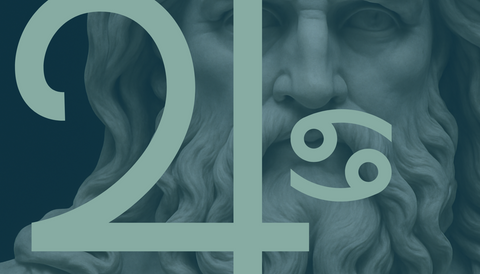
The Leo glyph (or symbol) comes from a stylization of the Greek letter lambda (Λ) , the initial of leon (λέων), meaning "lion." Its shape has been simplified over the centuries, but it retains the characteristic stroke reminiscent of the animal's mane and head .
Visually, it can be interpreted as a circle connected to an upward curve, which has been symbolically linked to the lion's mane fanning out to the side, or to the lion itself in motion. Unlike modern interpretations that associate it with the tail or the circulatory system, classical sources agree on its direct reference to the lion's body.
As we mentioned before, Leo is one of the signs most closely linked to solar imagery. The mane has also been interpreted as a visual metaphor for the sun's rays radiating from a center, in tune with the sign's solar rulership and its traditional association with vitality, courage, and individual expression.
From a symbolic perspective, the glyph then brings together three levels:
• the naming of the sign (through the initial Greek letter),
• the figure of the animal (the lion as an emblem of nobility and strength),
• and the solar function (the impulse to radiate and affirm life from the center).
Leo: Midsummer, the Harvest is on Display
In the agricultural cycle of the Northern Hemisphere—the symbolic origin of the zodiac we use in astrology—Leo marks the heart of summer . It's the phase that runs from the solstice to the equinox: the days remain long, the heat reaches its peak, and nature stops growing and begins to show off . As astrologer Cyril Fagan summarizes:
“Leo marks the solar zenith: nature no longer grows; it displays its abundance.”
During these weeks, seasonal crops such as wheat and barley ripen , and the fruits reach their peak sweetness. The energy is no longer one of gestation: it is one of irradiation.
This is also a period of solar festivities. In Celtic cultures, August 1 was celebrated as Lughnasadh , the first harvest, with grain offerings and fire rituals. In classical Athens, the heat of kaniklos —a term designating the period when the star Sirius rose alongside the Sun—was associated with offerings to Apollo to mitigate summer droughts ( Robert Hannah, 2005 ).
In present-day Croatian (and occasionally in medieval records from border areas of Serbia), the month of August is called kolovoz , a word derived from kolo ('wheel') and voziti ('carry' or 'transport'). Its literal meaning is 'the month of wheeling', and refers to the time of year when the roads are dry , the heat has stabilized the soil , and Harvests can be moved by cart without sinking. It's a word rooted in the August fairs that have been held since the Middle Ages in many parts of Europe: it indicates not only the harvest, but also the visible display of work already done : grains, animals, textiles. In that sense, the sunshine of August isn't just about temperature: it's about visibility, expression, public affirmation.
In nature, this period stabilizes and concentrates. Figs and grapes reach their peak sweetness; open flowers like sunflowers or lavender need no further development. The heat becomes constant.
In the African savannas, August coincides with one of the driest periods of the year . Lion prides gather around waterholes , and the males increase their surveillance of their territories, not to expand, but to maintain access to scarce resources. Unlike other animals that migrate in search of new lands, the lion protects what it has already integrated into its territory and stays there.

Characteristics of the Leonine Archetype
So, based on the characteristics of this part of the agricultural year, what traits define this energy in its purest form, before it becomes a personal experience? (Remember, we're not talking about people yet):
1. Centrality; concentration
Leo energy is not dispersed or distributed evenly: it tends to concentrate in one point and gather its vitality in a dense, visible and localized form.
2. Heat
Leo's energy acts through heat. In physical terms, heat is the result of the transfer of energy from a body of higher temperature to one of lower temperature. It is transmitted through contact, which implies proximity.
3. Permanence
This energy maintains a state achieved, without seeking further expansion or withdrawal.
4. Stationary energy
Leonine energy radiates intensely, but it doesn't move. It remains stationary while emitting (like the Sun, which remains in its center while generating constant heat and light).
5. Abundance; possible excess
It manifests itself at a point of maximum availability. Nothing is lacking: everything has reached its full form. But that same abundance, when it finds no limit or channel, can overwhelm.
6. Closeness
Leonine energy acts at close range. It doesn't operate from the abstract or the remote, but rather from direct contact.
7. No half measures
Its function is to bring things to consciousness. It needs what exists to feel alive, present, and defined. It doesn't express itself through ambiguities or intermediate nuances: it acts so that things can be clearly stated.
8. Irradiation
Leonine energy is transferred to the environment and modifies the energetic climate of your space.
9. Rituals and symbols
Leo's energy is expressed in visible forms. It is expressed through actions, gestures, or images that encapsulate a sense of identity. It needs to manifest itself in lasting symbols and rituals that make a difference.
10. Representation; sense of stage
It needs a frame to be seen in. It's activated when there's a space for it to be represented and displayed.
11. Self-reference; inner child
It tends to organize the world around its own experience. This mode of perception is similar to that of infancy: the young child cannot yet dissociate itself from its own perspective, so it interprets events from the center of its experience. Similarly, this energy is self-referential: it needs to verify its vitality through personal expression. Thus, the world is experienced as a stage where the "I" seeks to be reflected, understood, or affirmed.
How These Characteristics Are Expressed in People with Planets in Leo
When a person has planets in Leo, these archetypal qualities take shape in their life experience. However, the way they are integrated and expressed depends on many factors: the level of consciousness, internal work, and the rest of the birth chart . This is where free will comes into play, as Leo energy is not experienced uniformly. Each of its characteristics can manifest in constructive or challenging ways, depending on how it has been internalized and worked with.
1. Centrality; concentration
People with a strong leonine energy don't usually function well when they have to divide themselves among many things without a clear direction—they need to know their axis and act from there. On a psychological level, this centrality expresses itself as an identity that seeks to affirm itself from a solid core. Whether through the role they occupy, the talent they cultivate, or the narrative they construct about themselves, these people need a center from which to organize their experience.
When these people are balanced, they generate coherence: their actions have direction, their presence feels clear, and their commitment is undiluted. When they are not, they can become rigid and withdrawn, generating a logic where everything external must revolve around them. This can translate into difficulties registering and respecting the needs or rhythms of others.
2. Heat
They tend to be warm-hearted in their way of life and in their demeanor. There's something about their presence that conveys life, closeness, and enthusiasm. This warmth can be felt in their tone of voice, their laughter, and their willingness to respond to what's happening around them.
3. Permanence
They don't like change for the sake of change. They prefer to preserve what they feel reflects their vitality, their values, or their way of being in the world. They tend to protect what they consider their own: relationships, ideas, styles, customs. This can translate into enormous loyalty. They are people who, for the most part, remain steadfast with those they love, with their role models, and with their decisions.
In everyday life, this permanence can also be seen in aspects such as their way of dressing, speaking, or presenting themselves: when they like something or feel it represents them, they don't feel the need to change it. In its negative expression, this same permanence can become resistance to change. For example, they may become stuck in harmful relationships or environments, or they may not accept their age (because that would mean recognizing a loss of the vitality and power of previous stages).
4. Stationary energy
People with many planets in Leo tend to radiate warmth and vitality, but not in a hectic way. They are energetic, yes, but their energy remains stable, like a source that radiates without running out. Because of this, they are often perceived as calm. They are not usually the ones who take the first step quickly; they prefer to take their time before acting. And once they do, they persist thanks to their fixed mode.
In a completely literal sense, this energy can manifest as a certain resistance to physical movement: some people with a strong Leo presence simply don't like to exercise or move. Obviously, this can be a problem.
When this quality is expressed in a balanced way, it can be perceived as a natural dignity. The person doesn't need to constantly prove who they are: there is an inner conviction, a self-confidence that doesn't need external validation. But it can also turn into excessive comfort; a tendency to wait for things to change without changing anything.
5. Abundance; possible excess
People with well-integrated Leo energy tend to convey a sense of fulfillment. They can offer enthusiasm, presence, joy, and creativity. They have something to give (or rather, a lot to give; they can be a tremendously generous sign). And they enjoy giving it. Their energy—like the sun in August—is never lacking: it manifests itself fully, warmly, and luminously.
But if that same abundance isn't expressed generously, we move on to its negative expression, excess. A certain exaggeration then emerges: overacted emotions, unnecessary drama, a constant need for attention, excesses that don't respond to what's happening outside but to an internal imbalance.
6. Closeness
People with personal planets in Leo don't tend to operate from a distance or in the abstract. They engage with what's close—and that includes people, issues, or projects. That's why they often seek out settings where there's direct contact, where what they do has a perceptible impact. They often have difficulty connecting with things that feel cold, distant, or indifferent.
When this closeness becomes distorted, it can become demanding: the person needs to be the center of attention, to receive constant attention, to always have an emotional return for what they give. But at its best, this energy allows for the construction of living relationships, where contact is not taken for granted but is constantly renewed and protected.
7. No half measures
They don't tend to express themselves ambiguously. They often need what they do, feel, or think to be clearly expressed. This can result in a very sincere, direct, and emotionally honest attitude. There's something about these people that isn't afraid to show their affection or their position—even when it means exposing themselves. Therefore, when this energy is well-integrated, it can translate into sincerity, emotional openness, or even a certain nobility of character that doesn't hide their intentions.
But in its most disordered form, it can become ostentatious. Instead of affirmation, there is exaggeration and spectacle. There is a need to stand out that is no longer based on authenticity, but on excessive embellishment, on attracting attention even in bad taste.
8. Irradiation
People with a strong Leo energy don't tend to keep their feelings to themselves: they often express them. Their presence tends to change the emotional climate of a space, whether with enthusiasm, joy, or drama.
When well balanced, this radiance manifests as warmth, vitality, and a form of generosity that makes other people feel alive and special. But in its most negative expression, it can generate a form of "emotional selfishness," where people seek to make everything around them revolve around their own emotional state.
9. Rituals and symbols
They need to express what they consider important in a visible way: they seek a concrete manifestation that represents it. Therefore, they tend to create gestures, routines, objects, or moments charged with personal meaning (whether for themselves or their loved ones). They use external forms as a way to affirm who they are and/or what makes them feel alive.
In its mature form, this leads to respect for symbolic actions—from a meaningful birthday to a piece of clothing that represents something meaningful. But when this energy becomes disordered, it can become excessively rigid or formalistic: people cling to empty gestures or demand meaningless external forms, as if form alone could justify everything.
10. Representation; sense of stage
They are energized when they find a space to express themselves. They need a visible form to manifest their inner imagery and symbols. This doesn't imply frivolity, but rather an expressive logic: if something has meaning, it must be seen, celebrated, and affirmed within a framework. When this energy is expressed in an orderly manner, the need to reveal oneself is not egocentric, but communicative: the self becomes the channel for something that can inspire, organize, and mobilize. The person doesn't seek attention for the sake of existing, but because they have something to offer.
However, when this energy is distorted, the desire for visibility becomes an end in itself (most often to compensate for an internal insecurity). There is no contribution to share—only a need to be seen. This can manifest as constant theatricality, a demand for validation, or a purposeless pursuit of prominence.
11. Self-reference; inner child
They tend to organize reality around their own experiences. This self-reference isn't necessarily selfish: it can be a way of connecting from authenticity. It often manifests as spontaneity, emotional honesty, or the ability to be deeply passionate about what matters to them. As in childhood, when what they've experienced becomes a center of meaning, this energy gains strength when they can see their experience reflected in it.
But when this tendency becomes distorted, these individuals may invest their energy in constantly validating their own identity without opening up to other role models. A childish attitude toward frustration may emerge, or the belief that if something doesn't happen directly to them, it's not important. It can also manifest as difficulty absorbing criticism or tolerating when others don't respond as expected. The world becomes a mirror that must reflect an image consistent with who the individual believes themselves to be. If this doesn't happen, the reaction may be disproportionate, like that of a child who doesn't understand why they're no longer the center of attention.
Practical Examples: Pina Bausch and Dino De Laurentiis


Birth Chart of Pina Bausch, July 27, 1940, 6:45 AM, Solingen, Germany. Rodden Category: AA (birth certificate). Bottom image credit: Walter Vogel
Pina Bausch was born on July 27, 1940, in Solingen, Germany. She was one of the most influential figures in 20th-century dance, a choreographer, dancer, and director of the Tanztheater Wuppertal, where she developed a completely innovative stage language. Through the fusion of theater and dance, she broke with traditional narrative forms and redefined the body as an emotional and symbolic territory. Her work was recognized for its expressive power, its ability to move without words, and the way each gesture seemed to embody an entire universe. In her natal chart, we find a powerful stellium in Leo: Ascendant, Sun, Pluto, and Mars.
In her, leonine energy manifests itself not as stridency or outward exuberance, but as a contagious and vital expressiveness. Pina Bausch was a central presence in the world of contemporary dance , not only for her talent, but for her ability to gather around her a perfectly functioning artistic group, each member giving the best of their own talents and shining through them. For decades she worked with the same people , with whom she wove an affective and creative structure that reflects the loyal, constant, and protective dimension of the Leo sign. This permanence was deeply fertile: her works were nourished by shared time, by lasting bonds, by a trust forged rehearsal after rehearsal.
Her planets in Leo speak of an intense but restrained vitality. She didn't need to impose herself: her mere presence was enough to energize the stage . Everything revolved around her, not because she demanded it, but because she was the invisible axis of the stage experience.
Another typical characteristic of the leonine archetype we see in Bausch is her sense of ritual and representation. The scene, beyond aesthetics, took on a sacred character: the movements didn't illustrate emotions, they embodied them in an intense and concentrated manner. In this sense, her work is profoundly leonine: it speaks of the body as an altar, of the stage as a place of symbolic representation, of art as a way of affirming enthusiasm and the will to live.
We also find in it the affective dimension of the sign: Pina Bausch protected her dancers, listened to them, and built with them a space of expression where the personal was also collective. It wasn't just about creating works, but about creating community and closeness.
Finally, her life also reflects Leo's most authentic and unposed side: that need to express who one is, even when it means being vulnerable and imperfect. Pina Bausch turned pain and intimacy into an art form. She didn't seek to show her personal life, but rather to channel universal human experiences from an inner place. Her work wasn't an act of exhibition, but of revelation. In it, Leo's energy wasn't directed toward being seen out of vanity, but out of a need for truth.
Thus, Pina Bausch embodied leonine energy from a place of restraint, constant, and profound expressiveness. She didn't need to beg for attention to be heard, nor did she need to move for the dance world to revolve around her. Her art, like the sun in August, remains: warm, steady, indispensable.


Birth Chart of Dino de Laurentiis, 08/08/1919, 03:30, Torre Annunziata, Italy. Rodden Category: AA (birth certificate). Bottom image credit: Wireimage
Another clear exponent of Leo energy was Dino De Laurentiis. He was one of the most prolific and daring film producers of the 20th century , responsible for more than 500 films throughout his career, including classics such as La Strada , King Kong (1976), Dune (1984), Blue Velvet and Hannibal . His role was key to the expansion of Italian cinema throughout the world and to consolidating a new film industry in the United States, where he founded his own studios and left an indelible mark. In his natal chart we find an extraordinary stellium in Leo: Sun, Mercury, Jupiter, Saturn and Neptune.
In him, Leo's energy manifests as creative ambition, a sense of spectacle, and a determination to build symbolic empires. De Laurentiis didn't just produce films: he built worlds. His approach to cinema was neither austere nor restrained, but grandiose, daring, and deeply expressive. The Sun (creativity) in Leo, along with the planet of expansion (Jupiter), discipline (Saturn), and aesthetic and cinematic dreaming (Neptune), resulted in a cinematic oeuvre that has remained etched in the collective retina.
His Jupiter in Leo amplifies the need to create something visible, central, and majestic. But far from remaining merely spectacular, this energy was channeled through Saturn—also in Leo—into a body of work that not only dreamed big, but was structured and realized. Dino De Laurentiis was tireless. This blend of boundless imagination and iron discipline is one of the most characteristic hallmarks of his career, and a perfect reflection of the most positive side of Leo energy, in which majesty is not meant to attract attention but to channel something sublime, something that elevates the soul.
Mercury and Neptune in Leo, for their part, speak of an associative, symbolic mind, capable of conceiving fictions that intertwine human drama with fantasy. Many of his films have an epic tone, a resounding aesthetic, and a rhythm that doesn't escape the grand themes: good and evil, destruction, redemption, love, glory. His way of telling stories—although he wasn't a screenwriter or director—had a clear signature. He knew how to choose what kinds of stories needed to exist, and he also knew how to make them come true.
On the other hand, his name, like many people influenced by Leo, doesn't appear as a footnote: it appears in the title. In it, the sense of stage was literally translated into the construction of a solid, brilliant public identity that was difficult to ignore.
Finally, his legacy also speaks of permanence. His work spans generations; he managed to establish a standard, a style, a presence. His Leonine Sun never needed to move from the center. For decades, the world of cinema knew it revolved—even if only in part—around him.
Leo's Energy at the Collective Level
When Leo energy manifests in the collective, it expresses itself as a need to affirm identity and create a visible narrative that represents a group, a culture, or an era.
On the political and social level, Leo appears at times when societies seek charismatic leaders, figures who embody collective ideals and function as radiating centers of meaning. It's not simply about power, but about representation: in an ideal world, the Leo leader doesn't impose himself through force, but through his ability to be a symbol. This is why this type of energy is often associated with the emergence of figures who not only govern, but also embody a narrative—national, cultural, or historical—through their image. At its best, Leo organizes: it gives shape to the dispersed and turns it into a shared stage. At its worst, it concentrates everything in a single figure, stifling plurality (there are many dictators with planets in Leo, such as Benito Mussolini, Adolf Hitler, Nicolás Maduro, Vladimir Putin, Augusto Pinochet, and Napoleon Bonaparte).
On an economic level , leonine energy is linked to systems that value authorship, personal merit, and the ability to excel . It doesn't promote horizontal networks, but rather structures where everyone can occupy a visible—and, if possible, a central—place. It is observed in models where success is measured by exposure, personal branding, or the ability to stand out in a saturated market. In its healthiest expressions, this energy fosters productive creativity, self-affirmation, and the recognition of individual talent. But when it overflows, it can lead to forms of conspicuous consumption or a culture of vanity disguised as self-sufficiency.
In cultural terms, Leo promotes spectacle, the celebration of individual expression, and the production of shared symbols. It manifests itself in cycles where art occupies the center of public life, where aesthetics are not incidental, but the foundation of the collective narrative. Leo needs something to be represented, to have form, to be seen. That's why it promotes the creation of icons, rituals, and festivals . In its richest forms, this energy sustains identity pride, art as a life affirmation , and symbolic language as a way of radiating belonging. In its distorted form, it can promote superficiality or the cult of empty images.
Like all fixed signs, Leo doesn't seek change, but rather consolidation. That is, when there is a strong Leo presence in the astrological climate, its collective function is to affirm what already exists and make it recognizable . In that sense, its energy is essential for structuring identities.


Practical Example: Inauguration of La Scala in Milan (1778)
On August 3, 1778, with the Sun and Mercury in Leo, the most iconic theater in Italy and one of the most prestigious in the world was inaugurated: La Scala in Milan. That evening , L'Europa riconosciuta , an opera composed especially for the occasion by Antonio Salieri, was performed. The choice of the title was no coincidence: "Recognized Europe" not only alluded to an ancient myth but also offered a symbolic declaration of Milan's cultural ambition to place itself at the center of the European stage.
The opening of La Scala was a grand event. It arose as a symbolic and aesthetic necessity following the destruction of the old Teatro Regio Ducale in a fire two years earlier. The goal was not simply to replace a building, but to create a new center of cultural radiance , a temple of art that would not only host performances but also embody the city's very identity in terms of prestige, beauty, and symbolic authority. Here we clearly see the Leonine logic: affirmation of identity through visibility and aesthetic centrality .
The theater's architecture, designed by Giuseppe Piermarini (himself with Mercury in Leo in his natal chart), also responded to this solar spirit. Its interior was conceived to be grand, imposing, and hierarchical : arranged in boxes that not only allowed one to see the show, but also to view the rest of the audience. Each box was a small scene in itself. Furthermore, La Scala was not conceived as a space for mass artistic consumption, but as a stage where the elite could represent themselves while attending someone else's performance .
The night of its opening not only marked a cultural milestone, but also a political statement . In the middle of the 18th century, Milan was part of the Habsburg Empire, and La Scala functioned as a diplomatic instrument: a way to display refinement, stability, and brilliance. Clearly, the goal was to embody an idea of grandeur and permanence that persists to this day. It couldn't be more leonine.
Essential Dignities for Leo
Essential dignities in astrology are a system that determines the strength and quality of a planet's expression based on the sign it's in. Each planet has places where its energy manifests most easily and others where it faces more challenges. There are five main dignities: domicile , when a planet is in its ruling sign and operates completely naturally; exaltation , where its energy is enhanced and expressed in a heightened way; detriment , when it is in the sign opposite its domicile and its expression is weakened or outside its comfort zone; fall , when it is in the sign opposite its exaltation, which can hinder its manifestation; and terms and decans , which are minor dignities that modify the planet's influence in specific degrees of the sign (we will see these last ones in future blog posts). This system allows us to interpret how a planet functions in a natal chart based on its zodiacal position.

Sun at Home
When we say the Sun is domiciled in Leo, it means it's in the sign it naturally rules . This allows it to fully and directly perform its function. The Sun is the planet of vitality, the creative impulse, personal expression, and what we need to make conscious . In Leo, all of these functions operate strongly.
This position often translates into a defined and stable creative drive, a desire to excel in what one does , and abundant vital energy that is shared generously. Internally, this position fosters a strong will for coherence : betrayal of one's identity is unbearable. Therefore, crises can often arise when external factors prevent the expression of internal factors.

Saturn and Uranus in Detriment
When we say that Saturn and Uranus are in detriment in Leo, we mean that they are located in the opposite sign to the one they naturally rule. Saturn is the traditional ruler of Aquarius, while Uranus is its modern ruler . In Leo, both lose some of their functional logic: the former, associated with collective order, distance, and austerity; the latter, with disruptive change, depersonalization, and impersonal progress.
Leo is a sign that doesn't easily relinquish its centrality in favor of a system. Saturn can't easily impose its necessary coolness, humility, and service-mindedness , and Uranus encounters resistance to change when it threatens personal expression . Both planets have to operate in a realm that basically has nothing to do with what these two principles represent. Naturally, this creates tension.
In the case of Saturn, this position can make it difficult to internalize norms that don't arise from one's own judgment. External authority is questioned if it doesn't allow expression. Instead of disciplining, it can become insecure and authoritarian. If not integrated, Saturn in Leo can act as a strong internal censorship that inhibits authenticity and vitality out of fear of failure, ridicule, or loss of control.
Uranus , for its part, loses some of its transformative power when it must pass through the filter of personal pride. Uranian energy—which seeks to break patterns and open new paths— collides with the Leo's need for permanence and consistency . The result can be an irrational defense of one's own identity in the face of any innovation, or an empty rebellion that only seeks attention.
Even so, when these positions are worked on, they can give rise to very particular forms of leadership: Saturn in Leo can responsibly sustain a creative vocation , consistently constructing a body of work that transcends itself. And Uranus in Leo can express social change through symbolism , embodying new forms of identity or representation that mobilize those around them without losing their personal focus.

(Pluto in Exaltation)
This isn't a canonical assignment derived from traditional astrology, but many modern astrologers believe that Pluto finds its exaltation in Leo . This idea stems from a symbolic analogy: Pluto represents hidden power, profound transformation, and the processes of death and rebirth . Leo, on the other hand, is the sign of self-affirmation, vital expression , and the radiant center of identity. Although at first glance they may appear to be opposites—one is solar and external; the other, dark and subterranean— both operate on the axis of vitality and personal power .
In Leo, Pluto doesn't hide : it focuses its intensity on building a powerful identity, capable of regenerating itself again and again without losing its center. This position can be associated with people who channel their transformative force through an iron will , unwavering self-affirmation, and a need to leave an indelible mark on the world. Plutonian power here becomes charismatic, visible, and central .
In its most integrated form, this combination can produce figures capable of exerting creative power that modifies collective symbols and rituals , with enormous personal magnetism. In its most distorted form, it can lead to self-centered power plays, a will to dominate that requires constant recognition and brooks no loss of control .

Leo Mythology: The Nemean Lion
Leo is linked to the myth of Heracles' first labor, in which the hero must confront an invulnerable creature: the Nemean Lion. This animal was not simply a wild beast, but a primordial force of nature, born of chaos. Its hide was impervious to any weapon , and its presence disturbed the peace of the entire region. This lion represented a threshold: whoever wished to cross it had to do so with their whole body, without armor, without strategy. Only with willpower.
Heracles initially fails with his weapons. Then he realizes that the only way to defeat it is to throw himself headlong into combat. He strangles it with his bare hands, not out of fury, but from an inner strength that overcomes fear and insecurity in his own abilities . In doing so, he not only tames the beast but tames himself . This moment marks a transformation: by defeating the lion, Heracles does not seize power , but becomes worthy of bearing it. He uses the animal's skin as a protective cloak, but that cloak does not cover him: it reveals him . From then on, his strength no longer needs to be demonstrated. Authority is born from having faced the untameable—outside, but above all inside—and having incorporated it.
This is also how the leonine archetype works. There is no authenticity without proof, nor is brilliance worth anything if one has not first achieved self-sovereignty. The lion represents the instinctive power that only becomes an expression of nobility when consciously integrated. It's not enough to have strength: you have to know how to use it for something greater. And this is only possible when you have crossed the threshold that separates ego from character.
In the sky, the constellation Leo doesn't celebrate a victory over another. It celebrates the moment when someone stops seeking external approval because they've found internal direction . Heracles didn't need witnesses while he carried out this task. The myth of the Nemean lion teaches us that true dominance makes no noise.

The Ruby and the Golden Color
The stone associated with the sign of Leo is the ruby. Ruby is a variety of corundum —an extremely hard mineral—whose red color comes from small amounts of chromium . This crystalline structure gives it an extraordinary chromatic intensity : it's not just red, but an incandescent red that seems to contain an internal source of heat (remember that in Leo, everything is concentrated).
Since ancient times, the ruby has been considered a symbol of life, power, and vitality . In Vedic India, it was called ratnaraj —the king of precious stones—and was believed to protect the wearer from enemies and misfortunes. In medieval Europe, it was used as an amulet against poison, sadness, and lovesickness. Its fiery hue also made it the stone of royal blood, the heart, and great oaths—something not to be taken lightly.
Ruby refracts light with undeniable, stable, and striking intensity. In fact, many natural rubies (especially Burmese ones) exhibit intense red fluorescence under ultraviolet light.
On the other hand, the color gold isn't just a symbol of wealth or status. It's, in physical terms, the result of high reflectivity that returns light with warmth . Unlike white, which reflects light without modifying it, gold gives it a warm, sunny, affirming hue.
On a cultural level, gold has historically been reserved for the sacred, the imperial, the immutable. It's found in saints' halos, monarchs' thrones, and illuminated manuscripts. Its function is not simply to decorate, but to highlight: to mark what must be seen, what has its own place at the center of the stage.
Keywords Associated with Leo:
Italy - amber - almond trees - big cats (lions, cheetahs, lynxes, pumas, tigers, etc.) - arrogance - back and spine - betting and gamblers - chamomile - Berlin (Germany) - card games - castles - Chicago, Illinois - children - movie theaters - circuses - citrus trees - gold coins - creativity - crowns - deserts - dance halls - places of entertainment - fainting - extravagance - parenthood - Detroit, Michigan - fever - actors and actresses - fireplaces and hearths - France - gin and its makers - gambling - golden color - golf - governments and their representatives - fennel - honey - grandeur - heart and heart disease - sunflowers - heat - jewelry, jewels and jewelers - romantic affairs - sexual relations - Miami, Florida - monarchs - olive trees - ovens - parks and park rangers - parties - pleasure - romance - Rome (Italy) - rubies - saffron - sports and sports associations - stadiums - stages - Vatican City - thrones - stock markets.