Here we continue with the third part of this 12-post series exploring the energy of each zodiac sign, dedicated to Gemini . Beyond the popular astrology that associates the signs with personality, we'll delve into their most essential meaning: their archetypal nature, their symbols, their characteristics, and their manifestation in the human experience on a personal and collective level.
What is a Zodiac Sign?
Before talking about Gemini itself, it's important to clarify the following: when we talk about signs, most people assume we're referring to the personality of those whose Sun is in that sign. In reality, this is a huge simplification that leaves out many layers of valuable meaning for us.
First of all, a zodiac sign isn't a person or a personality type . It's a pattern of expression, a way a principle behaves . In astrology, principles are represented by planets, asteroids, angles, and any other points on the celestial sphere. Depending on the sign they fall under, their manifestation takes on a specific quality. And that quality is, in essence, an archetype.
What is an Archetype?
An archetype is an essential pattern, an image or energy that is repeated throughout history and in different cultures . They are primordial models that structure the way we experience reality. In astrology, each sign is an archetype with its own characteristics, an energetic quality that shapes the way any astrological principle is expressed.
When a planet is in a sign, the archetype of that sign acts through it . The sign doesn't change the essence of the planet, but it does determine its style of manifestation. For example, Saturn will behave very differently when it's in Taurus than when it's in Aquarius.
In other words, signs are the way in which a principle takes shape.
Archetypes are Multiple, Eternal and Inexhaustible
Archetypes are profound and sophisticated realities, with countless nuances and manifestations. They are not static or limited to a single form of expression ; on the contrary, their richness is so vast that no human being can fully embody the entirety of an archetype in a single lifetime. They are eternal forces that exist beyond our individual experience and express themselves through us in diverse ways according to our consciousness, evolution, and choices.
This is where free will comes into play: (at least consciously) we don't choose which archetypes are present in our birth chart, but we do choose how we experience them. Throughout life, our relationship with an archetype changes . Having a planet in Libra at age 8 isn't the same as having it at age 55. The energy is the same, but the way we understand and express it transforms with experience. We learn to modulate it, integrate it with greater awareness, and use it more constructively.
From this, it follows that all archetypes are neutral. The same sign can express itself instinctively, chaotically, or unconsciously, or it can be channeled with wisdom and purpose.
We'll return to the archetypes later. Now let's look at the basics of Gemini.

A Diurnal, Air, Mutable Sign, Ruled by Mercury
The name of the sign Gemini comes from the Latin gemini , meaning "twins." But long before that name, the image of twins was already part of the collective imagination of various cultures, symbolizing an irreconcilable yet complementary duality : light and shadow, earth and sky, life and death. Gemini's energy reflects the acute awareness that everything has its other side. In this sense, Gemini does not seek unity or synthesis: it embodies the living tension between opposites, expressed through internal dialogue, language, and movement.
It is also a sign of Air , the element that symbolizes the realm of ideas, abstract intelligence, logic, and communication . It is an invisible but indispensable element, like the bonds that connect us to others through words, signs, and signals. Air has no form of its own: it adapts to space and inhabits it without occupying it. Its essential quality is circulation. In astrology, this implies exchange, dialogue, and mental displacement . In air, there is no emotional density or material stability: rather, we find speed, variability, and continuous translation between codes. The air element needs to connect, because it only exists in interrelation.
The mutable modality adds another layer: these are the signs that mark the end of a season. In the case of Gemini, it announces the end of spring in the northern hemisphere. Mutable signs don't initiate or consolidate: they transition . They are zones of passage where previous forms no longer reach, but new ones are not yet fully defined. Hence their flexibility, their adaptability , and also their tendency to inhabit the edges. The mutable is always provisional. In this instability lies their power: mutable signs do not adhere to a single form because they understand that all form is momentary.
On the other hand, Gemini is ruled by Mercury . In astrology, rulership indicates a direct affinity between the planet's energy and that of the sign . That is, Mercury expresses itself naturally in Gemini.
(We will go into more detail on these features later.)

The Gemini Glyph
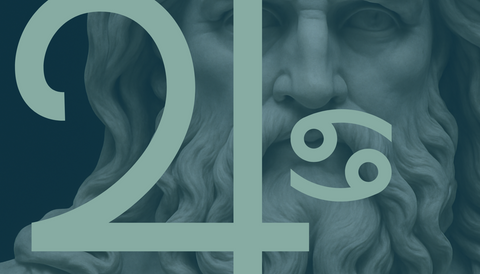
The Gemini glyph (or symbol) literally represents two vertical lines connected by two horizontal crossbars. This shape immediately brings to mind two columns supported by a common structure .
One of the most widespread interpretations of this glyph connects it with the pillars of knowledge . In many ancient traditions—including sacred and mystical architecture—the twin pillars represent the passage between the known and the unknown . In Solomon's Temple, for example, the pillars Jakin and Boaz marked the entrance to the sacred place , and only those who passed between them could access wisdom. The glyph, then, is both a structure and a door.
In addition to these symbolic pillars, the Gemini glyph can also be read as a form that suggests language and the structure of thought: the horizontal crossbars join the two columns like bridges , reminding us that the word unites worlds that seem unconnected.
On the other hand, the shape of the glyph also refers to all the parts of the body that exist in pairs: the lungs, the cerebral hemispheres, the hands, the arms.
Gemini: Spring Ends, Preparations for a Busy Summer
In the agricultural cycle of the northern hemisphere—the symbolic origin of the zodiac we use in astrology—the sign of Gemini corresponds to the final stretch of spring .
If we live in large cities, we may not realize it and associate this time of year with the excitement of the approaching holidays, but in the agricultural cycles—which still mark the pulse of the rural world—this is a time of intense transition . The splendor of spring is already behind us. The ground is covered with dead petals, the flowers have been fertilized, and the developing fruit is already beginning to appear in the treetops. The solstice is approaching: the peak of light arrives, and with it, the beginning of the most demanding tasks of the year. Everything must be ready for that moment.
In this sense, Gemini not only marks the end of spring, but also the preparation for a period of collective effort . Tasks pile up: tools must be checked, crops must be organized, information must be exchanged, resources must be negotiated, pests must be monitored, fences must be repaired, trades must be coordinated, and the weather must be monitored. In ancient and modern agriculture, this part of the year is marked by nervous but necessary activity , where every decision must be made quickly and in coordination with others. It is a time to plan ahead and anticipate, and especially in ancient times , survival depended on reaching summer with everything ready.
All of nature is aware of this nervousness and tension: bees extend their flight radius—almost double that of winter—to reach the last sources of nectar before the extreme heat ; the Etesian winds—present in the Aegean between May and September—begin to blow, facilitating pollination but accelerating evaporation and demanding precision in the organization of work. Birds begin to feed their young outside the nest. Life spreads out in various directions , adjusting to the coming weather.
Characteristics of the Geminian Archetype
So, based on its relationship with the agricultural cycle, what characteristics does Gemini energy typically have? (Remember, we're not talking about people yet):
1. Versatility
This energy adapts to the moment. It perceives opportunities in transit and acts without needing everything to be in place. It works best when it can improvise.
2. Ability to operate simultaneously
It doesn't follow a sequential logic. It operates in parallel, on several fronts at once, without hierarchy. It can observe, communicate, coordinate, and resolve issues without focusing on a single focus. It is designed to connect different systems.
3. Movement between thresholds
It inhabits passages. It works best when something is changing shape, direction, or environment. It's interested in what's moving, what's in contact, what can cross from one side to the other.
4. Curiosity
He constantly seeks to receive, process, and disseminate information. He isn't afraid to theorize.
5. Change as a structure
It doesn't respond to change: it's made to change. There's no fixed core. Gemini energy is organized as an open system, capable of reconfiguring itself without this representing a loss, but rather as part of its operating logic.
6. Lightness; air
He doesn't accumulate unnecessary weight. He prefers removable, mobile, and interchangeable items.
7. Dynamic rhythm
It moves at variable speeds, adjusting to its surroundings. It accelerates or slows down depending on the moment. It doesn't need urgency, but it doesn't stop when something changes either. Rhythm is a form of response: it's attentive to real time.
8. Exchange capacity
This energy sees intersections. It detects places where ideas, tasks, and resources can move.
9. Focus on the immediate future
He doesn't project into the long term. He sees what's about to happen soon, even if it's not yet obvious.
10. Improvisation; contextual resolution
It doesn't start from fixed structures. It builds solutions with what's available. It reorganizes in real time, without losing direction. Its logic is situational: context defines what works and what doesn't.
11. Ease of establishing connections
It doesn't always create something new, but it activates networks between things that already exist. It connects spaces, transmits information, links systems. It's more an agent of circulation than of origin.
12. Internal dialogue
Ideas are your raw material. You don't need to concretize them in the physical realm for them to have value: you can think them over, discuss them, modify them, or simply transport them. The important thing is that ideas communicate with each other, often without leaving the intangible realm.
How These Characteristics Are Expressed in People with Planets in Gemini
When a person has planets in Gemini, these archetypal qualities take shape in their life experience. However, the way they are integrated and expressed depends on many factors: the level of consciousness, internal work, and the rest of the natal chart . This is where free will comes into play, as Gemini energy is not experienced uniformly. Each of its characteristics can manifest in constructive or challenging ways, depending on how it has been internalized and worked with.
1. Versatility
They tend to have multiple skills, learn quickly, and respond differently depending on the context. They have no problem changing roles, adapting to new situations, or taking on different roles depending on what's needed. They function best when they're not pigeonholed. The downside if this energy is taken to the extreme? They're not really good at any particular skill, due to a lack of focus.
2. Ability to operate simultaneously
They naturally have multiple stimuli. They often work on several projects at once, jumping from one topic to another without losing the thread, and need some variety to stay active. Linearity bores them; their mind prefers to layer layers.
3. Movement between thresholds
They have a knack for conveying ideas, teaching, translating, or explaining things that others don't fully understand. They act as bridges: what they learn, they pass on. They can facilitate learning or change processes in others.
4. Curiosity; a very active mind
Gemini is the sign of internal dialogue (unlike the other two air signs: Libra, which is a dialogue between two people, and Aquarius, which is a collective dialogue). They're always asking questions, exploring, and comparing. Their attention is engaged almost constantly. They're interested in what they don't yet know, what could complete an idea, what someone else can contribute. This restlessness doesn't easily fade. The negative potential: too much mental noise and nervousness.
5. Change as a structure
Change doesn't usually scare them: they seek it, they need it. When everything is too still, they get bored or feel trapped. The difficulty can lie in persistence: they struggle to maintain a rhythm if the situation isn't changing.
6. Lightness; air
They avoid anything emotionally dense or complicated. They prefer relationships without major drama, spaces to breathe, and mental exchanges rather than things that are too complex. They tend to gravitate toward things that can be reasoned or discussed. If they take this to the extreme, they can disconnect from the basic emotional depth of any solid human bond; or end up dissociating themselves from their own emotions.
7. Dynamic rhythm
They are people who need to be doing something, especially mentally. They like to change activities, talk, read, write, and move. Boredom sets in when there's no succession of events. However, it's important to take time to pause.
8. Exchange capacity
They tend to understand very well how an exchange works. Sometimes this is evident in trade, other times in teamwork, and sometimes in their way of negotiating or coordinating. They aren't confined to one system: they know how to navigate between several.
9. Focus on the immediate future
They tend to be interested in what's happening now or what will happen in the near future. They find the long term vague or boring. If this trait is taken to the extreme, it can lead to an inability to plan.
10. Improvisation; contextual resolution
They don't get stuck if something changes suddenly. They're good at adapting what they have and solving quickly, even if it's not the perfect solution. In spaces that require a very fixed structure, they can feel out of place.
11. Ease of establishing connections
They can have a brilliant sense of humor, grasp references on the fly, or make unexpected connections between different topics. Their intelligence is agile, with surprising verbal and conceptual creativity. They are often sociable people, capable of conversing with very different types of people.
12. Love for ideas
They live thinking, comparing, and imagining possibilities. Their inner world can be filled with ideas, hypotheses, dialogues, and strategies. The downside of this trait is if they get stuck in that mental plane and fail to take action.
Practical Examples: Kylie Minogue and Phil Foden


Kylie Minogue's Birth Chart, 05/28/1968, 11:00 AM, Melbourne, Australia. Rodden Category: B (biography). Bottom image credit: Getty Images
Kylie Minogue was born on May 28, 1968, in Melbourne, Australia. A singer, actress, and producer, she is one of the most enduring icons of international pop. Her birth chart shows a very high concentration of Gemini energy: Sun, Moon, Mercury, Venus, and Mars in Gemini . This configuration reveals an identity built on flexibility, a mobile intelligence, and the ability to mutate without losing focus. Everything about her—from her voice to her career choices—expresses the logic of this air sign.
Throughout her career, versatility has been a constant. Kylie began as an actress on Australian television and, at just twenty years old, moved into the world of music, where she has managed to reinvent herself with each decade . Since her beginnings in bubblegum pop, she has traversed styles as diverse as dance, synthpop, techno, and even country-disco, without these changes disconnecting her from her personal signature. This fluid transition between forms and genres —which somehow always feel natural and unforced—reveals an energy that adapts to her environment without conflict. As she changes and evolves, she detects opportunities for expression in her artistic career.
Another clear trait of her Gemini stellium is her inexhaustible curiosity. Minogue has always sought to surround herself with new producers, different sounds, and changing influences . She isn't afraid to explore unsafe territory. Her album , Impossible Princess (1997), one of the most daring of her career, marked an alternative turn when many expected more commercial formulas. And more recently, during the pandemic, she released Disco , an album that responded to a specific need: to offer lightness, color, and movement in a time of confinement. This is another of her Gemini characteristics: a focus on the immediate future. She doesn't plan twenty-year careers. She observes what the environment needs now and acts accordingly.
Even her vocal style reflects the lightness so characteristic of the sign: a light, almost whispered voice, with high, soft tones that float over the rhythmic base. Of course, Kylie Minogue doesn't seek to overpower her music with its dramatic quality. Her strength lies in rhythm, in flow, in the ability to move energy without holding it back.
Throughout her artistic life, Minogue has vividly embodied what it means to have so many personal planets in Gemini: to live in versatility, to adapt quickly, to process diverse information, to connect distant points . Her career isn't a straight line, nor an upward curve. It's a network. What unites all her changes isn't a fixed image, but a dynamic principle: the desire to keep connecting.


Phil Foden's Birth Chart, 28/05/2000, Stockport, England. Rodden X Category: No birth time. Bottom image credit: Manchester City FC.
This same Gemini energy is also present in the quintessential Gemini sport: soccer . While many midfielders have planets in Gemini, Phil Foden has a larger stellium than other players. Born on May 28, 2000, in Stockport, England, he currently plays for Manchester City and the English national team. His natal chart includes the Sun, Venus, Mars, and Mercury in Gemini.
The versatility of Gemini's energy is evident in his career: he has played as a winger, attacking midfielder, midfielder, and even a false nine (according to scouting analysis, he ranks above the 90th percentile in offensive metrics from multiple positions). He doesn't often find himself struggling to change roles depending on the team's needs. His ability to operate on different fronts—finishing, assisting, tracking back, creating play—a clear reflection of what it means to have a Gemini stellium: a quick mind, multiple technical resources, and enormous tactical flexibility.
The first thing that stands out about his playing style is his "light" and airy pace, so to speak. He doesn't need to run all the time to be decisive; he accelerates or slows down depending on the play, and that makes him completely unpredictable. Furthermore, his possessions are brief (less than 2 seconds per touch on average). He receives, turns, passes, or faces in seconds, resolving the immediate situation efficiently.
He also stands out for his improvisation . If a play breaks down, he doesn't even flinch: he finds another. This ability to react—mental and physical—allows him to adapt even when the opponent changes their scheme . Rather than limiting him, the context is what stimulates him and brings out that stellium in Gemini. This is most clearly visible at City.
In the English national team, his Gemini energy is expressed in different ways. Unlike at Manchester City, where the entire system emphasizes his mobility, in England he tends to play in more rigid environments. However, even there, Foden manages to adapt. He switches flanks, fills open spaces, and connects lines. It's clear that his role isn't about protagonism, but his presence commands command. In several important matches, he has been decisive, being the cog that keeps the game moving.
Thus, everything about Phil Foden reminds us of the Gemini glyph—two columns open like a door. It doesn't represent a destination, but rather a passage. Its impact lies in the number of times something was able to continue thanks to it.
The Energy of Gemini at the Collective Level
When Gemini energy manifests on a collective level, it manifests itself in periods of transition, reorganization, and intense circulation of information . These are not stable moments, but rather phases where the established world begins to lose shape, and it becomes necessary to quickly adapt to new conditions.
In the political and social sphere, Gemini appears in scenarios where the speed of events demands agile responses. It is the energy of multiple changes, of coordination between sectors, of the need to communicate, translate, and connect diverse parts of a society. It can be seen in moments where traditional systems are no longer sufficient and alternative collaboration networks are activated: assemblies, platforms, media, multiple spokespersons. It also occurs in contexts where information becomes a central resource and where the mode of circulation of ideas defines the course of events.
Economically, Gemini energy is linked to trade, intermediation, logistics , and the agile exchange of goods and services. It represents mobile, lightweight, and adaptable economies that operate in real time. It is associated with diversification, microproduction, informal markets, and the alternative circuits that emerge when large structures slow down or collapse . In this sense, Gemini manifests itself in forms of work that do not seek rootedness or durability, but rather functionality and versatility.
In the cultural sphere, Gemini expresses itself in the multiplicity of voices, styles, and languages. This can be seen in the proliferation of media, the fragmentation of the dominant narrative , and the circulation of previously marginalized knowledge. It can also be seen in the rise of social media, digital media, translation between fields, and the rapid redefinition of symbols . Gemini does not seek to impose a single meaning, but rather to open the field of possibility through contrast.
On a global level, Gemini energy can be reflected in periods where information chaos, data overload, or overconnection generate both new possibilities and collective confusion . It can lead to rapid advances in science, technology, and communication methods, but also to crises of confidence, polarization , or the collapse of systems of reference. It's an energy that doesn't stabilize: it accelerates, decentralizes, and redistributes .
Like all mutable energies, Gemini doesn't come to consolidate, but rather to facilitate the passage. Its collective function isn't to provide definitive answers, but rather to keep the channels open while the world moves on.

Practical Example: Inauguration of the Panama Canal (1914)
On August 15, 1914, the Panama Canal, one of the most ambitious engineering feats of the 20th century, was officially opened. Connecting the Atlantic Ocean with the Pacific Ocean, this waterway redefined global trade, shortening routes, redistributing naval power, and completely transforming relations between continents. It was not just a physical canal, but a radical reorganization of global connections .
That day, Saturn was at 29° of Gemini (an anaretic degree and therefore very strong), along with the Moon also in Gemini . That is to say, a tremendously Gemini astrological climate that reflects the very core of what this monumental work represents: a structure (Saturn) dedicated to connecting (Gemini), communicating territories, and bridging distances . Saturn in the last degree of the sign isn't initiating the logic of connection: it's consolidating it, formalizing it, closing a cycle of communication engineering that had been brewing for decades.
Gemini is the sign of bridges, canals, crossings, and networks . All for the purpose of enabling transit, exchange, and the circulation of information and goods . The Panama Canal is a literal embodiment of that logic: it doesn't produce or store anything, but it allows everything else to move . It's the node that connects extremes, and therefore a profoundly Gemini infrastructure .
The presence of the Moon in Gemini reinforces this reading: it indicates that the collective emotional landscape of that day (the Moon as a reflection of social sentiment) was attuned to the idea of openness, mobility, agility, and connectivity. It was a time of high expectation and also of transition, with the world entering the First World War and the global map undergoing a complete reconfiguration. The Moon in Gemini registers the event as a shift in common sense : the world was becoming more interconnected, faster, and more technical.
Saturn's function was to give the canal shape, control, boundaries, and permanence . It's no coincidence that it was a complex infrastructure, with locks, levels, and floodgates: an entire system of traffic modulation , faithful to the spirit of Saturn.
Essential Dignities for Gemini
Essential dignities in astrology are a system that determines the strength and quality of a planet's expression based on the sign it's in. Each planet has places where its energy manifests most easily and others where it faces more challenges. There are five main dignities: domicile , when a planet is in its ruling sign and operates completely naturally; exaltation , where its energy is enhanced and expressed in a heightened way; detriment , when it is in the sign opposite its domicile and its expression is weakened or outside its comfort zone; fall , when it is in the sign opposite its exaltation, which can hinder its manifestation; and terms and decans , which are minor dignities that modify the planet's influence in specific degrees of the sign (we will see these last ones in future blog posts). This system allows us to interpret how a planet functions in a natal chart based on its zodiacal position.
In the case of Gemini, we only have domicile and detriment.

Mercury in Domicile
When we say that Mercury is in its diurnal domicile in Gemini, it means it's in one of the two signs it rules. This allows it to express its function freely, precisely, and quickly . Mercury is the planet of communication, perception, language, and thought. In Gemini, all these functions operate in their most agile register: that of information exchange .
This position favors an intelligence oriented toward connecting rather than concluding . It's interested in building bridges between ideas, between people, between planes of reality , and to do so it uses all kinds of codes, associations, word games, and mental shifts. It moves fluidly between opposites, gathering information from different sources, cross-referencing it, and reformulating it. Its power lies in the speed with which it detects patterns, changes register, and adapts its language to the environment. In Gemini, Mercury is the messenger par excellence.
In terms of essential qualities, Mercury in Gemini has full command of its astrological function: it is quick, versatile, lucid, and adaptable . It favors the ability to learn, to communicate, to interpret signals, to play with language without getting caught up in it. It can translate what happens from one plane to another without losing meaning. Its presence is often marked by a lively lightness , perceptive acuity, and a remarkable ability to be mentally in several places at once.

Jupiter in Detriment
Jupiter is in detriment in Gemini. This doesn't mean it's malfunctioning, but rather that it finds itself in a territory whose logic isn't natural to it . Jupiter represents the expansion of knowledge, the search for meaning, and the construction of a unifying worldview. Its impulse tends toward the broad, toward connecting all the pieces into a single coherent narrative. Gemini, on the other hand, works with fragments: loose data, multiple questions, partial versions. It doesn't seek a grand answer, but rather to explore all possibilities.
Therefore, in Gemini, Jupiter cannot unfold as it would in Sagittarius or Pisces. Instead of moving from broad convictions, it finds itself immersed in a terrain where everything can be questioned, compared, and relativized . Here, Jupiter's function must adapt to a logic of diversity, crossover, and constant exchange. This can be uncomfortable for a planet that normally operates on the basis of certainties.
Jupiter in Gemini often displays a wide range of interests, but may struggle to synthesize . Faith becomes more rational than intuitive, more verbal than philosophical. Instead of a single, broad belief, there may be a variety of opinions that change depending on the context. The worldview becomes mobile, flexible, and often ironic. What is gained in mental agility can be lost in direction.
However, this position also allows for the translation of complex ideas into accessible language . Jupiter in Gemini doesn't pontificate, it explains. Therefore, even in detriment, Jupiter in Gemini can become a lucid voice in contexts where absolute certainty has lost its force, and what matters is knowing how to navigate between nuances.

Gemini Mythology: Castor and Pollux
The sign of Gemini is associated with the myth of the Dioscuri , a word that literally means "sons of Zeus" in Greek. This was the name given to Castor and Pollux, the twin brothers who, according to Greek tradition, were worshipped as tutelary heroes in Sparta and later venerated in many other regions of the ancient world. They were considered protectors of voyages , difficult passages, battles, and, above all, the sea: their appearance in the night sky indicated to sailors that there was a possible course even in the midst of a storm. But beyond its cultic function, the myth of the Dioscuri encapsulates the bond between two halves that never quite unite, and whose relationship becomes a symbol of a split but functional consciousness.
Castor and Pollux are born to the same mother, Leda. But while Pollux is the son of Zeus—who joins Leda transformed into a swan—and therefore immortal, Castor is the son of Tyndareus, king of Sparta, and bears a mortal destiny . They share body, blood, and childhood, but not their end. They fight together, grow together, recognize each other as one, until death separates them: Castor falls in battle. Pollux, unable to tolerate the separation, begs Zeus to allow him to share his immortality with his brother. He doesn't ask for resurrection: he asks not to have to live without him. The agreement he receives is not an eternal fusion, but an alternation: both will spend one day on Olympus and one day in Hades (here we see very clearly the symbolism of displacement and transition). Together, but not at the same time. United, but without wholeness. It is from this pact that Zeus raises them to the sky as the constellation of Gemini: two twin stars that never touch, but shine side by side.
Thus, Gemini doesn't represent the fusion of opposites, but rather the awareness that between two distinct poles, there can be a relationship without the need for dissolution . One of the twins is immortal; the other isn't. One looks toward the sky, the other remains tied to the earth. Gemini operates in that intermediate space, where diversity connects without losing its identity.
In nautical tradition, it was believed that when two lights appeared on the masts of a ship in the midst of a storm—the phenomenon known as St. Elmo's Fire —they were the Dioscuri accompanying the voyage to mark the possible path through the water.

Citrine and the Color Yellow
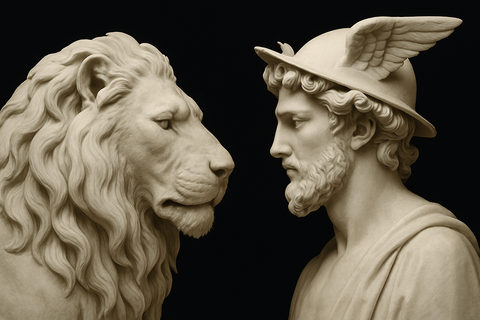
Citrine —a variety of quartz colored by ferric iron—is the stone associated with Gemini. Its yellow color activates the area of the thalamus responsible for filtering visual light, promoting clear attention without saturation or blackouts. In many cultures, it was recognized for this quality: in temples dedicated to Hermes (the Greek equivalent of Mercury) , citrines were placed in oculi to protect against glare without blurring vision.
Beyond symbolism, there are actual records that underline its functional use. In ancient Mesopotamia, golden citrine-like stones were carved for commercial seals used during the June solstice, a time when clarity was essential for precise transactions . The term "honey stone" appears on Assyrian tablets, associating it with that time of year when the light is clear and exchange must be precise.
In Imperial Rome, citrine wasn't used as decoration for vanity: it was used in weights and counterweights for public scales. Pliny the Elder mentions it as a "guarantor of equity in exchange," a use that fully reflects the Gemini logic: clarity, communication, and fairness in the process of measuring and trading. .
Mineralogyically, citrine is a highly sensitive pyroelectric and piezoelectric material . When rubbed or pressed, it generates an electrical charge (up to tens of thousands of volts in some cases), a latent tension comparable to that of a sky that ripples before a summer storm: ready to activate at just the right moment, like the Gemini intelligence that nervously watches before change, ready to act.
On the other hand, yellow is the color of Gemini because it is associated with mental light, perceptual agility and the ability to distinguish between nuances. In the visible spectrum, yellow occupies a range between 570 and 590 nanometers , located between stabilizing green and stimulating orange . Its wavelength makes it the most visible color to the human eye in natural light conditions, which is why many warning or emergency signals are printed in this shade: it is immediately captured by the retina. In chromotherapy, it is used to activate mental processes , stimulate concentration , improve mood and reinforce intellectual clarity . It does not induce introspection or rest, but rather dynamic attention : awakening without exhausting.
Culturally, yellow has been a symbol of both wisdom and ambiguity . In many Eastern traditions, it is associated with intelligence and spiritual power. In Buddhist iconography, for example, it is one of the colors of monks' robes, associated with emptiness and discernment. In the West, however, it has oscillated between light and suspicion: it was the color of intellect in alchemy, but was also used to mark those who "deviated" from the social order. This double symbolic charge speaks to the Gemini nature of language : it can clarify or confuse, liberate or betray, depending on how it is used.
Even in contemporary contexts, yellow retains its signaling function: traffic lights, warning signs, and product packaging that aim to immediately attract attention. It stimulates, focuses, and accelerates mental processes.
Keywords Associated with Gemini:
Armenia - arms - mail - cars - Belgium - bicycles - books, bookstores and libraries - breathing - briefcases - brothers and sisters - bronchi - taxis - buses - Eastern Canada - clerks and administrators - clavicles - Colombia - media - computers - contracts - neighboring countries - cousins - desks - nervous diseases - dualities - editors - primary and secondary education - mechanical engineers - forms - gas stations - gossip - hands - intellect - short trips - speeches - letters - literature - linguists - Lombardy (Italy) - London - Melbourne - lungs - messengers and couriers - nervous system - news and newspapers - offices - pillars - journalism - printing presses - railroads - San Francisco (California) - telephones - the stock market - secretaries - relatives in general - writers.