Astrology is a discipline with thousands of years of development, observation, and constant research. Over the centuries, different cultures have accurately recorded the movements of the sky to understand the rhythms of life on Earth. Many of these discoveries are still used today, and among them stands out one invaluable discovery: the Metonic cycle , the great synchronicity between the Sun and the Moon that repeats itself every 19 years.
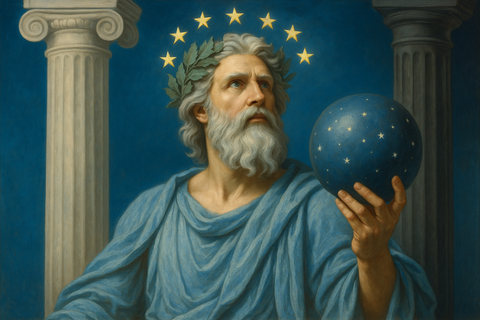
The Metonic cycle is named after Meton of Athens , a Greek astronomer and mathematician who in the 5th century BC made one of the most precise observations of his time. He discovered that after 19 solar years , the phases of the Moon returned to repeat themselves on practically the same date and in the same degree of the zodiac.
In numbers, this means that 235 synodic months (the time it takes for the Moon to repeat a phase) are almost exactly equivalent to 19 solar years. The difference is minimal—only a few hours—imperceptible in the daily lives of the ancients. With this, Meton provided a key that allowed the solar and lunar rhythms to be united in a single mechanism.
The Astronomical Basis of the Cycle
A solar calendar keeps dates in sync with the movement of the Sun. For example, June 21 corresponds to the summer solstice in the Northern Hemisphere, when the Sun reaches its highest point in the sky. This cycle lasts 365 and a quarter days , hence the need to add an extra day every four years (leap years).
A lunar calendar , on the other hand, is adjusted to the phases of the Moon. The 1st may coincide with the New Moon, the 8th with the first quarter, and the 15th with the Full Moon. Different traditions—such as Jewish, Muslim, Chinese, and Buddhist—were organized around this type of calendar.
The problem is that the lunar month doesn't fit with the solar year. To understand this, we must distinguish between two types of months:
• Synodic month : lasts 29.53 days and is the time it takes for the Moon to repeat a phase.
• Tropical month : lasts 27.32 days and is the time it takes for the Moon to return to the same point in the sky in relation to the constellations.
A solar year contains 12 synodic months and 13 tropical months, creating a continuous phase shift . The Metonic cycle shows how this difference is corrected over a longer period: after 19 solar years, the calculations again coincide fairly exactly, synchronizing the solar calendar with the lunar calendar.

The Context of Discovery
Meton presented this discovery around 432 BC, during the height of Athens' splendor. Calendars were a central issue: religious festivals, agricultural cycles, and the city's administration depended on them. His discovery was so influential that it was inscribed on the Pnyx, the meeting place of the Athenian assembly, so that everyone could see it.
Thus, the Metonic cycle allowed the Greeks to precisely adjust the lunisolar calendar. Until then, the discrepancy between the solar year and the lunar months meant that extra months had to be added irregularly. With the 19-year cycle, the rule was established to insert seven additional months into that period, maintaining the correspondence between the seasons and the phases of the moon.
The Embolic Years
The offset between the solar year and the lunar months is about 11 days per year . After three years, the lunar calendar is already more than a month behind the solar calendar. To correct this, cultures that used lunisolar calendars added an extra month every so often.
That year with an additional month is called an embolismal year .
• An ordinary lunar year has 12 lunar months (354 days).
• An embolismal year has 13 lunar months (about 383 days).
Meton's discovery was to show that, in a cycle of 19 solar years , exactly 7 embolismal years had to be introduced to keep the calendar in synchrony with the seasons.
The distribution was not random: in the classical cycle, the embolismal years were placed in the years 3, 6, 8, 11, 14, 17, and 19 of the cycle. This ensured that, at the end of the 19 years, the lunar and solar calendars again coincided almost at the same point.
Embolismal years are still used today, but no longer in the international civil calendar (or Gregorian, which is solar) but in lunisolar calendars that are still in use, such as the Hebrew, Chinese, and Buddhist.
The influence of the Metonic cycle extended far beyond Athens. The Babylonians had already worked with similar cycles, and after the discovery of Meton, its use was consolidated in various Mediterranean calendars. The Hebrew calendar adopted it to regulate religious festivals, ensuring that celebrations such as Passover always coincided with spring. Later, the Christian calendar also used the Metonic cycle: it was the basis for calculating the date of the Christian Easter , which depends on the first full moon after the vernal equinox.
The Ecclesiastical New and Full Moons
In Christian tradition, the Church adopted the Metonic cycle to calculate the date of Easter. However, since direct observation of the sky in each location was not possible (cloudy conditions, different time zones, etc.), the so-called "ecclesiastical New Moons" were created.
What are they?
• They are not actual astronomical New Moons, but dates tabulated from the Metonic cycle.
• They were used to predict uniformly throughout the Christian world on which day the “ecclesiastical” Full Moon following the vernal equinox would fall.
• That Full Moon, in turn, served to set the date of Easter: the Sunday after that ecclesiastical Full Moon.
In short: the Ecclesiastical New Moons are a symbolic calendar, based on tables derived from the Metonic cycle, which the Church used to have a standardized calculation of the lunar phases, even though they did not exactly coincide with the actual phases observed in the sky.
In short, Meton's discovery united astronomy, religion and everyday life in a single measure of time (which was truly revolutionary).
The Astrological Dimension of the Metonic Cycle
Now we turn to pure astrology. In it, we use the Metonic cycle to understand deeply personal processes. If we think about it, we are all born in a specific lunar phase : the relationship between the Sun and the Moon at the moment of our birth sets a pattern that accompanies us throughout our lives. This pattern can involve different signs and sometimes an aspect between the two luminaries (not all natal charts have the Moon and Sun making an aspect to each other), but whatever the case, there is always a natal lunar phase.
Every 19 years, the Metonic cycle reactivates this same phase when the Sun and Moon return to the (almost exact) position in which we have them in our natal chart, returning us to the themes linked to the natal position of the Sun and Moon and what both planets symbolize in our chart. In practice, this Metonic cycle is clearly observed in the Solar Revolution and in the Lunar Revolution that occurs simultaneously with this first one (in them the Sun and Moon will appear). the same lunar phase they had in our natal chart). This brings us back to the themes associated with those two luminaries: the way we project our vitality (Sun) and how we process our emotions and instincts (Moon).
Why Do We Say “Almost Exact”?
The Metonic cycle isn't a perfect mathematical coincidence, but rather an extraordinarily precise approximation. The key is in the numbers:
• A synodic month (from phase to phase) lasts 29.5306 days .
• In 235 synodic months, 6939.688 days pass.
• In 19 solar years, 6939.602 days pass.
The difference between the two calculations is 0.086 days , or just over 2 hours .
This small time lag accumulates, and that is why in most cases, during a Solar Revolution or a Lunar Revolution associated with the Metonic cycle, the Sun and the Moon are not exactly at the same degree and minute as in the natal chart, but with a slight variation (as we will see later in the practical examples).
The Mathematics Behind the Gap
It's important to keep in mind that the Metonic cycle isn't a perfect mathematical coincidence, but rather an extremely precise approximation. Calculating average values, we found that the difference between 235 synodic months (6,939.688 days) and 19 solar years (6,939.602 days) is just 0.086 days, or a little over 2 hours.
However, in practice, the discrepancy is usually greater. This occurs because neither the synodic month nor the solar year always have the same length: the lunar orbit varies between 29.26 and 29.80 days, and the solar year also exhibits slight oscillations. These irregularities mean that, when observing specific Metonic solar and lunar revolutions, the Sun and Moon do not coincide exactly at the same natal degree and minute, but rather appear with wider differences.
Even so, the closeness remains notable: what returns is not a rigid mathematical point, but the natal lunar phase in its profound dynamics. And that pattern, although it appears with slight variations in sign or degree, is strongly reactivated in the person's life every 19 years.

What the Metonic Cycle Looks Like in the Solar Revolution
Each year, the Solar Return marks the return of the Sun to its natal position and opens a new annual cycle. However, every 19 years the Moon also returns almost exactly to its natal position , faithfully reproducing the original relationship between the Sun and Moon at birth (Metonian Solar Return).
The Metonic solar revolutions occur at ages 19, 38, 57, and 76. These years often feel like turning points : deep dynamics of creativity, vitality, and instinct are reactivated, and decisions made during this period often have a lasting impact.

...And in the Lunar Revolution
Lunar revolutions are calculated based on the synodic month (29.53 days), because what repeats itself is the phase of the Moon in relation to the Sun, not just its position relative to the stars. Throughout the year, we have many lunar revolutions, each marking the emotional climate of a month.
Now, every 19 years, simultaneously with the Metonic Solar Revolution, a Metonic Lunar Revolution also occurs. At that moment, the Moon returns to its natal degree and, at the same time, reproduces the original phase it had with the Sun at birth. This Lunar Revolution lasts just one synodic month, but it strongly concentrates the beginning of the new Metonic cycle: emotions, internal reactions, and experiences in the immediate environment are activated, serving as very clear signals of the internal process that is beginning.
We could say that the Metonic Solar Revolution opens the a full year under the imprint of the cycle, while the Metonic Lunar Revolution is like the initial peak , the condensation of the internal impact that will then unfold in the following months. It is a month in which the body, emotions, instinct, and sense of security intensely display the tone of the transition that marks the new 19-year cycle.
Practical Examples: Metonic Cycles in Two Different Natal Charts
Example 1: Sun at 22°01' Aquarius and Moon at 29°09' Scorpio

In the first natal chart we're going to use as an example, the person has the Sun at 22°01' of Aquarius and the Moon at 29°09' of Scorpio . Every time the Sun returns to that exact degree, its Solar Return will occur, and every time the Moon returns to its natal degree, its Lunar Return will occur.
In the three charts below, we see three different Metonic solar revolutions for this same person. In this case, since the Moon is in the last degree of Scorpio, the Metonic solar revolutions do not have the Moon in Scorpio. Due to the time lag explained above, some of them will have the Moon in Scorpio, but in others it will appear in Sagittarius , the next sign. This is clearly seen in the three examples below, where the Moon appears in different degrees of Sagittarius. However, this does not alter the cycle's significance: even if the Moon does not fall in the same degree (or sign) as the natal chart, the proximity is sufficient, and the revolution continues to function fully as Metonic.


In this case, we observe in the image below that the Moon is located at its exact natal degree, 29°09' of Scorpio, while the Sun is at 21°29' of Aquarius. In other words, the Metonic Solar Revolution has not yet occurred, but is about to occur in a few hours. Although both occur almost simultaneously, the two types of revolutions provide different clues: the Lunar Revolution, although lasting only a month, provides precise signals about the beginning of the Metonic cycle—small events, everyday situations, synchronicities that act as indicators of the central theme—while the Metonic Solar Revolution concentrates that same pattern in the vital and creative impulse of an entire year.

Example 2: Sun at 29°23' Libra and Moon at 25°15' Capricorn

In the second birth chart we analyzed, the person has the Sun at 29°23' of Libra and the Moon at 25°15' of Capricorn . Therefore, every time the Sun returns to that point, its Solar Revolution, and every time the Moon returns to its natal position its Lunar Revolution will occur.
In the four images below, we see four Metonic Solar Returns for this natal chart, in which the Moon changes signs: three times it appears in Aquarius , the sign following Capricorn, and then in the last one it returns to Capricorn. This again shows the same phase shift as in the previous example.


Finally, looking at a Metonic Lunar Revolution in this example, we see that the Sun is at 28° of Libra , which means it occurs one day before the Solar Revolution. In this type of configuration , the Sun can even change signs : in this person's case, the Metonic Lunar Revolution can have the Sun in the last degrees of Libra or in the first degree of Scorpio. This only happens in people born with the Sun at the extremes of a sign (end or beginning), because in other cases, as the Sun moves more slowly, this sign change does not occur in the Metonic Lunar Revolution.

Meaning of the Different Metonic Cycles
While each Metonic cycle will have a unique meaning for each person depending on their natal lunar phase and the signs in which the Sun and Moon are located in their chart, the 19-year time structure is consistent. That said, we can observe how these cycles manifest in general terms:
19 years old : This is the first Metonic return and marks the transition to adulthood. Vitality is at its peak, and we feel a strong urge to assert ourselves, to express who we are in the world, and to discover how to sustain ourselves materially and emotionally outside the family sphere. This is also the stage in which the first significant emotional experiences arise, where we often repeat—consciously or unconsciously—the relationship model we saw in our parents: the dynamic between the Sun and Moon in our natal chart is usually clearly evident during this period. Here appear both the patterns we continue to replicate and those we begin to question so as not to repeat them. It is a cycle of intense exploration: we test our autonomy, build bonds, and make decisions that mark the beginning of our adult life.
38 years old : The second cycle brings an inevitable point of comparison with what we imagined at 19. Tensions arise between the projects we dreamed of and what we actually built. Here we review whether we're continuing on our own path or letting ourselves be dragged along by inertia. The body also emerges strongly: it no longer responds the same way and demands adjustments. It's a cycle of redefinition, of organizing what we feel and what we show to the outside world.
57 years old : This cycle is often experienced as a clear turning point. The body begins to show hormonal and energetic changes that force us to adjust habits, and new questions arise about how to take care of ourselves and how to manage our energy. It's a cycle of taking stock and letting go of the superfluous, in which creativity is redirected toward the essential. Psychologically, it's common to review what we've built: jobs, relationships, projects that continue, and others that are closing. The need arises to give meaning to what we've done and decide whether we want to leave a concrete mark or fall into a feeling of stagnation. It's a cycle in which we evaluate the path we've taken and in which what we do from here takes on special weight, because we no longer live with the idea of infinite time.
76 years : In this cycle we usually face physical limits and the need to reorganize daily life around them. For most people, it represents the final metaphysical cycle of life. It's also a stage in which we seek to pass on what we've learned: what we know is valuable and what we want to leave as a reference.
95 years : If we reach this cycle, physical vitality is at its most fragile. The vital impulse (Sun) weakens, and the lunar—memory, emotion, the security instinct—takes center stage. The mind tends to be oriented toward the subjective: memories, sensations, basic needs. This translates into an almost complete detachment from the outside world. It is a stage of withdrawal in which existence focuses on the essential and one prepares, in a calm but solitary manner, for the end of the life cycle.
How to Use the Metonic Cycle?
If we're beginning a new Metonic cycle, it's a time to stop and review. Every 19 years, we have an opportunity to take stock of ourselves: to remember what happened in the previous cycle, what connections or experiences marked that period, what decisions we made, and which ones we'd like to make differently now.
The first thing is to observe the lunar phase in which we were born . This phase determines our character and a particular way of relating our Sun and Moon: how vitality and emotion are integrated, in which signs and houses they are located, and what tension or harmony they generate. Knowing this natal phase gives us a clear basis for understanding what is reactivated in each Metonic return.
The exercise involves looking back to recognize patterns of maturation and the closing of stages . The same themes often recur: relationships that test our way of relating, changes in our bodies that force us to adjust, decisions about work or projects that reflect how much we've grown since last time. Of course, it's not about returning to the past, but rather understanding it from a different perspective to take a different step in the present moment.
Observing what was happening at 19, 38, 57, or 76 years old clearly shows us how our natal lunar phase evolves: the emotions we carry, the way we seek security, the relationship between what we feel (Moon) and what we project (Sun). Each cycle invites us to become aware of these axes and to live them with greater maturity.
And, of course, it's essential to pay attention to what appears in our Metonic Solar and Lunar Returns : in which houses the Sun and Moon are located, what ascendant these charts have, and what particular message they convey to us. Studying them carefully is essential, because they contain concrete clues about the theme that inaugurates the new 19-year period.
Questions to Reflect On:
• What was happening in my life 19 years ago, and what threads of that story are being reactivated today?
• How am I honoring my current emotional needs and not just those of the past?
• What aspects of my life give me real security right now, and which ones have stopped fulfilling that function?
• How am I integrating what I feel with what I want to project outward?
• What parts of my creative identity have been relegated and need to have space again?
• What does my body tell me about the stage of my life I'm in?
• What links or situations show me that I am closing one chapter and opening another?
• What direction do I want to give my energy in the coming years so that it aligns with who I truly am?