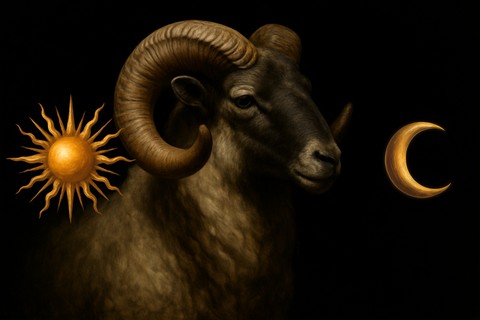
Among the many traditional terms we still use in astrology, cazimi is one of the most common. A cazimi occurs when a planet is exactly in conjunction with the Sun , entering what was formerly called "the heart of the Sun." Although at first glance it may seem like a simple conjunction, the precision with which it must occur— less than 17 arc minutes —transforms this configuration into something much more specific: a spark of revelation, integration, or internal reconfiguration.
To understand its meaning, it's important to remember what the Sun represents in astrological terms: the consciousness , creativity , and vitality we seek to express in the world. Everything that comes into close contact with this symbolic center receives a brief, direct charge of light and direction. That is, when a planet enters cazimi, its function is visibly "ignited."
A cazimi doesn't form every day, and when it does, its effect isn't always visible from the outside. But for those of us who use astrology as a guide, it's a key moment to observe what becomes clearer, what we can understand from a different perspective, or what aspect of our lives benefits from renewed energy.
In this post, we explore in detail what this astrological condition consists of, what differentiates it from other conjunctions with the Sun, how it manifests itself when it affects each planet, and what kinds of experiences can be triggered both in transit and in the natal chart.

What is Cazimi Exactly?
The word cazimi comes from the classical Arabic kaṣmīmi , meaning "in the heart" or "in the center." In medieval astrological tradition, it was used to describe the exact moment a planet entered the "heart of the Sun." It is a direct legacy of Hellenistic astrology, where the Greek term kentron was already used with the same meaning.
Technical Condition: Exact Degrees and Minutes
A planet is cazimi when it is less than 17 arc minutes from the Sun. This definition, supported by sources such as William Lilly, Vettius Valens, and Al-Biruni, arises from the following observation: cazimi occurs when the planet is geometrically absorbed into the center of the solar disk , not just nearby. Some modern schools have extended this margin to 1°, but doing so dilutes the exceptional character of the phenomenon.
It's important to note that the Sun's apparent diameter, as seen from Earth, ranges between 30 and 32 arc minutes . This is why 17' represents the most concentrated central band, the total absorption in its core. Beyond this threshold (even in exact conjunction), the planet enters another state: combustion.
Difference Between Combustion and Sunlight
In traditional astrology, a planet is said to be in combustion between 8° and 17 arc minutes of separation from the Sun: a critical zone in which its visibility, strength, and autonomy are compromised. It's as if it were dazzled by sunlight, weakening its function. However, the cazimi is an exception within this same zone: when the planet manages to position itself at the exact center, it ceases to be consumed by the solar fire and merges with it.
Unlike when a planet is under the Sun's rays (up to 17° of arc), which makes the planet invisible in the sky due to sunlight and usually has diffuse effects, the cazimi is a millimetric and powerful instant, in which the planet does not lose strength but channels it from the center of consciousness, will and direction that the Sun represents.
Symbolism
In symbolic terms, a planet entering the heart of the Sun implies that its essential function aligns with the core of consciousness and life direction that the Sun represents. It is a moment in which what that planet symbolizes is reconfigured from within. In other words, the planet accesses the core from which decisions are made, created, and affirmed.
What Kind of Internal Processes or Revelations Can It Bring?
A cazimi can act as a functional epiphany for the planet involved. What previously seemed fragmented, confused, or weakened (especially considering it was coming off a period of combustion) can, in that brief interval, acquire an unusual clarity. The experience is more internal than visible: clarity of thought when it's Mercury, understanding of something we value when it's Venus, a reconnection with desire when it's Mars. Most often, it's not an external event, but an inner condensation that, as a result, reorganizes the ongoing process.
Why, even though it is not visible as an external event, it is significant
Because its duration is so fleeting and its manifestation is more symbolic than tangible, cazimi often goes unnoticed externally. But its impact can be felt as a moment of precision or alignment that leaves a mark, especially if the transit touches a sensitive point in the natal chart. It's as if, for a moment, planetary function emerges from its confusion or uncertainty and finds a new axis. Something is reorganized from the inside out.

Cazimi According to the Planet Involved
Moon
• Frequency : The Moon enters cazimi every 28.5 days when the exact conjunction with the Sun (astronomical New Moon) occurs with less than 17 minutes of separation.
• Meaning : This is what makes the New Moon have its emotional reset effect. A precise alignment between the unconscious, the bodily, and the conscious will.
Mercury
• Frequency : It is the planet that most frequently enters cazimi, around 6 to 7 times a year, alternating between direct and retrograde motion.
• Meaning : It can bring mental clarity, reorganization of ideas, or a new understanding of previously tangled situations. It can mark a shift in perception.
Venus
• Frequency : It enters cazimi approximately every 9 months , alternating between direct and retrograde motion .
• Meaning : This is a particularly significant time for values, relationships, self-esteem, and attraction. Retrograde Cazimis often imply an internal review; direct Cazimis, a more visible affirmation. In both cases, the effect is intense and symbolically renewing.
Mars
• Frequency : Enter cazimi approximately every 2 years .
• Meaning : The rarest of all cazimi. It coincides with moments of redefinition of will, drive, or the ability to act. It can mark decisive decisions, conflicts that can no longer be avoided, or a clearer affirmation of desire.
Jupiter, Saturn and Transpersonal Planets
• Frequency : Each person enters cazimi once a year.
• Meaning :
• Jupiter : Provides clarity about opportunities, convictions, or possible growth.
• Saturn : Indicates a time of internal adjustment in relation to limits, structures or responsibilities.
• Uranus, Neptune and Pluto : Although they also enter into cazimi, their impact is usually felt at a collective level, unless they activate key points in the natal chart.


Differences Between Upper and Lower Cazimi (for Mercury and Venus)
Only Mercury and Venus can form retrograde orbits, because they are the only planets located between the Earth and the Sun during their retrograde motion. This position—in which the planet passes in front of the solar disk—allows an orbit to occur with the planet in retrograde motion, which is known as an inferior (or interior) orbit . All the other planets, on the other hand, are never located between the Earth and the Sun (and the Moon is not retrograde), so their orbits occur only when they are in direct motion.
What Changes Depending on the Type of Cazimi
The difference between a lower and a higher cazimi is not in the angle, but in the relative position of the planet with respect to the Sun and the Earth .
• In the lower (or inner) cazimi, the planet is between the Earth and the Sun.
• In the upper (or outer) cazimi, the planet is behind the Sun, further away from Earth.
Both types mark a central point in the planet's cycle with the Sun, but the direction of the process and the nature of the experience are different.
The lower cazimi has a more subjective, intimate, or introspective tone. It involves a phase of internal review or reset. The upper cazimi tends to be more projective, affirmative, or clear . What was integrated in the previous stage can now begin to be expressed.
When Each Occurs
• The lower cazimi occurs when Mercury or Venus are retrograde .
• Upper cazimi occurs when Mercury or Venus is in direct motion .

How to Interpret a Cazimi in Transit
What to Keep in Mind When Interpreting It Superimposed on the Natal Chart
For a cazimi to have a real impact on an individual's experience, it's important to observe whether it occurs on a sensitive point in the natal chart : a planet, an angle, or an important axis. If it doesn't touch anything relevant, it may go unnoticed. But when it does, it can mark a symbolic shift in the function of that planet, a kind of internal reordering that isn't always expressed through events, but rather through clarity or internal resolution.
It is also useful to observe whether the planet Cazimi rules an important house , or if it activates a dynamic that was already in progress due to other transits or progressions.
What Type of Houses Are Most Activated
When the Cazimi falls in transit over a natal house , it can signal a moment of quiet reorganization in the issues associated with that house. For example, if it's in the 3rd house, it could be a new understanding in communication or the environment. If it's in the 7th house, a sudden clarity about a relationship may emerge.
Let's remember that these are not visible or dramatic actions, but rather an internal alignment that prepares the ground for what will come next.
What to Expect if It Falls on a Home Planet
When a cazimi occurs on a natal planet , that function is exceptionally intensified. What that planet represents may be felt more clearly or aligned with a clearer will. In the case of personal planets, it may mark an affirmation, a desire taking shape, a decision we can no longer avoid or want to avoid.
This is often a key moment in a broader process , which is often only understood over time.

The Cazimi in the Natal Chart
In a natal chart, a kazimi—especially if it's on a personal planet like the Moon, Mercury, Venus, or Mars—is a power point . If a planet is in kazimi in the natal chart, its energy is extremely enhanced and aligned with the Sun's energy. This planet becomes more visible, effective, and accessible . There are no shadows in its expression; its function is felt clearly and strongly.
This aspect may imply that the person will live with a particular expression of that energy throughout their life, feeling that this planet is deeply integrated with their vitality and creative impulse, like a radiant core that never loses its intensity. It is a focal point for the person, something that can be very noticeable and, at times, an area of high activity and expression.
The Impact of a Cazimi on Personal Planets
When a personal planet such as the Sun, Moon, Mercury, or Venus is in cazimi in the natal chart, its functions become central to that person's identity or potential. For example:
• Cazimi de Luna : The person's emotional world feels extraordinarily clear and direct. Their ability to connect with their inner selves is stronger than that of many others.
• Mercury Cazimi : Communication and thinking become very powerful, possibly with a more agile mind capable of integrating complex ideas.
• Venus Cazimi : The person will probably tend to experience great clarity in relationships and values, a magnetism in their way of interacting with others.
This type of cazimi can grant exceptional ability in the areas governed by the planet, but in its most negative expression, there can be an over-identification with those energies, which can lead the person to feel vulnerable if there is no proper balance.
The Impact of a Slow-Moving Planet Cazimi
If the cazimi occurs with slower-moving planets, such as Jupiter, Saturn, Uranus, Neptune, or Pluto , the experience becomes much more collective, generational, or structural . These cazimi are less personal, but they can reorder large areas of a person's life , and not always in such immediate or obvious ways.
• Jupiter Cazimi : Marks a point of significant expansion, clarity about beliefs, or alignment with philosophical purpose.
• Saturn's Cazimi : Provides inner strength to assume responsibilities with integrity and clarity, or it can symbolize a key moment for a structural redefinition in life.
• Cazimi of Uranus, Neptune or Pluto : These cazimis profoundly impact life at a generational level, revolutionizing the way in which the person connects with the collective, their vision of life or their way of transforming realities.

Featured Characters with a Cazimi
Of course, the traditional cazimi (17' arc) is extremely rare. Two known examples that do exist are:
Oprah Winfrey , renowned American presenter, producer, and businesswoman, has Venus in Aquarius . Her public image was built on the ability to connect, give voice to other voices, and turn the intimate into a collective issue. Venus, in her chart, is not limited to the personal: it becomes a central function of emotional connection and social visibility.
Annie Lennox , a Scottish singer and activist known for her career with Eurythmics and her solo career, has Mercury in Capricorn . Her style communicates with precision, strength, and structure, without losing sensitivity or direction. The voice—in every sense—becomes a central function there, organized from a mind that articulates the emotional with the political.

Practical Tips
How to Take Advantage of a Transit Cazimi
Since the cazimi lasts only a few hours, it's best to note the exact date and time it will occur in advance , especially if it occurs with a personal planet. If it coincides with a pending decision, a key conversation, or a moment of inner definition, that brief moment can offer greater clarity, focus, or direction .
More than acting at all costs, it's about being available to record what becomes clear —even if it doesn't immediately translate into something visible. Sometimes, it's enough to write down, synthesize, decide, or record something that was already brewing.
What to Watch for in the Days Before and After
The days before the Cazimi are marked by the combustion of the planet , which can be felt as confusion, fatigue, or disorder linked to the function of the planet involved. In this context, the Cazimi functions as a peak of clarity within the chaos .
After the cazimi, the planet will be in commotion again , so the feeling of clarity may be short-lived. That's why it's helpful to record what was clearly visible during those hours , even if the fog returns.
What to Do (and What Not to Do)
— If you can, choose that moment to take note of what is ordered in your perception.
— If the cazimi falls on a natal planet, observe what is activated and what perception is refined.
— Don't wait for big events or external signs. The cazimi is precise, but internal.
— Don't overinterpret if you don't feel anything visible. Sometimes, its effect is only understood in retrospect.