We continue this 12-post series exploring the energy of each zodiac sign. Beyond the popular astrology that associates the signs with personality, we'll delve into their most essential meaning: their archetypal nature, their characteristics, and their manifestation in the human experience, both personally and collectively.
What is a Zodiac Sign?
When we talk about signs, most people assume we're referring to the personality of those whose Sun is in that sign. In reality, this is a vast oversimplification that leaves out many layers of valuable meaning for us.
First of all, a zodiac sign isn't a person or a personality type . It's a pattern of expression, a way a principle behaves . In astrology, principles are represented by planets, asteroids, angles, and any other points on the celestial sphere. Depending on the sign they fall under, their manifestation takes on a specific quality. And that quality is, in essence, an archetype.
What is an Archetype?
An archetype is an essential pattern, an image or energy that is repeated throughout history and in different cultures . They are primordial models that structure the way we experience reality. In astrology, each sign is an archetype with its own characteristics, an energetic quality that shapes the way any astrological principle is expressed.
When a planet is in a sign, the archetype of that sign acts through it . The sign doesn't change the essence of the planet, but it does determine its style of manifestation. For example, Jupiter will behave very differently when it's in Pisces than when it's in Aries.
In other words, signs are the way in which a principle takes shape.
Archetypes are Multiple, Eternal and Inexhaustible
Archetypes are profound and sophisticated realities, with countless nuances and manifestations. They are not static or limited to a single form of expression ; on the contrary, their richness is so vast that no human being can fully embody the entirety of an archetype in a single lifetime. They are eternal forces that exist beyond our individual experience and express themselves through us in diverse ways according to our consciousness, evolution, and choices.
This is where free will comes into play: (at least consciously) we don't choose which archetypes are present in our birth chart, but we do choose how we experience them. Throughout life, our relationship with an archetype changes . Having a planet in Libra at age 8 isn't the same as having it at age 55. The energy is the same, but the way we understand and express it transforms with experience. We learn to modulate it, to integrate it with greater awareness, to use it more constructively.
From this, it follows that all archetypes are neutral. The same sign can express itself instinctively, chaotically, or unconsciously, or it can be channeled with wisdom and purpose.
We'll return to archetypes later. Now let's get to the basics.

A Night Sign, Earth, Fixed, Ruled by Venus
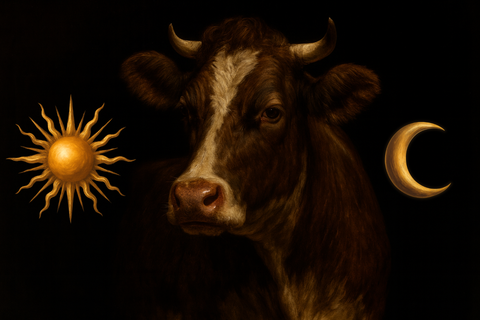
The name of the sign Taurus comes from the Latin taurus , meaning bull. However, in its symbolic origins, Taurus was much more closely linked to the cow —and all the feminine baggage that entails. —than the bull. In ancient agricultural and lunar cultures (and long before Latin existed), the cow was considered a second mother , providing milk absolutely generously and unconditionally, asking nothing in return. It was with the subsequent transition to a solar astrology, centered on the Sun and the masculine, that many feminine symbols were transformed: the image of the bull replaced the cow, giving the sign a more virile connotation focused on physical strength, which distanced it from its original meaning.
Taurus is a night sign, also called yin or feminine in traditional classifications. This means its energy is receptive: it collects, integrates, and preserves. Unlike day signs like Leo, Libra, and Aquarius, night signs direct their energy inward.
It's also an earth sign, a fixed one . The earth element represents the physical plane and what manifests within it. In ancient cultures, the earth was the basis of all stability: the place where fruits grow, shelters are built, and roots are planted. On the other hand, the fixed modality comes from the Latin fixus , which means "fixed," "established." Fixed signs represent the force that gives continuity to the processes initiated by cardinal signs . Fixed signs consolidate; to do so, they need to resist change and focus on one thing at a time.
On another side of this energy, Taurus is a sign ruled by Venus . In astrology, to say that a planet rules a sign means that there is a direct affinity between the two. Venus is the planet that rules harmony, what we value, what we attract (as opposed to what we strive for), and what we relate to each other . As the ruler of Taurus, Venus manifests as the harmony/relationship between the body and the environment in which that body lives . This dimension of Venus is precisely what the philosopher John Dewey (1859) called aesthetic experience : a moment of integration between perception, body, and environment, where everything takes on form and meaning through experience. Taurus is the sign of that experience. The senses function as a bridge between the internal and external world , and Venus, as a planet that builds relationships, does so here from its sensory dimension.
Finally, Venus also rules beauty, and in Taurus, it's the beauty of nature that guides the canon. Think, for example, of the beauty of seeing an animal being born in the countryside, the colors of the sunset, or the sound of thunder in a spring storm.
Thus, this Venusian dimension of Taurus gives it a softness that the other earth signs lack. Virgo and Capricorn also belong to the earth element (and are therefore also very sensorial), but their relationship with the material world is more functional, more focused on action and efficiency. Added to this is the fact that the Moon—another planet linked to connection, the body, and nourishment—is exalted in Taurus. But we'll get to that later.

The Glyph of Taurus
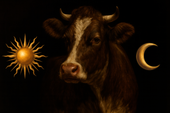
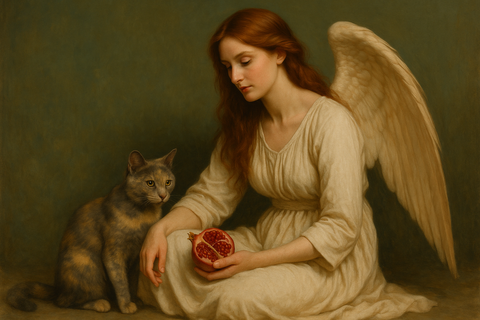
The glyph (or symbol) for Taurus literally represents the head of a cow with its horns . However, its symbolic meaning is much broader. As we mentioned before, since ancient times, the cow has been considered a sacred animal in many cultures for its generosity: it gives milk, meat, and leather. It is the symbol of the mother par excellence, for its constant dedication and its role of stability within the tribe or family. The maternal archetype has multiple dimensions, but the one associated with Taurus is the nurturing, stable, and, above all, abundant mother.
The horns of Taurus are also linked to the cornucopia: the horn of plenty. In Greek mythology, the cornucopia is a horn that Zeus transforms into a magical object that provides endless food and goods. Since then, the horn has come to represent abundance, fertility, and the ability to give without scarcity.

And finally, the glyph's horns also refer to the shape of a crescent moon . Throughout history, the relationship between the cow and the Moon has been documented in different agricultural and symbolic cultures. In Sumerian culture, for example, there are literal representations of cows with the Moon between their horns, as a symbol of fertility, abundance, and connection to natural cycles. Not only because of the curved shape of the horns—identical to that of a crescent moon—but also because of the connection that both figures share with nutrition, the rhythms of the earth, and the body. The Moon has always governed agricultural cycles : sowing, harvesting, growth. It has also been associated with the menstrual cycle, with the receptive principle, with the body that responds to the times of nature .
Taurus: Stabilization and Full Spring
Speaking of agricultural cycles, in the Northern Hemisphere—where the zodiac we use in astrology originated—the agricultural calendar has always begun with the March equinox, when spring begins and the Sun enters Aries. Following that logic, if Aries (the sign before Taurus) represents the first bud to emerge after winter, Taurus embodies the moment when the season takes hold. This isn't a literal correspondence—planets can be in Taurus at any time of year—but a symbolic one. Taurus represents the point in the cycle when spring has reached its fullest potential . The flowers have already opened. The landscape is at its most beautiful. There is no fruit yet, therefore, the petals of the already fertilized flowers have not yet begun to fall. Everything is at its best. The weather stabilizes, the light no longer increases as rapidly as it did when the Sun was in Aries, and nature settles. What sprouted finds form, and the days pass amid a feeling of peace and pleasant slowness.
From this, it follows that Taurus energy doesn't need to struggle: there are no threats in sight, the weather is predictable, the days are stable, and there's no risk of frost. The sprouts that made it through the first stretch of spring will likely develop. The same goes for the offspring that have made it to this period: they have a high chance of survival. Food is readily available, and this is the time when they gain strength and size. The fragility of Aries is behind them.
Characteristics of the Bullfighting Archetype
So, what are the characteristics of taurine energy? (Remember, we're not talking about people yet):
1. Inertia: Taurus energy doesn't activate immediately. It starts slowly, but once in motion, it's hard to deflect. It doesn't respond quickly or seek sudden changes; it needs time and stable conditions to get going, but when it does, it continues steadily.
2. Repetition: You have a natural inclination to follow the same path more than once. You don't seek novelty, but rather what's familiar, what's already proven effective. You feel more attuned to the cyclical rhythm than to disruption.
3. Persistence: It's not an explosive or spectacular energy. It manifests itself in continuous, uninterrupted processes, without the need to impose itself. It doesn't act out of urgency, but rather from a silent perseverance that maintains what it started without major changes.
4. Slowness: From the logic of this energy, there's no reason to rush. There are no threats, no struggle, no scarcity. Everything comes in its own time. Like an established spring, life blossoms without pressure, following a rhythm that doesn't need to be demonstrated or justified.
5. Ability to focus on what is valuable: Taurus energy is not dispersed. It focuses on what it recognizes as valuable and directs its attention there. It doesn't invest in the superfluous. It prefers clarity, concreteness, and what stands the test of time.
6. Simplicity, naturalness: There's no interest in the complicated. Any complexity is seen as an unnecessary waste of energy. Taurus energy tends toward the essential, step-by-step, and a single-minded focus. It isn't interested in splitting itself into multiple directions, because it understands that energy is nurtured not by multiplying fronts, but by staying focused on what matters.
7. Resistance to change: What is already part of their structure doesn't easily let go. From this perspective, letting go implies a loss of abundance. Taurus energy isn't oriented toward ending or breaking, but rather toward permanence. That's why letting go feels alien to them: it doesn't fit with their accumulating and receptive nature.
8. Inflexibility: Once something is established, it's difficult to move. Taurus energy defends what's already in place, even if it's no longer useful. It tends to become fixed on what's already known, and any attempt at modification is experienced as a disturbance of balance.
9. Taking something and consolidating it: This energy neither invents from scratch nor destroys what came before. It acts on what already exists, gives it form, and stabilizes it. It is the force that transforms momentum into structure, the ephemeral into duration.
How These Characteristics Are Expressed in People with Planets in Taurus
When a person has planets in Taurus, these archetypal qualities take shape in their life experience. However, the way they are integrated and expressed depends on many factors: the level of consciousness, internal work, and the rest of the birth chart. This is where free will comes into play, as Taurus energy is not experienced uniformly. Each of its characteristics can manifest in constructive or challenging ways, depending on how it has been internalized and worked with.
Inertia, for example, can be expressed as a great difficulty in starting something new . The person may feel paralyzed by change or have an excessive need for certainty before acting. But it can also be experienced as an enormous force of continuity : once you start something, you have the ability to stay strong, to keep going without the need for constant encouragement or external urgency.
Repetition often appears as a way to generate security. People with planets in Taurus can develop personal rituals , stable routines, habits that allow them to feel in control of their environment. This can give them consistency and order, but it can also become limiting if repetition becomes automatic, as a way of avoiding change or the unknown.
Persistence is one of this energy's greatest strengths. It isn't impulsive, nor does it need immediate recognition. Its strength lies in consistency, in doing the same thing over and over again until it consolidates what it desires . But if a certain flexibility isn't cultivated, this same persistence can lead to stubbornness , a refusal to revise course even when conditions have changed.
The classic Taurus slowness often translates into a slow way of processing what's happening . People with this energy don't react quickly: they need time, space, and a sense of security to make decisions. When this slowness is integrated, it generates emotional stability and depth in relationships . But if it becomes a defense, it can lead to chronic procrastination, denial of the urgent, or spending too much time in places that no longer contribute.
Focusing on what has value allows them to build a life consistent with their real needs . They don't let themselves be swayed by superficiality or external pressure: if something doesn't have true value for them, they're unlikely to invest energy in it. But when this focus becomes rigid, it can close them off from new possibilities , making them distrustful of anything that doesn't fit their pre-existing criteria of value.
Simplicity and naturalness can lead to an unpretentious way of being in the world . People with planets in Taurus often seek tranquil environments, stable relationships, and a way of life that allows them to enjoy life without complications. This connection with simplicity can be very healing, but it can also become a form of avoidance of complexity, as if life always has to be flat to be safe.
Difficulties in letting go manifest when a person clings to something that has already completed its lifespan. It could be a relationship, a job, an object, or even an idea. What's familiar provides security, and letting go can generate a profound sense of loss . Learning to close cycles is one of the greatest challenges for people with planets in Taurus.
Inflexibility appears when stability becomes an end in itself . People with planets in Taurus may have very firm internal structures, but they may also resist change even when it is necessary. New things can be experienced as a threat to the foundation they have worked so hard to build.
The ability to take something and consolidate it is one of Taurus's most valuable talents. People with planets in this sign can take a family business started by someone else and turn it into something profitable and lasting. They can take a project that was in its infancy to a mature, stable, and functional stage. In the family, they can bring peace of mind and continuity: turning the everyday into something livable, predictable, and sustainable.
Practical Examples: Jon Kortajarena and Karl Marx


Birth chart of Jon Kortajarena, 19/05/1985, Bilbao, Spain. Rodden Category: X (no birth time). Right image credit: Simon Upton.
Jon Kortajarena is a Spanish model and actor born on May 19, 1985, in Bilbao. Internationally known for his work in campaigns for Tom Ford, Versace, and Giorgio Armani, he has also built a career as an actor, participating in films such as A Single Man and series such as Quantico and The Truth . His natal chart shows a strong concentration of Taurus energy: Sun, Moon, Mercury, and North Node in Taurus.
In his life story, this energy is clearly evident. While he got off to a fast start in modeling after being discovered in 2003 at a fashion show in Barcelona, at 19, he decided to reconsider whether it was worth pursuing. He figured he'd only continue if the work, travel, and connections truly warranted it. If he could earn the same amount of money doing something else, he saw no point in risking the best years of his life for an unstable industry (stability, money, courage... all of which relate to bullfighting).
On the other hand, despite living in London and working between New York, Milan, and Los Angeles, Kortajarena has said he diverts flights only to stop in Bilbao and get a haircut from his mother , the only person he trusts for that. It's not just a professional issue—his mother is a hairdresser—but also a bullfighting passion for repetition and a commitment to what already works.
His acting vocation also demonstrates this perseverance. Since his debut in A Single Man in 2009, he has determinedly pursued his path as an actor , without completely abandoning modeling, but remaining steadfast in what he always felt was his true desire. Each new project has brought him closer to that place: from supporting roles to leading roles, from aesthetic to more emotionally profound. For him, this has been a continuous journey, like someone who knows that what is worthwhile needs time to mature.


Birth Chart of Karl Marx, 05/05/1818, 2:00 AM, Trier, Germany. Rodden AA Category: Birth Certificate.
Karl Marx was born on May 5, 1818, in Trier, Germany. He was a philosopher, economist, journalist, and political theorist. He is considered one of the most influential figures in modern thought for having formulated a radical critique of capitalism and having developed the theory of historical materialism , the basis of Marxism. His natal chart shows a very marked concentration of Taurus energy: Sun, Moon, Venus, and North Node in Taurus.
In an unequivocal expression of his bullfighting energy, Marx was not interested in metaphysical abstractions or spiritual themes. His gaze was focused on the concrete : the actual conditions of life, work, production, property. That is, on how people live, eat, reproduce, and die within an economic system. His theory is based on a clear premise: human history is not driven by ideas, but by needs . The struggle is not between concepts, but over resources .
The question that runs through all his work is profoundly Taurus-like: who produces? Who accumulates? Who controls its value? How is the value of something defined? By its usefulness? By the labor it took to make it? By the time invested? All these questions revolve around the great symbolic axes of Taurus: value, possession, body, effort, accumulation, production.
Another central theme of the bullfighting archetype also emerges: alienation. Marx describes how, under capitalism, the worker is separated from the product of his labor. What he produces ceases to belong to him. And with that, the connection to his own body, his time, and his sense of agency is also lost. What should be his own—the result of his effort—becomes alien. Capitalism, for Marx, distorts an essential relationship: the relationship with what one does, with one's worth, with what one creates.
Needless to say, the Taurus energy in his chart didn't manifest as an attachment to comfort or a pursuit of pleasure. It expressed itself as an obsession with understanding what gives things value, how they are produced, how they are owned, and what is lost when these things are left in the hands of others. This is an excellent example of how the same archetype can be expressed in two variants as different as Jon Kortajarena and Karl Marx.
The Energy of Taurus at the Collective Level
When Taurus energy manifests on a collective level, it expresses itself in moments of stabilization, consolidation, and preservation within history and society.
In the political and social sphere, Taurus appears in periods of reconstruction following major changes. It is the energy that drives societies to seek security, order, and continuity. It is associated with agrarian reforms, territorial protection policies, resource conservation, and structures that aim for collective stability . In historical moments marked by uncertainty or crisis, movements frequently emerge that seek to return to the basics, defend their own, or recover simpler and more sustainable ways of life.
Economically , Taurus energy is linked to financial systems, property, land, and natural resources . It represents the accumulation and management of assets, constant work, and the need to protect what is valuable. It is also associated with productive models that prioritize long-term stability over accelerated growth . Taurus energy can be reflected in both austerity policies and movements that challenge excessive consumption and promote economies based on care and sufficiency.
In the cultural sphere , Taurus expresses itself in movements that value the natural, the artisanal, and the sensorial. It can be seen in movements that promote connection with the earth, simple beauty, and aesthetics linked to the rhythm of nature. It also finds expression in trends that champion slow, careful, and handmade work.
On a global level , bullish energy can be reflected in periods where stability becomes a priority : economic recovery, a return to traditional models, the defense of resources, or resistance to rapid change. But it can also manifest itself as rigidity , a collective desire to preserve structures even when they no longer meet the needs of the moment.

Practical Example: Autonomy of the Bank of England (1997)
On May 6, 1997, then-new British Prime Minister Tony Blair announced that the Bank of England would no longer be under direct government control and would be given the autonomy to set interest rates . This decision transformed the United Kingdom's financial system and marked a turning point in the way countries approach monetary policy. From then on, the value of money—the symbolic heart of Taurus—was regulated by a technical, stable entity, not subject to immediate political fluctuations.
That day's chart shows a New Moon in Taurus , with the Sun, Moon, and Venus —ruler of the sign—also in Taurus. That is, a precise concentration on the sign associated with matter, value, stability, and accumulation. This event wasn't just an institutional adjustment: it was a symbolic declaration of profoundly Taurus principles. Control over resources—money, interest rates, credit—had to be transferred to a stable, regular, predictable force. Taurus doesn't improvise; Taurus regulates, stabilizes, and shapes what sustains it over the long term.
The fact that this monetary transformation occurred during a New Moon in Taurus is also significant: a New Moon is the beginning of a cycle, a seed of seeds. Here, a new economic paradigm was sown, based on independence, restraint, and the technical management of trust. It was no longer about impulsive decisions or populist measures, but about establishing clear rules that would allow the economic system to find a solid foundation.
Essential Dignities for Taurus
Essential dignities in astrology are a system that determines the strength and quality of a planet's expression based on the sign it's in. Each planet has places where its energy manifests most easily and others where it faces more challenges. There are five main dignities: domicile , when a planet is in its ruling sign and operates completely naturally; exaltation , where its energy is enhanced and expressed in a heightened way; detriment , when it is in the sign opposite its domicile and its expression is weakened or outside its comfort zone; fall , when it is in the sign opposite its exaltation, which can hinder its manifestation; and terms and decans , which are minor dignities that modify the planet's influence in specific degrees of the sign (we will see these last ones in future blog posts). This system allows us to interpret how a planet functions in a natal chart based on its zodiacal position.

Venus in Domicile
When Venus is domiciled in Taurus, it means it's in the sign it rules, allowing it to express its energy in a stable and undisturbed way. Venus is the planet of courage, attraction, harmony, and enjoyment , so Venus operates naturally here. It tends to manifest itself through an innate awareness of beauty, harmony, and tranquility : it doesn't need to learn to appreciate them; it simply recognizes them and orients itself toward them.
In this sign, Venus doesn't seek fleeting connections or noisy aesthetics. She prefers what lasts, what is real, what can be touched, felt, and repeated. She values what gives constant pleasure: contact with nature, a calm body, the simple beauty of things.
This position provides a great capacity to recognize what is valuable and from there build a sense of well-being. There's no rush or agitation: Venus in Taurus knows that what's valuable comes in its own time. However, its attachment to stability can translate into an overly comfortable stance, where conflict is avoided and there's a tendency to keep everything at a pleasant level, even if this implies a certain passivity . A tendency toward excessive hedonism may also emerge, leaving the rawest or most challenging aspects of life out of the picture.
In terms of essential dignities, Venus in Taurus has complete control over its astrological function, making it a strong position. It favors constancy and stability in relationships , an elegant and natural aesthetic sense, and the ability to create relationships, spaces, and rhythms where harmony simply occurs without much effort.

Moon in Exaltation
The Moon is exalted in Taurus because its nature closely matches that of this sign. Traditionally, the Moon has been associated with the physical body , biological rhythms, the internal perception of the body's needs, and everything related to care, nutrition, and the maternal figure . These themes are also central to the energy of Taurus, which is oriented toward preserving what provides stability and well-being, and creating conditions that allow life to be sustained and developed.
Taurus offers the Moon the stable foundation it needs to express its full potential without setbacks . In this sign, the Moon doesn't have to defend itself or adapt to changing conditions: it can settle, register what it needs, and nourish itself and feed from a predictable environment. The emotional stability, direct connection to the body , and practical sensitivity that define this position allow the Moon to function here with security, regularity, and depth. This is why this is one of the Moon's strongest positions in terms of essential dignities.

Mars and Pluto in Detriment
Both Mars and Pluto are in detriment in Taurus. This doesn't mean they're functioning poorly, but rather that they find themselves in a territory they're not comfortable with. Mars represents direct action , impulse, the urge to move, to cut corners, to react. Pluto, on the other hand, refers to profound transformation , the destruction of what no longer serves a purpose, the psychic intensity that pushes for change. Taurus, on the other hand, tends to preserve, to sustain what already exists, to avoid conflict unless strictly necessary. Therefore, in this sign, both Mars and Pluto have to operate differently than is natural for them.
Instead of moving forward quickly, in Taurus, Mars is forced to act slowly , to wait for the right moment, to adapt to more stable and less reactive rhythms. This can lead to frustration or passivity if a concrete way to channel the desire to act isn't found. Pluto , on the other hand, encounters resistance in an energy that doesn't easily give in to transformation . Taurus doesn't give ground without reason, and this can make the processes of internal change slower, more restrained, but also more lasting once activated. Here, the transformation isn't explosive or radical, but sustained, worked through layer by layer.

(Uranus in Fall)
This isn't a canonical assignment coming from traditional astrology, but many modern astrologers consider Uranus to be in fall in Taurus because its nature is in direct tension with that of this sign. Uranus represents rupture, unexpected change, innovation, and disruption . Its function is to destabilize what is no longer evolving, to break down obsolete structures and open up the new, even if this implies discomfort or chaos. Taurus, on the other hand, seeks stability, continuity, and permanence . It doesn't change unless strictly necessary, and when it does, it needs time and security to adapt.
For this reason, in Taurus, the energy of Uranus cannot unfold easily. The desire for change encounters resistance, and the unexpected is not experienced as liberation, but as a threat . This can generate internal tensions: a need to transform that meets with a structure that refuses to yield. However, when Uranus manages to operate in Taurus, it does so from the material, from the concrete: it revolutionizes the economy, values, the use of resources, and the relationship with the body and the earth.

Taurus Mythology: Europa and the Minotaur
The energy of Taurus is linked to two distinct myths from Greco-Roman tradition: the Rape of Europa and the Minotaur. Each of these stories touches on a different aspect of the Taurus archetype (all Taurus attributes are in bold).
Europe and the bull
Europa was a Phoenician princess, daughter of the king of Tyre. Her beauty was renowned, so much so that it caught the attention of Zeus. To approach her, Zeus took the form of a white bull . Not a fierce or threatening animal, it was serene , imposing, with shiny skin and even a pleasant smell that captivated Europa. She didn't flee or defend herself; she was attracted to the bull and, without any struggle, she climbed onto it. Zeus took her to Crete. There, Aphrodite —the Greek name for Venus—revealed to her that the bull was, in fact, Zeus himself. From that union , Minos was born, and the surrounding lands were named after him: Europa.
The Minotaur
Minos, son of Europa, came to reign in Crete and accumulated enormous wealth , with which he built the palace of Knossos. But it was not enough . To consolidate his power, he asked Poseidon for a sacred bull to be sacrificed in his honor. The bull he received was extraordinarily beautiful , too much so. Minos regretted sacrificing it and decided to add it to his personal herd , offering a common bull instead. Poseidon, outraged, punished Minos: he turned the bull wild and uncontrollable and, in addition, made Pasiphae, the king's wife, fall in love with the animal. From this union the Minotaur was born.
Minos, deeply ashamed of what had happened, imprisons the creature in a labyrinth. There, the Minotaur demands human sacrifices.
This myth shows what happens when attraction to something is distorted, turning into gluttony and excess that finds no outlet. The labyrinth symbolizes the consequences of not having stopped unbridled greed in time. And let's remember that the Minotaur is Europa's grandson, that is, a distorted manifestation of the same energy that had previously produced beauty and fertility.

The Emerald and the Color Green
The emerald is the stone associated with Taurus because, being green, it is linked to growth, fertility, and abundance . It is a stone that directly refers to the living, to that which develops in contact with the earth. Unlike the diamond—known for its high refractive index and the optical effect known in gemology as fire (the dispersion of white light into flashes of color)—the emerald has a much more subdued brilliance. Its light is internal, soft, and without stridency. It often has visible inclusions, known as "garden ," which reinforce this connection with nature. It is not a perfect stone, nor polished to the point of artificiality: it conveys serenity, restraint, and a stable, less dazzling elegance.
Throughout history, the emerald has been a symbol of fertility, wisdom, and truth . In civilizations like the Egyptian, it was considered a sacred stone. Cleopatra wore it as a personal emblem, and the ancients associated its color with eternal renewal . It has also been considered a healing stone: it is believed to harmonize the heart, balance emotional states, and promote a deep calm that centers, not lulls, but rather.
Green is the color of Taurus because it automatically reminds us of the organic, the fertile, and what grows in the midst of nature. In the visible spectrum, green is right in the center. Its wavelength—approximately between 495 and 570 nanometers—makes it the color of visual balance . It neither excites like red nor cools like blue. It neither accelerates nor stops. Therefore, in chromotherapy, it is used to regulate, harmonize, and regenerate . It is associated with emotional stability, physical recovery, and rest of the nervous system.
Culturally, green has also been a symbol of renewal, hope, and abundance . In many cultures, it's associated with spring and the growth of fields, with the promise of life that has yet to bear fruit but is already in the making. It's the color of the heart chakra, the point where the physical and emotional merge, the bodily and the emotional—a place where Taurus moves naturally.
In economic contexts, green also has a significant presence. Many banknotes—such as the US dollar—are printed in green , not only for technical reasons (durability of the pigments), but also because of its symbolic association with stability, value, and permanence. Green suggests trust, support, and continuity—all essentially bullfighting concepts.
Keywords Associated with Taurus:
Australia - artists - banks and bankers - beauty - bonds - money - livestock, cattle - pastel colors - copper - cows - culture - emeralds - wheat fields - Ireland - Cyprus - jewelry and jewelers - music - neck and thyroid - movable and immovable property - precious stones - spinach - stubbornness - vocal cords - tonsils - stables - Asia Minor - coins - currencies - farms and farmers - larynx - leather goods - obesity - polyps - safes and vaults - stocks - wallets - wealth - chests - actors and actresses - architecture - cereals - cough - daisies - ears - gluttony.
Do you have planets in Taurus in your birth chart? Do you resonate with this energy or are you in the process of integrating it?